

The Best Girl Groups With Only 1 Major Hit
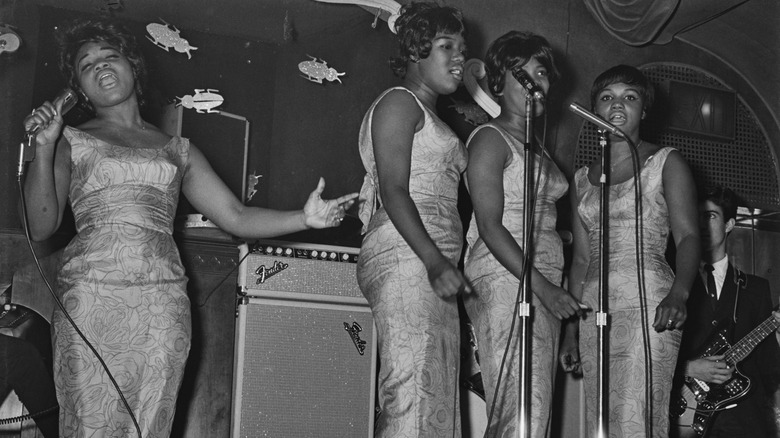
Girl groups made some of the most indelible pop of the 1950s and 1960s. While many went on to lasting success and could easily sell a lot of records — such as the Ronettes, the Supremes, and Martha and the Vandellas — many girl groups only ever really hit it big once. They're the one-hit wonders of their realm, but their hits were at least vital and formative. Built on tight, gorgeous harmonies and traditional street corner singing as much as early forms of mainstream R&B and rock 'n' roll, girl group pop took off because young boomers could relate to it. The songs were generally about first love and first heartbreak, and the best girl group songs featured a bouncy backbeat or emotion-stirring backdrop provided by studio musicians that allowed the vocals to soar and shine through. While the best girl groups of the '50s and the best girl groups of the '60s provided all of those elements and more, some acts could only effectively pull off the trick once.
Here are some less-remembered girl groups responsible for some of the biggest hits and most recognizable songs of their genre and era — the Exciters, the Bobbettes, the Jaynetts, the Murmaids, and the Teen Queens — who made one appearance in the Top 40.
Tell Him — The Exciters
In 1961, four teenagers from Queens, New York, came together as the Masterettes, the all-female version of the male singing group the Masters. The guys got their counterparts studio time after they signed with Le Sage Records, and the Masterettes went on to outpace their benefactors. After a lineup change and rebranding as the Exciters, the girl group, led by Brenda Reid, recorded the single "Tell Him." Reid, while youthful, promises that she knows a thing or two about love, and she advises listeners that a relationship won't ever develop unless they let the object of her affections know about it. With an ominous, two-note medley that surprisingly leads to and oddly mixes with rapid-fire backing vocals and professions of devotion, "Tell Him" was a curious elevation of the girl group sound. In late 1962, the track went all the way to No. 4 on the pop chart.
The Exciters continued with the assertive love songs, but they didn't click with listeners the way that "Tell Him" did. "He's Got the Power" and "Get Him" couldn't get past the middle of the Hot 100, while Reid let various revamped versions of the group over the years to little commercial notice.
Mr. Lee — The Bobbettes
Fast, joyous, and undeniably catchy, the harmony-soaked party-starter "Mr. Lee" was such a revelation that it helped kick off the girl group pop sub-genre. There were plenty of all-male singing groups by 1957, but the Bobbettes suggested that vocal collectives consisting entirely of women could also make a name for themselves and record a huge national hit song. Sisters Jannie and Emma Pought connected with Laura Webb, Helen Gathers, and Reather Dixon in their school's glee club in Harlem, quickly branching off into their own act that played local events. Within two years of their creation, the vocal act once known as the Harlem Queens had a deal with Atlantic Records and a song on the pop chart. School flavors the Bobbettes' origin and also its triumph — "Mr. Lee" was named after and inspired by one of their teachers. The song subsequently became a No. 6 hit.
The Bobbettes couldn't sustain that momentum. Four more singles recorded for Atlantic didn't make the pop chart at all, and in 1959 they signed with Triple-X Records and released the audacious and violent sequel song "I Shot Mr. Lee," which didn't even garner much morbid curiosity.
Sally, Go 'Round the Roses — The Jaynetts
Girl groups generally followed a proven formula — hooks, harmonies, and pining was what the audiences wanted and what so many groups perfected by the early 1960s. Then along came the Jaynetts, who subverted the form and got a little weird with "Sally, Go 'Round the Roses." Such pop music disruptors rarely repeatedly rack up hit after hit, and the Jaynetts are no exception, but the trio definitely made girl group music more interesting and progressive. The single is so relaxed and mid-tempo that it's closer to jazz or surf rock than teeny bopper fare. "Sally, Go 'Round the Roses" moves along thanks to a destabilizing start-and-stop rhythm, electric guitar stabs, and a hypnotic, chant-like melody sung in a kind of harmonic unison. The lyrics are a dark reinvention of schoolyard rhymes, presented as foreboding fragments about the demise of a toxic relationship.
As seemingly daring and off-kilter as it was, "Sally, Go 'Round the Roses" was still a smash. It spent two weeks as the No. 2 song in the country in 1963, and the Jaynetts would never again see the inside of the Top 40.
Popsicles and Icicles — The Murmaids
Because the music industry and music publishers were based in New York City in the 1960s, the majority of girl groups came from there and released their songs on established and entrenched record labels. The Murmaids came all the way from Los Angeles, and on a little-known, independent local label, Chattahoochie Records. Convinced to give them a chance by the mother of two of the young female vocalists who made up the trio, the company selected for them the tune "Popsicles and Icicles," composed by struggling neophyte songwriter David Gates, a '70s musician we completely forgot about, who would later lead the iconic soft rock band Bread. A goofy pop confection very much of its time and quite dated now, "Popsicles and Icicles" is essentially a list of all the things that make the boy the narrator is crushing on so special — he likes popsicles, icicles, guitars, the drive-in, and jeans, for example. Toward the end of 1963, the song was extremely popular, climbing to No. 3 on the pop chart.
It took so long for "Popsicles and Icicles" to take off that when it came time to capitalize on its success, Murmaids members Terry and Carol Fischer had enrolled in college and were more interested in that than pursuing music. Their producer, Kim Fowley (who was the promoter behind the Runaways in the '70s), kept releasing singles attributed to the Murmaids (but performed by different lineups), but to no avail on the Hot 100.
Eddie My Love — The Teen Queens
The cute puppy love ballad "Eddie My Love" is an early and definitive girl group song not just for its content and the way it sounds, but because of how popular of a recording choice it was for vocal groups in the 1950s. In 1956 alone, hitmakers like the Fontaine Sisters and the Chordettes scored big with their versions of "Eddie My Love," released after the Teen Queens originated the pop gem. A rare two-member girl group, the Teen Queens were populated by sisters Rosie and Betty Collins, and their breakthrough single was co-written by their brother, Aaron Collins, a member of '50s boy groups like the Jacks and the Cadets.
"Eddie My Love" helped further the careers of so many musicians, but not the Teen Queens. Their take on the song cruised to No. 14 on the pop chart in 1956, a domain which they would grace no more. Their follow-up singles, primarily charming love songs like "Baby Mine," "Billy Boy," "Red Top," and "I Miss You," failed to sell. The Teen Queens retired from the recording industry in 1961.