

5 Classic Singles That Define The Yardbirds
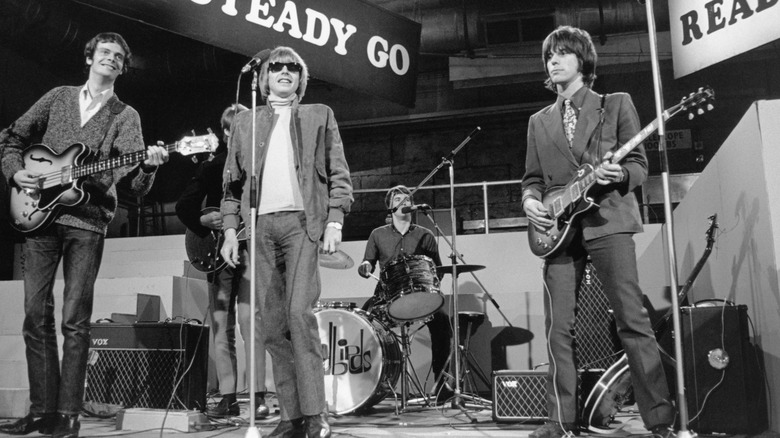
The Yardbirds' legacy is a unique and important chapter in the history of classic rock. Their music failed to match the long-term success of other blues-rock British invasion bands like the Beatles or the Rolling Stones, but their influence on the British rock scene is undeniably significant and changed the sound of hard rock forever. Despite a laudable touring history and a respectable recording catalog, the Yardbirds are most remembered for the legendary guitarists that passed through their ranks: Eric Clapton, Jeff Beck, and Jimmy Page.
Each period of their music is marked by these visionary voices taking turns on lead guitar. With Clapton, the group was loyal to the blues, running through blues riffs while lead singer Keith Relf whipped through harmonica riffs. The group turned to psychedelia and progressive rock with the inclusion of Beck, although the song structures stayed short, bluesy, and poppy. And in their final era, you can hear Page erratically experimenting with fuzz-tones, atonal guitar solos, and taking the band in a hard rock direction.
These singles best define the Yardbirds' legacy because each one represents a stylistic turning point for the band, perpetuated by their lead guitarist. Although not all of these songs were commercial hits, their influence on the medium of music and the art of rock 'n' roll have earned them longevity, and the songs to ultimately define the legacy of the Yardbirds.
For Your Love
This song reportedly made Eric Clapton quit the band. As the Yardbirds began experimenting away from the blues, they landed on this tune by young British songwriter, Graham Gouldman. The recording features a production that leans into pop and music hall, characterized that way primarily by the inclusion of the harpsichord. Although Clapton plays guitar on the recording, he was unhappy with the new creative direction, which led him to quit the band and recommend Page to take his place. Page declined, but recommended Jeff Beck, who accepted and led the Yardbirds through their new stylistic era.
The song did what the band wanted it to do — it was a chart-reaching hit. The song went No. 3 in the UK and peaked at No. 6 in the US on the Billboard Hot 100. The harpsichord half-notes across the verses and the chorus add an interesting texture to the track without veering too far into baroque pop, and when it transitions to staccato eighth notes, the instrument seems to evoke a rock organ. The bridge halfway through the song sticks out as Beatles-adjacent, sort of mimicking the rapid downstrokes on songs like "A Hard Day's Night." Gouldman was intentionally emulating the Beatles, as he later recounted in an interview with the BBC in 2011: "The Beatles had started and I thought, 'well, I'm gonna really have a crack at song-writing.' I had dabbled a bit, but they were really my inspiration."
Another pop-y addition to the production was the bongos accentuating the drum set. The high-pitched drums, reminiscent of the rapid high-hat, gives the song a surf rock feel, evocative of early Kinks songs like "Got My Feet on the Ground" or "Till the End of the Day." Capitalizing on the success of the track, The Yardbirds released an album in 1965 titled, "For Your Love" which included the track as well as a mishmash of singles. Although Clapton might not have cared for the track, "For Your Love," is a definitive song in the Yardbirds catalog as well as one of their most popular; it's the opening track of their 2023 compilation, "The Best of the Yardbirds," and one of their most streamed songs on Spotify.
Heart Full of Soul
Another Graham Gouldman-penned hit, "Heart Full of Soul" was the band's first single with new guitarist, Beck. His sitar-like playing on the instrumental breaks and solo section was ahead of its time as it was released months before the Beatles released their first sitar-based song, "Norwegian Wood," which kicked off the raga rock subgenre. In fact, the Yardbirds hired Indian musicians to play the sitar and tables on the track, but their inability to play along to the song's groove led to Beck imitating the sitar with his guitar instead.
In many ways, the song itself also feels ahead of its time: its raucous acoustic guitar rhythms evoke '70s rock, recalling the guitar parts on David Bowie's "Ziggy Stardust" record or even Heart's "Barracuda." The psychedelic solo, provided by Beck, expands on the main riff through bends and fuzz-based distortion, a quality that became iconic of late '60s psych rock. And don't forget the heavily reverbed "ooh-oh-ooOooh" haunting the background of the soundscape that reappears other tracks, like "Still I'm Sad."
The song was another charting hit — It peaked at No. 9 in the US, and went No. 2 in the UK and Canada. On Apple Music, Spotify, and Amazon Music, "Heart Full of Soul" is one of the band's most streamed songs across all platforms. Not only was this song an introduction to the band's new sound with Beck, to modern listeners it's a great entry point to the Yardbirds as a whole, and an iconic part of their discography.
Shapes of Things
According to the Rock & Roll Hall of Fame, this might be the most influential rock song the Yardbirds ever made — it's the only song by the band to be included in their list of the 500 Songs That Shaped Rock and Roll, and it's not hard to see why. Unlike the previous songs on this list written by Graham Gouldman, this one was written collectively by the group and came together organically, rather than being derived explicitly as a charting hit. "I suppose we were lucky," said Yardbirds drummer Jim McCarty (via Songfacts). "When we did 'Shapes of Things' it was like a hit song, but we were really coming from not trying to create a sort of 3-minute piece of music, it was just something that seemed natural to us."
"Shapes of Things" was the band's first foray into psychedelic rock. Its march-like rhythm, and the nursery rhyme delivery of Relf's vocal melody, is stylistically adjacent to contemporary psychedelic acts, such as Syd Barrett' era Pink Floyd or Jefferson airplane's "Surrealistic Pillow." The bass line thumps around the scale very heavily, which according to McCarty was inspired by a jazz record, and that's juxtaposed by the highlight of the track: Beck's guitar playing.
Particularly in the solo before the last verse and chorus, Beck's guitar sounds otherworldly. The ear-piercing feedback, the rich distortion, and the finger-dancing licks of the guitar solo don't sound like anything the Yardbirds had done up to that point. The atmosphere is also aided by the mix — which phases channels in and out, especially during the solo — to further aggrandize that sense of other-worldliness. The song was a major influence on David Bowie who recorded a cover of the song for his 1973 covers album, "Pin-Ups."
The Train Kept A-Rollin'
That's not a train you're hearing on the opening of this track — it's a guitar. By cleverly using his volume knob and a fuzz effect, Beck paints an image of that train a-rollin' before the rest of the band jumps in. This song, released in 1965, is a cover of an original by Tiny Bradshaw, whose version dates back to 1952. Why this song best defines the Yardbirds, and not Bradshaw, is how it demonstrates the Yardbird trademark: the rave-up.
What is now a common feature in blues-rock and jam bands is what that the Yardbirds marketed as a "rave-up," which is the practice of adding double-time breaks in between verses and choruses. The drums played twice as fast, the guitars got to chomp down on their riffs, and Relf would break out in a harmonica solo; it all amounted to a high-energy, no holds-barred jam/solo time.
Although the band incorporated these rave-ups into their recordings, when applied live, it allowed the band to experiment with their instruments in a live setting and whip the crowd into a frenzy. Page must have been aware of its effectiveness because when he launched the New Yardbirds (the band that would become Led Zeppelin), "The Train Kept A-Rollin'" was the first song they ever played together. Despite all the hit songs, singles, and legendary musicians, there might not be a greater legacy to the Yardbirds than the rave-up.
Happenings Ten Years Time Ago
Although Page came to replace Beck in the Yardbirds, there was a moment where the two shared lead guitar, and this song is a product of that collaboration. A psychedelic mind-bender, the song is torn from the same cloth as "Shapes of Things" and leans even further into the distortion, feedback, and mind-bending mixing. The relentless, heart-pounding bass line is delivered by none other than the future Led Zeppelin bassist, John Paul Jones, who was a session musician at the time.
The opening downbeat on this track sets the tone immediately. None of the instruments come in on time and the first note you hear is an indiscernible guitar hit: a mix of distortion, feedback, and unpleasantness that disappears almost instantly before the rest of the band raucously leaps in. Relf's vocal melody in the verses is eerie, but on the chorus its absolutely haunting, sounding more like an occult religious chant than a rock melody.
After Relf's incantation, the guitar solo sounds like you're being plunged right into hell. Of the two guitars, one seems to be emulating a car siren, while the other lays down massive chords before pick sliding into a vibrato-filled melody of disconnected notes. This is all introduced by an audio sample of what sounds like an explosion. A progressive record for its time, it was also a look into the future of hard rock and what was to come in the form of Led Zeppelin.