

The '70s Band That Time Forgot Looked Like Glam Gods But Played Hard Rock
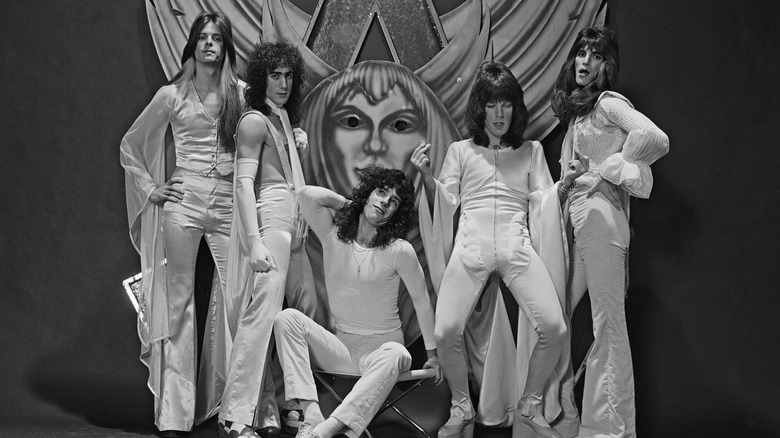
Plenty of bands don't look like how they sound. Ghost? It looks like "satanic" black metal but sounds like ABBA. Forgotten, white-frocked '70s hard rock band Angel? It looked like a disco troupe or glam outfit, but sounded more like stadium rock à la Boston. We're talking basic rock chord progressions, a few synth lines, and some semi-hooky choruses.
Angel made something of a splash back in the '70s, though not enough to catapult it into superstardom. All six of its albums from the decade breached the Billboard 200, while its highest single, "Ain't Gonna Eat Out My Heart Anymore" from 1978's "White Hot," reached No. 44 on the Billboard Hot 100. Angel toured with some big-name bands, like ZZ Top, Aerosmith, and Bob Seger, but in the end those efforts left the group chasing greater fame. By 1980, the members hung up their spandex and broke up. Nowadays, Angel has a modest 28k monthly listeners on Spotify, a reformed lineup, and a couple of new albums from 2019 and 2023.
So what actually kept Angel from top-tier success? As Angel guitarist Punky Meadows told Classic Rock in 2020, the band's extremely ambitious concept from the get-go was, "Yes meets Led Zeppelin and Queen." He also called Angel glam's true progenitor, which was way ahead of its time and grossly misunderstood. But to everyone else, there was just too much of a mismatch between Angel's body-hugging garb, bell-bottomed legs, and somewhat generic, hard-ish rock sound.
Angel's mismatch of image and sound
Angel wasn't exactly the first band to go theatrical (Queen), don flamboyant costumes (Kiss), and adopt an androgynous appearance (David Bowie). It was even on Kiss' label, Casablanca, had a ridiculous, animated logo, and pushed hard for over-the-top live performances. The band's white costumes, an architected part of its schtick, led some people to dub it "anti-Kiss." But there was something about the entire package that just didn't click, especially when combined with Angel's music. Maybe it was all too forced (though look at Kiss, no matter its litany of haters).
As for Angel's music, it does skew glam at times, though more like a fusion of '80s hard-leaning arena rock mixed with what's been pejoratively dubbed "corporate rock": highly curated, image-focused, and label-produced fare. That doesn't mean Angel's songs are without merit, but we'd argue that if its music was as good as its members hoped it would be, its image might not have gotten so much criticism.
There were also some unverified, behind-the-scenes shenanigans going on in the '70s, albeit which should be taken with a grain of salt. Angel guitarist Punky Meadows told Louder Sound that Kiss refused to tour with the band, yet come 1982, he also said he was invited into a new Gene Simmons-led band (Simmons did once try and recruit Eddie Van Halen into Kiss). There's also an odd story about Rush refusing to tour with Angel because the band was so image-obsessed, even though Rush played with it in 1977. Whatever the truth of such tales, Angel remains a cautionary tale about ensuring that an act's appearance complements, rather than hinders, its music.