

5 British Rock Bands That Changed Their Lineups For The Better
It's not easy being in a rock band; between the grueling hours on the road, the wild lifestyle, and creative personalities to manage in close proximity, there's a lot that can make a person want to call it quits. Although it can't be easy to lose a band member, these classic British rock bands demonstrated that sometimes changing your lineup can be to everyone's benefit.
New people can lead to new ideas, and the new members of the bands we chose helped define their very sound and identity. Some, such as Genesis, had reached their creative peak after years of playing together, and switching out musicians allowed the remaining members to explore new and adventurous musical directions. Others, like the Rolling Stones, were forced to replace members amid tragic circumstances, yet they, as with the rest of these entries, earned their place as rock 'n' roll legends. These bands all changed for the better by shaking up their lineups, achieving new heights of creativity and success, whether it was selling millions of albums, winning awards, or topping the charts again and again.
The Yardbirds
Although the Yardbirds scored a string of hits during their existence, the band's legacy is almost singularly defined by their changing lineup of legendary guitarists: Eric Clapton, Jeff Beck, and Jimmy Page, each marking a significant shake-up in their sound and evolving the band's character. With Clapton, they operated as a traditional blues band, pulling from early Chicago blues influences and working the circuit of U.K. blues acts like Cyril Davies and the Rolling Stones.
When the band decided to go in a poppier direction in 1965, Clapton quit, and after Page declined the spot, Beck was brought on board. This new era spawned most of their charting hits, developed their sound to introduce psychedelia and raga rock, and represents their most critically and commercially successful period. Page was asked to join in 1966 and played alongside Beck, until the latter left to launch his solo career a few months later.
The Yardbirds experienced one last revolutionary change in 1968 when the entire band quit except for Page, and he had to pull together an entirely new group. Marketed as the New Yardbirds, Page recruited Robert Plant, John Paul Jones, and John Bonham for a tour of Scandinavia. After the tour, the lineup of the New Yardbirds rebranded and changed their name to form Led Zeppelin, kicking off what would become one of the most legendary rock bands of all time.
Iron Maiden
One of the progenitors of British heavy metal, Iron Maiden has gone through several lineup changes across its approximately 50-year existence, but one in particular had the most significant impact: the recruitment of Bruce Dickinson on lead vocals. The band's first vocalist, Paul Di'Anno, participated on the group's first EP, its self-titled debut album, and the smash-hit sophomore LP, 1981's "Killers." Despite his talent, he was not fired for being a bad singer; the real reason Paul Di'Anno left Iron Maiden was his hedonistic lifestyle, which was negatively affecting the band. He was replaced by Dickinson, who had previously been part of the band Samson with Iron Maiden's drummer, Clive Burr.
The results were immediate— the band's first album with Dickinson, "The Number of the Beast," was a huge success. The album topped the charts in the U.K. and gave Iron Maiden its first Top 10 U.K. single, "Run to the Hills." Dickinson led the band into its most successful era, following "Number of the Beast" with a string of hit albums including "Piece of Mind," "Powerslave," and the experimental "Somewhere in Time."
Although Di'Anno's time with Iron Maiden shouldn't be ignored — he did lead the band to its first success — the lineup change was indisputably for the best. Dickinson's outstanding vocal range and timbre brought an operatic quality that paired perfectly with the band's counterpoint-riddled melodies and harmonic structures. Dickinson is celebrated for having one of the greatest and most celebrated voices in heavy metal history, which elevated the band and opened new avenues for creativity and exploration through the 21st century.
Genesis
By the time Peter Gabriel left Genesis, he had been with the band for 10 years, since he was 15. Starting as a high school music project, the core members of Genesis stuck together from 1965 to 1974 and made their rock-star dreams come true. But after such a long period of time and growth together, it was no wonder that by the time they were recording their most ambitious album, "The Lamb Lies Down on Broadway," Gabriel was getting ready to move on.
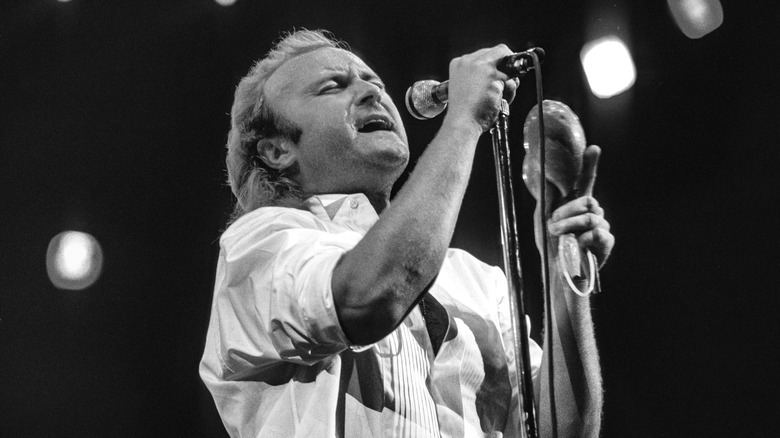
"The Lamb Lies Down on Broadway" was the band's sixth and final album with Gabriel, who left at the end of that album's respective tour in 1975. Although the band tried to audition for a new singer, they decided to appoint their drummer, Phil Collins, as the new lead singer. This was ultimately the right move for everyone involved — Genesis developed into a pop band and created their most commercially successful work. Furthermore, Peter Gabriel was free to explore a solo career that became hugely successful, and Phil Collins was granted a spot in the limelight that also led to an outstanding solo career. Everybody won, including fans.
Although it is widely argued in the Genesis fandom which era was better, Gabriel or Collins, ultimately, when Gabriel left the band, everyone was the better for it. The band had reached their artistic peak with "The Lamb Lies Down on Broadway" and were free to explore a new creative avenue rather than retread old ground. This wasn't the end for Genesis, just the start of a new chapter.
Pink Floyd
The world of rock 'n' roll owes a great deal to Syd Barrett. As its original frontman, songwriter, and band leader, Pink Floyd has Barrett to thank for giving it the original spark that pushed the envelope further than any other band in the English psychedelic rock circuit. Barrett originals such as "Astronomy Domine" and "See Emily Play" have since become psychedelic classics.
Barrett displayed issues with his mental health in 1968 after their first album, "Piper at the Gates of Dawn." Although David Gilmour was never meant to be a permanent member of Pink Floyd, he was recruited to support Barrett on guitar and vocals. But Barrett's erratic behavior on stage and his personal conduct behind the scenes eventually led to his departure, and Gilmour took over his role completely.
Pink Floyd's new era with Gilmour led to albums such as "Ummagumma" and "Atom Heart Mother," which saw the band exploring a new, more conceptual direction. This evolution led to a hugely successful string of albums, including "The Dark Side of the Moon," "Animals," and "The Wall." The band immortalized Barrett's influence and importance with its album "Wish You Were Here," a tribute to a former bandmate and friend.
The Rolling Stones
Brian Jones was the Rolling Stones' founder and lynchpin until his erratic behavior led to his firing by the rest of the band. Although not a singer or guitar virtuoso, his chemistry with Keith Richards helped set the Rolling Stones apart from the rest of the British blues rock circuit, with a dual-guitar counterpoint style that helped define the shape and essence of rock 'n' roll to come.
As Mick Jagger and Richards took over the band's songwriting and frontman duties, Jones' involvement and influence began to wane. By the late '60s, his rowdy lifestyle was catching up to him and affecting his ability to play and contribute effectively. After estranging himself from Jagger and Richards, he was fired from the band in June of 1968, and tragically died a month later.
Jones' departure from the Stones coincided with a creative overhaul of the band and a period of major commercial success. Jones was replaced by Mick Taylor, by all means a guitar virtuoso, who helped redefine the band's sound as they exploded into the 1970s with huge albums like "Let It Bleed," "Sticky Fingers," and "Exile on Main Street." Expanding on the counterpoint style established by Jones and Richards, Taylor's incredible playing established Richards and Taylor as some of the best guitarists of their day and shot the Rolling Stones into a new era of superstardom.