

5 Legendary Session Musicians Behind Classic Rock's Biggest Hits
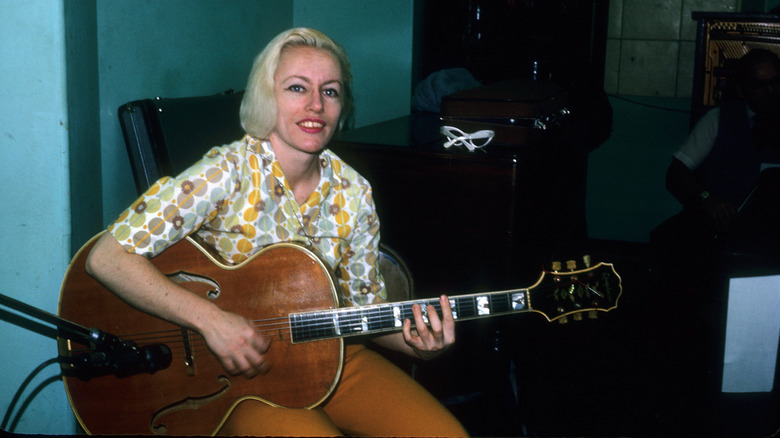
While they never made it onto album covers, received fan letters, or sometimes even got credited at all, session musicians have been the engine under the hood of some of classic rock's biggest, best hits. You can thank a largely unknown and tight community of hired guns and workman like pros for countless memorable and iconic moments in recorded music. If the wider world won't, it's up to us to give these legends their flowers: to shine a spotlight on the workers in rock's trenches without whom the magic couldn't have happened.
As part of the Wrecking Crew — a troupe of Los Angeles-based session musicians — bassist and guitarist Carol Kaye has played on a dazzling and giant list of '50s, '60s, and '70s hits for artists like Richie Valens, the Beach Boys, and Sonny & Cher, among many others. Jim Keltner is the drummer keeping time and adding fills on heavyweight tracks by most of the Beatles, Joe Cocker, Steely Dan, and many more, including one of Bob Dylan's absolute barnburners. And hits by the Kinks and the Rolling Stones wouldn't sound the same without criminally underheralded pianist and keyboardist Nicky Hopkins.
Most rock fans don't know these names, but all have fallen in love with their playing and been seduced by their parts. Always ready to clock (and count) in, these session musicians assembled the ingredients and added that secret sauce — the feel, the flair, the flourish — that catapulted classic rock songs up the charts and into history.
Jim Keltner
When it comes to drummers, Jim Keltner may not be the first name you think of, but you're definitely familiar with his work. From the late '60s on, he racked up credits with a long list of rock legends: three ex-Beatles in John Lennon, Ringo Starr, and George Harrison; Pink Floyd; Leon Russell, the Pretenders, Alice Cooper, Joe Cocker, and Tom Petty, to name just a few. Jazz-trained, influenced by R&B, and with a refined touch, few drummers have been as versatile and adept at finding the groove.
The hits he's played on reflect these traits. He's subtle and understated on Carly Simon's "Anticipation," jaunty and light on "Short People" by Randy Newman, and a funky technician on "Josie" by Steely Dan." Becoming the beating heart of Bob Dylan's "Knockin' On Heaven's Door" "was a monumental session for me because it was such a touching song," he told Drummer World, "it was the first time I cried while recording." You can practically hear the tears in his playing.
You don't become one of Los Angeles' top session drummers overnight, and it took Keltner some time to find his footing in the business. He scored his first work when fellow Oklahoma-to-California transplant Leon Russell tapped him to play on Gary Lewis & the Playboys' "She's Just My Style," which climbed to No. 3 on the Billboard Hot 100 in 1966. However, by the early '70s, his name was on everybody's Rolodex. It's his drums you hear on John Lennon's "Imagine," and you can hear him on more songs by luminaries including Brian Wilson, Joni Mitchell, the Rolling Stones, Jerry Garcia, Jackson Browne, and Warren Zevon, and many others. He found the pocket.
Steve Lukather
While Steve Lukather did find wider acclaim with pop rock powerhouse Toto, the volume of his session work is astonishing. You'd be hard-pressed to find a busier guitarist in Los Angeles in the '70s and '80s, and his playing graces countless classic rock, R&B, and pop hits. On Michael McDonald's "I Keep Forgettin' (Every Time You're Near)," and Christopher Cross's "Arthur's Theme (Best That You Can Do)," his playing helped define yacht rock. It got R&B and jazz rockers Chicago back to the top of the Billboard Hot 100 charts with "Hard to Say I'm Sorry" in 1982, and added flair to the bridge of the Top 5 charting Stevie Nicks' single "Stand Back," released the following year.
Like most on this list, Lukather started music early. By the time he got his first guitar and a copy of "Meet the Beatles" at age 7, he was already learning keyboards and drums. But George Harrison's playing stood out and inspired him. "'I Saw Her Standing There.' Off The Beatles first album," he recalled on the Music Radar podcast. "That was the one where I said, 'I want to be that guy.'" He met Toto bandmates Jeff Porcaro (of Steely Dan) and David Paich while still in high school; they helped him get established as a session musician. The work came and continued even after Toto took off in 1978.
Lukather always loved the challenge of session work. "We all had a blast doing it, and that's why people hired us," he told Guitar Thrills, "Not because of my ability to read music ... but [because of] creativity and what we brought to every song we ever recorded."
Carol Kaye
As bassist and guitarist of the Wrecking Crew — the crack team of LA-based session musicians that included drummer Hal Blaine and guitarist Tommy Tedesco — Carol Kaye is estimated to have contributed to roughly 10,000 recording session. Her fingerprints are on some of the most beloved hits of the boomer generation: from Richie Valens' "La Bamba" to the Beach Boys' "California Girls," "Sloop John B," and "Good Vibrations" to Sonny and Cher's "The Beat Goes On," and so many more. "She was the star of the show," Beach Boy Brian Wilson recalled in the 2008 documentary "The Wrecking Crew." "I mean, she was the greatest bass player in the world."
The daughter of musicians — her father a jazz trombonist and her mother a pianist (they'd divorce when she was 4) — Kaye took to guitar early. She was gigging with jazz bands by the time she was 14, and at 21, she was hired for her first recording session with Sam Cooke in 1957. "I knew it looked like money," she recalled in Far Out Magazine, "and I had two kids to pay for." When a bassist skipped a session in 1963, she filled in and found her place on the low end. She managed to break into the male-dominated club of studio musicians as a single working mom, making her both trailblazer and everyday hero. Kaye never sought recognition or fame and has rejected the "Wrecking Crew" label. And in 2025, she refused her induction into the Rock & Roll Hall of Fame. But if anyone deserves a spot, it's her.
Nicky Hopkins
If you judged English pianist and organist Nicky Hopkins solely based on his work with the Rolling Stones, you'd have more than enough to rank him a rock legend. As Mick Jagger, Keith Richards, and their bandmates hit creative heights in the late '60s and early to mid '70s, he filled out some of their most iconic songs, including "Gimme Shelter" and "Sympathy for the Devil." Blending classical music chops with an ear for improv, he played the shuffling piano on the Kinks' "Sunny Afternoon," nailed his part on the Beatles' "Revolution" in one take, and helped Joe Cocker score a hit with "You Are So Beautiful."
Raised in Middlesex, England, Hopkins took to piano early. At just 16, while a student at London's Academy of Music, he got his start playing in the band of off-beat rocker and countercultural politician Screaming Lord Sutch. But chronic health issues — which would turn out to be severe Crohn's disease — slowed him down throughout his life; he'd tour occasionally, but the road lifestyle would take its toll. Still, so in demand was he that he turned down spots in the Who and in the New Yardbirds, which were about to become Led Zeppelin.
Hopkins passed away in 1994 at 50, and as with too many session players, he deserved far more writing credits and royalties than he got. But with work on more than 250 albums, his legacy is undisputed. "[H]e had the ability to turn an ordinary track into a gem," Kinks frontman Ray Davies wrote in The New York Times, "... just enough to make you want to dance."
Roger Hawkins
As the drummer of the Swampers — the house band of the legendary Muscle Shoals Sound Studio in Sheffield, Alabama — Roger Hawkins played on some of the most iconic hits of the '60s and '70s. He got his start playing R&B, helping to define the Southern soul sound, playing on hits like Aretha Franklin's "Respect" and "Chain of Fools" and "When a Man Loves a Woman" by Percy Sledge. But as his studio and its band developed a reputation in the early '70s, it became a hot spot for rock bands and artists looking to tap into the local sound. Bob Seger, Willie Nelson, Rod Stewart, Joe Cocker, the Rolling Stones, and Cher all booked his time. While he did venture out of the studio on tour with Traffic in 1973, that didn't last long; he knew where his bread was buttered.
As far as outright classic rock hits, Hawkins is on quite a few. He drummed the beat of Paul Simon's "Kodachrome," which reached No. 2 on the Billboard Hot 100 in 1973, on a tape box. And he swings through Bob Seger's "Mainstreet" and nails straight-time on classic rock radio staple "Old Time Rock & Roll," all Top 40 hits in the U.S. Few drummers were as versatile and able to provide exactly what a song needed. "I was always a better listener than I was a drummer," he told Modern Drummer. "I would advise any drummer to become a listener" (via The New York Times). No doubt, when he passed away in May of 2021 at 75, he left us so much to listen to.