

5 One-Hit Wonders Who Found Success Long Before Their Signature Songs
Typically, one-hit wonders are musical acts that came out of nowhere to score a significant (usually in the Top 40 on the U.S. pop charts) hit single, only to vanish back into obscurity after a forgettable follow-up or two that don't peak anywhere as high as the breakthrough hit. However, there are some one-hit wonders who actually first tasted success elsewhere, several years before they had their proverbial five minutes of fame in the mainstream music world with their signature song.
When talking about success before the hit, we're not exclusively looking at people who are or were musicians first and foremost — in fact, some of these performers were actors who ended up scoring Top 10 hits before returning to their main field of expertise. We even included someone who became well known for their behind-the-scenes work in movies, and was close to middle age when they landed their signature hit. Having said all that, let's meet these performers, examine how they became successful prior to achieving one-hit-wonder status, and look back on the songs that briefly made them famous in music.
Richard Harris
Richard Harris was already an established actor in the late '60s, having appeared in a number of noteworthy films that decade, including "Mutiny on the Bounty," "This Sporting Life," and "Camelot." He had even won a Golden Globe Award for best actor in 1964, and this was around the time when he decided to branch out into music and record a version of Jimmy Webb's composition "MacArthur Park." The song reached No. 2 on the Billboard Hot 100 in June 1968, and for many people, it's still the first thing they think of when Harris' name is mentioned — rather than his extensive filmography or later roles such as Albus Dumbledore in the first two "Harry Potter" movies.
Unfortunately, that's not always a good thing. Harris' lone Billboard Top 40 hit and signature song is widely considered among fans and critics to have some of the worst lyrics in pop music history. Few listeners initially understand what "MacArthur Park" is really about, and that isn't helped by the unintentionally funny mentions of a cake left out in the rain and never having the recipe for it again. That may not be how you'd want to be remembered as a one-hit wonder, but thankfully, Harris kept doing pretty well for himself as an actor until his death in 2002.
Sylvia Robinson
Is it possible for a one-hit wonder to enjoy success many years prior as part of another one-hit wonder act? Indeed it is, since that's what happened to Sylvia Robinson as the female half of the duo Mickey & Sylvia, which had a No. 11 hit on the Billboard Hot 100 in 1957 with "Love is Strange." Although this classic earworm remains familiar to many a present-day listener, it was their only Top 40 appearance on the Billboard singles charts. Robinson began her career as a producer a few years later, but often found it hard to get properly credited for her work behind the scenes. She did, however, briefly return to relevance as a performer with her first — and only — significant solo hit, 1973's "Pillow Talk."
A funky, sensual R&B jam that can be considered an example of a proto-disco track, "Pillow Talk" peaked even higher than "Love is Strange," reaching No. 3 on the Billboard Hot 100 and reestablishing Robinson — then billed solely under her first name — as a hitmaker. But while "Pillow Talk" wasn't followed up by any other comparable hits, Robinson's involvement in music was far from over. She co-founded Sugar Hill Records later in the 1970s and also produced the Sugarhill Gang's "Rapper's Delight" — a '70s song that changed the course of music history by helping introduce rap music to the general public.
Toni Basil
With a career dating back to the early '60s, Toni Basil first made her name as a dancer and choreographer, serving in the latter capacity on movies such as the Monkees' bizarre 1968 box-office bomb "Head" and the 1973 coming-of-age classic "American Graffiti." She also had acting roles in several films, including acclaimed projects "Easy Rider" and "Five Easy Pieces." Most music fans, however, know her best (if not exclusively) for the 1982 No. 1 "Mickey," an '80s monster hit you probably didn't realize was a slightly rewritten cover of obscure English glam rockers Racey's 1979 song "Kitty."
Given that she was already in her late 30s by the time "Mickey" topped the Billboard Hot 100 in December 1982, Basil proved that it's never too late for someone to make a huge impact in the world of music. And make a huge impact she did — to this day, "Mickey" is an irresistibly catchy, sing-along tune with a chorus that can live rent-free in one's head well after the fact, and a similarly unforgettable video. Basil's time in the musical spotlight, however, didn't last anywhere as long as her signature song's enduring legacy. Her two other Hot 100 placings peaked in the lower rungs of the charts, and by the mid-'80s, she was back to doing what she does best — handling choreography duties on the big and small screen alike.
Eddie Murphy
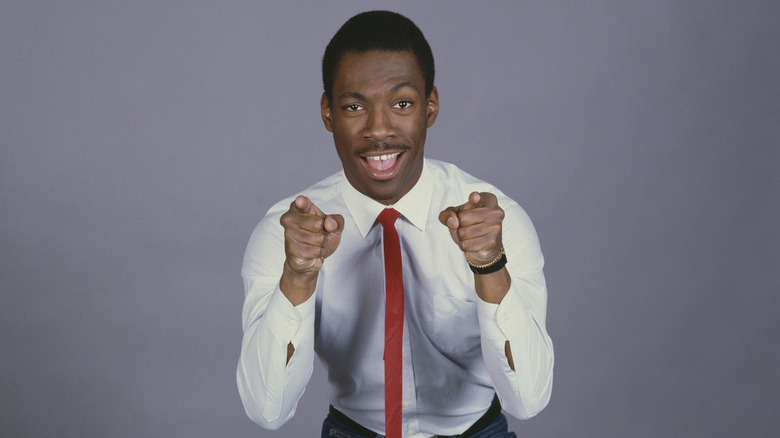
By the mid-'80s, Eddie Murphy was undoubtedly one of the hottest young actor-comedians in Hollywood, having starred in films such as "48 Hrs.," "Trading Places," and the first "Beverly Hills Cop" movie, and gotten his big break at the start of the decade on "Saturday Night Live." But beyond his rising status as a big-screen funnyman, Murphy also had a remarkably more successful singing career than the average actor dabbling in music.
It all started with a bet Murphy made with his comedy hero, Richard Pryor, who offered him $100,000 if he recorded an actual album with serious music, as opposed to a standard comedy album. In 1985, Murphy released "How Could It Be," with funk legend Rick James producing the record's big hit, the upbeat dance track "Party All the Time." That song made it all the way to No. 2 on the Billboard Hot 100 toward the end of the year, and while Murphy returned to the Top 40 in 1989 with "Put Your Mouth on Me," let's be honest — who even remembers that song anymore?
Allegedly, Pryor never paid Murphy the $100,000, even as "Party All the Time" raced up the charts. The song has also made its share of "worst songs of all time" lists, with BuzzFeed calling it the "'Norbit' of music" — a reference to one of Murphy's worst-reviewed movies. All that aside, though, "Party All the Time" has guilty-pleasure music written all over it, with its overly simple lyrics and insistent main hook, and somehow remains memorable among listeners to this day.
Shakespears Sister
This is a rather unique case of one-hit wonders doing well for themselves in music several years before the fact, as the two members of Shakespears Sister (no, that's not a typo) took separate paths to success. Siobhan Fahey first gained fame as one-third of Bananarama, the girl group best known for songs like the Gen Xer summer vacation playlist staple "Cruel Summer" and their cover of Shocking Blue's "Venus." Meanwhile, Marcella Detroit (real name Marcella "Marcy" Levy) took a more low-key route as a session musician, and was best known for co-writing and singing background vocals on Eric Clapton's late '70s hit "Lay Down Sally." Fahey and Detroit teamed up in 1988 to form Shakespears Sister, and four years later, they had a huge hit on the U.S. pop charts, reaching No. 4 in September 1992 with the atmospheric ballad "Stay."
Putting it simply, "Stay" is as far removed as you can get from Bananarama's bubblegum pop and the country-rock of "Lay Down Sally." And while maybe a little too dramatic, it's a more-than-respectable showing for Shakespears Sister, and one that could have propelled them to greater things as an alternative pop act. Sadly, their follow-up single, "I Don't Care," fell way short of the Top 40, and escalating personal differences tore the duo apart before they reunited in the late 2010s — nearly three decades removed from their brief moment of glory as mainstream hitmakers.