

5 Hit Songs You Never Knew Phil Collins Played Drums On
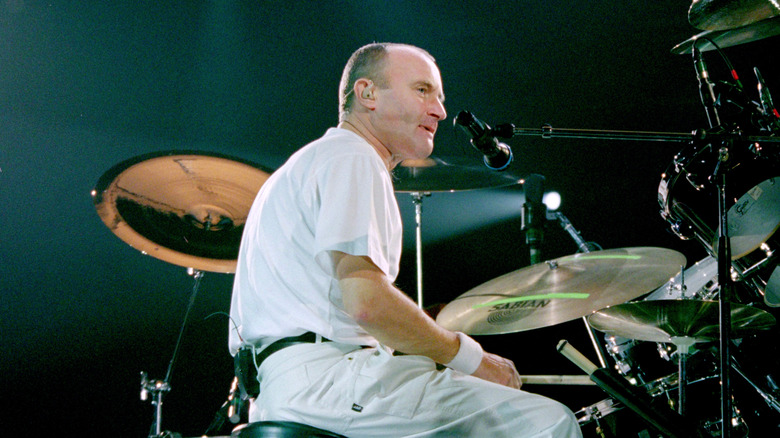
Phil Collins had one of the most timeless rock 'n' roll voices of the 1980s, and he took his talents to fame and success on the pop chart and in the world of soft rock. All the while, the musician behind "In the Air Tonight," "Sussudio," and "Two Hearts" remained the drummer and lead singer of Genesis, a progressive rock band that gradually turned more to the mainstream. While two parallel and wildly successful careers is enough to keep anyone busy and artistically fulfilled, Collins still made a lot more music on the side: He was a drummer for hire for the biggest names in rock, and it's his percussion that powered a number of big hit singles.
It was a smart and savvy choice for artists across genres in the '80s to bring in Collins to play the drums on their potential smashes. He had both the world-class drumming chops as well as a keen pop sensibility. It was not widely publicized when Collins played on another artist's stuff, but his particular drumming style is nevertheless unmistakable and hard to ignore once you hear the hits on which he kept time and pounded the skins, credited solely to musicians like Robert Plant, Tina Turner, and Tears for Fears.
I Know There's Something Going On – Frida
Generally credited as Anni-Frid Lyngstad, the artist later known as Frida was one of the most successful singers of the '70s, as a member of ABBA. In advance of the pop group's almost inevitable breakup in 1982 — the two men in ABBA had been married to the two women in ABBA, and they'd all divorced — Frida planned her next professional move. After she heard Phil Collins' 1981 album "Face Value," an LP he wrote and recorded in part to process a divorce, Frida aimed to work with the musician. "She thought I was a kindred spirit as she was going through this painful divorce," Collins told Classic Rock. "She thought I'd understand her. I picked the songs with her — or for her, actually."
Collins produced Frida's album, "Something's Going On," while also variously contributing drums, other percussion, and background vocals. Collins' distinctive '80s-era style — enthusiastic, heavily treated with a thunderous echo effect, and played in a stop-start manner — is obvious on the record's semi-title track. A song about coming to terms with the end of a relationship and the unease that shows a split is looming, the hard-rocking "I Know There's Something Going On" was Frida's only post-ABBA solo hit. It climbed to No. 13 in the spring of 1983.
Big Log – Robert Plant
After establishing himself as one of rock's all-time greatest lead singers, Led Zeppelin frontman Robert Plant launched his solo career in the early 1980s. He wouldn't score a smash hit on the pop chart until album No. 2, "The Principle of Moments." Two singles from the LP reached the Top 40: "Big Log" and "In the Mood," peaking at No. 20 and No. 39, respectively. Phil Collins played drums on both tunes, as well as on album cuts from both that and Plant's previous LP, "Pictures at Eleven." At a time when Plant was in search of a drummer, and one who'd have to take on the unenviable task of succeeding Led Zeppelin's deceased percussionist John Bonham, Collins sent Plant a letter. He offered his drumming services should the need arise, ensuring him that he was an admirer of the singer's deceased Led Zeppelin bandmate John Bonham. (It also helped that both artists were signed to Atlantic Records.)
On "Big Log," a somber, mid-tempo blues-rock ballad, Collins' drums don't overstate, but they do push along the song with a crisp and hypnotic beat. Collins gets to have a bit more fun on "In the Mood," cutting loose with his bouncy, rapid-fire technique and echo effect, reminiscent of his work on "In the Air Tonight" and "Don't Lose My Number."
No One Is to Blame – Howard Jones
Howard Jones is an '80s musician we completely forgot about, but he mixed pop, new wave, and R&B, and frequented the Hot 100 with tracks like "New Song," "Things Can Only Get Better," and "No One Is to Blame." The tender synth-pop breakup ballad first showed up on Jones' 1985 album "Dream Into Action," and then a different version entirely was released in conjunction with 1986's "One to One." Jones hadn't been happy with the original take. "I always thought the song could have been done in a more obvious radio-friendly way," Jones told Cherry Red Records. To get "No One Is to Blame" into airplay shape, he called up someone who got songs onto the radio with ease: Phil Collins.
After meeting at the Prince's Trust charity concert and becoming friends, Jones asked Collins to play drums on the new and improved "No One Is to Blame." Collins requested that Jones provide him a segment of two bars that he could use as a guide. He did, and Collins then turned out a complete drum track, a simple, restless, and persistent, clock-like beat befitting the song's themes, captured in one take. Everyone got it right, because "No One Is to Blame" became a No. 4 hit in 1986.
Typical Male – Tina Turner
"Typical Male" was the first single from 1986's "Break Every Rule," Tina Turner's first album after her massive mid-1980s comeback LP "Private Dancer." By that time, Phil Collins was also one of the biggest solo stars in music, but he approached playing the drums for Turner as a hired, session musician. "Typical Male" was a synth-heavy, dance-pop song, far from the typical soft rock Collins fare of the era, and so he ceded judgment about how to handle the drums to one of its co-writers, Terry Britten. "Terry was saying, you know, we really needed to stick very close to, like, what was there," Turner explained in an interview (via YouTube).
Rather than inject his own sensibility or musical instincts into the song, Collins did as he was asked, without overstepping. The drummer and superstar also provided the drums on the "Break Every Rule" track "Girls," but "Typical Male" was the LP's most notable hit, peaking at No. 2 in the fall of 1986.
Woman in Chains – Tears for Fears
In 1989, Tears for Fears issued their first album in four years, "The Seeds of Love." Looking to pick up where they left off with moody, atmospheric, and philosophical new wave smashes like "Shout" and "Everybody Wants to Rule the World," the album incorporated traditional sounds from around the world and classic rock homages, up to and including Genesis's Phil Collins on the drums. He played on the LP's second single, "Woman in Chains."
It's mostly low in the mix, and so overproduced that it sounds like a drum machine, but Collins' bombastic and precise performance is in there, serving as something of a cameo, a musical wink to listeners who get it. "Tears for Fears just wanted me to do that big drum thing from 'In the Air Tonight' on 'Woman in Chains' — 'We want you to come in here in a big way,'" Collins recalled to Classic Rock in 2016, evoking the surprising and crucial fill present in the song. In February 1990, as Collins' former No. 1 hit "Another Day in Paradise" slid down the Hot 100, "Woman in Chains" reached its peak position of No. 36.