

The 5 Most Complex Drum Solos In Progressive Rock History
We may receive a commission on purchases made from links.
There's no denying it — progressive rock has some of the most complex drum solos of all rock subgenres. The music is complex in general, really. It's ambitious and mixes techniques from all over the world of music — when it's not inventing something entirely new. But even so, not every prog rock drum solo is multifaceted. That's where this list comes in. We've wrangled up the best of the best, the most complex drum solos in progressive rock history.
This wasn't an easy decision to make, as there are so many intense percussion solos in prog rock that putting five of them above the rest is almost impossible. At the end of the day, it comes down to subjectivity, but not entirely. Every selection on this list has certain things in common. They're technically impressive, utilizing skills that not just any drummer can master. They each also have coherency. You can hear the rhythm and what they're trying to say, so to speak. It's not just "Gruck hit hard, hit fast" like in some of the heavier genres. The proficiency of the drummers can be heard in the execution of these solos and the way in which they turn complexity into something unique.
Live At Wembley Stadium (1987) — Genesis
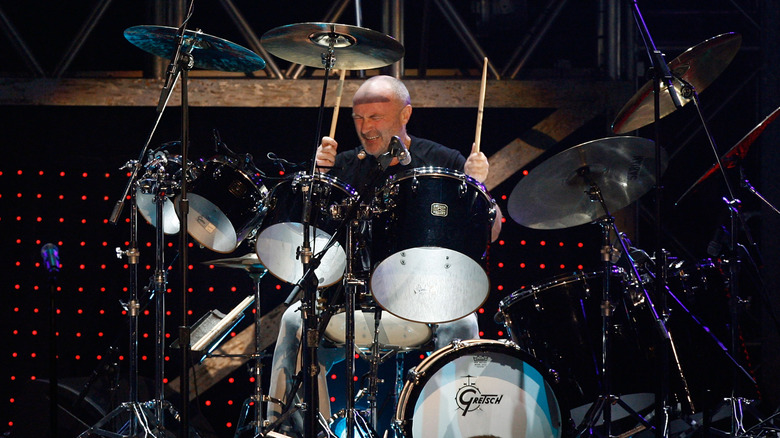
Phil Collins was one of the most talented musicians on the planet when he was still active. He could do it all, and he's proved it through multiple bands, solo projects, and instruments. Phil Collins' prowess on the drums, specifically, is rarely matched. With Genesis, he included absurdly complex drumming on many of their albums, but he wasn't the only drummer the band had — not during live performances anyhow. And those live performances are when Genesis laid out their most complicated percussion solos, and they were truly something to behold.
For much of Genesis' history, they toured with a second drummer to help free up Collins for vocals, and that drummer was the legendary Chester Thompson. Having two phenomenal drummers on stage led to some wild solos, including the drum duet captured on the "Genesis: Live At Wembley Stadium" video from their 1987 "Invisible Touch" tour.
You really can't get much more intricate than two elite level drummers performing in unison. The drum duet solo incorporates an obviously rehearsed rhythmic base that the two play on their side-by-side drum kits. They still add in their own flairs and do some call and response work, however, giving the duet solo the undertones of a drum-only song with fast and complex fills that utilize quick pedal work and rapid sticks. The performance doesn't feel like Thompson and Collins competing in any way. Instead, it's a beautiful and technical choreography meant to be a standalone mini show within the greater concert. And it's honestly one of the best things to ever come out of prog rock.
The Rhythm Method (Live) — Rush
"The Rhythm Method" by the progressive rock band Rush is, in essence, one long drum solo that gives Neil Peart the space to show off all of his talent and complexity. You won't find this track on any studio album, but it appears on two Rush live albums — 1989's "A Show of Hands" and 1998's "Different Stages." If you compare both recorded iterations of this epic drum solo, you'll notice they're drastically different lengths. This was a highlight piece played at live shows, and solos of this nature are improvisational even when structured, so it's doubtful that it ever came out exactly the same twice.
In this solo, Peart keeps an overarching and rapid rhythm while changing up styles. His drum set utilizes so many different heads and extra instruments that it's difficult to count exactly how many. Amidst the cymbals, toms, and other skins, there are cowbells, windchimes, and even a xylophone. Nothing goes untouched.
It's like listening to a band made of percussionists when really it's just Peart. The bass is doing its steady thing while the snare plays its own tune. The cowbells and xylophone add the melody beyond the rhythm. He even adds in call-and-response techniques between the pieces, where the xylophone reaches out for an answer from the snare. This solo isn't just complex — it's practically madness.
Tank — Emerson, Lake & Palmer
The 1970 song "Tank" by prog rock supergroup Emerson, Lake & Palmer is a legendary piece of music for its drum solo and beyond. Of course, that's what happens when you put the master drummer that was Carl Palmer from Atomic Rooster into a recording studio with Greg Lake from King Crimson and a legend who helped define prog rock like Keith Emerson from the Nice. And it really did take all three of them to make Palmer's drum solo hit so hard.
The buildup to the drum solo in "Tank" is just as important as the solo itself. It utilizes an interesting hashing of the 4/4 time signature with eight notes and triplets that make it flow while simultaneously almost difficult to count. The synthesizer and strings are broken up with quick bursty fills of the drums before they entirely take over mid-song.
The solo itself starts in the way you'd expect a rock drum solo to sound. It's fast and it's hard, but there's a steady rapidness in the snare that would be difficult for even proficient drummers to replicate. Without breaking stride, Palmer starts to include toms and cymbals, and the whole time — regardless of what his sticks are striking — it feels as if that drum roll never breaks. Then, even smoother than it began, the solo moves us into the groovy next act of the song. It's masterful drum work that balances artistry prog rock and the brute force of a hard rock. Truly one of the best rock drum solos of the '70s.
The Time Machine — Colosseum
Here's another live drum solo that was recorded as its own track on an album. "The Time Machine" by Colosseum — well, pretty much just by Colosseum drummer Jon Hiseman — was recorded during a live show at Royal Albert Hall in London in the summer of 1970. It's the only live track on the entire 1971 "Daughter of Time" album, and while that might allude to it being out of place, it was a performance that needed recorded so the world could hear it.
This solo is eight minutes of pure technical complexity. It starts with a very short introduction by the full instrumental ensemble while Hiseman builds a steady, fast drum sequence that utilizes tom, bass, and cymbals to sound almost like a war march that was touched by the percussion section of the big band era. While some of the solo going forward sounds like one rhythm played by an individual's expert hands, other parts give the illusion of more than one percussionist. It's almost as if each hand and each pedal is playing a separate drum track that was later mixed into one, and that's something that takes a level of technical coordination that's exceedingly rare.
One of the most impressive aspects of this solo is how Hiseman keeps an overall groove throughout with everything going on — and he really does have a lot going on. Tempo changes, rhythm shifts, the works. Pure proficiency.
Incomudro – Hymn to the Atman — Kansas
If you only know the progressive rock band Kansas from hits like "Dust in the Wind" and "Carry On Wayward Son," you'll have a hard time believing that the band's drummer Phil Ehart is capable of pounding out a complex drum solo. You'd be wrong, but it's an easy thing to assume given the simplicity of the drum tracks on those songs. In truth, Ehart produced one of the most multifaceted solos in prog rock history on "Incomudro – Hymn to the Atman" off the band's 1975 "Song For America" album.
"Incomudro – Hymn to the Atman" is a multipart suite that runs over 12 minutes long. It goes through some pretty stark tonal shifts that aren't bad, but they can be a little jarring when you're not expecting them. Still, it's a journey that's worth having. The band utilizes everything from seemingly sci-fi sound effects to crisp piano. The drums start climbing their way towards the forefront about 4 minutes and 40 seconds into the track, but, outside of a few rapid fills, they don't really take center stage until the solo starts just shy of the 7-minute mark.
It begins with a groovy jam that transitions into some seriously involved stick work. Somehow, Ehart manages to drastically increase his tempo while throwing in ultra fast drum rolls on the snare without breaking stride. He ends the roughly minute-and-a-half solo with some impressive flair and another accelerando to bring to a close one of the best and most complex drum pieces to date. And like each of the others on this list, it isn't a solo that would be easy to replicate.