

5 Rock Songs From 1969 That Sound Even Cooler Today
The world of rock music was reaching a high-water mark in 1969. More than half a decade on from Beatlemania, the 1960s counterculture, flower power, and psychedelia had utterly transformed the genre, which was now open to greater sonic experimentalism and a wider tonal palette.
But the end of the 1960s also saw the hippie movement turn in on itself. The legendary Woodstock festival was messed up in many ways, and disasters such as Altamont and the realization that some corners of the counterculture, such as the Hells Angels motorcycle club and the Manson Family cult, were inhabited by truly dangerous criminals was reflected in the music of the era, which grew increasingly sour in the years that followed. The Vietnam War continued to claim the lives of thousands of young Americans and resulted in several notable artistic statements, such as Jimi Hendrix's legendary and subversive performance of "The Star-Spangled Banner," which became a regular feature of his stage shows toward the end of the decade.
But while it is tempting to place the music of 1969 in its immediate context, the truth is that many of the songs recorded that year have proven to be timeless, and indeed have come to sound even cooler with the passage of time. Here are five songs from 1969 that have kept their cool, chosen for their continued listenability and appeal to modern listeners.
The Stooges – I Wanna Be Your Dog
The Stooges are today hailed as one of the most influential bands of their generation, with a raw sound that subverted much of what was being released at the end of the 1960s. Arguably comparable only to The Velvet Underground in terms of their slow-burn impact on the artists that came after them, the Michigan band led by future star Iggy Pop released just three studio albums between 1969 and 1972, before splitting amid growing drug misuse and turmoil.
The Stooges commanded a loyal cult following but never gained commercial success during its first flush as a working band. Instead, it would take decades for the public to catch up and make The Stooges iconic, by which time the band's heavy, driving sound and Iggy's snarling, yelping vocals had become guiding lights for the punk movement.
Most fans would tell you that the Stooges' short discography is well worth exploring in its entirety, but that one song stands above all others as the band's crowning achievement: 1969's "I Wanna Be Your Dog." Built around a grinding 3-chord descending riff and Iggy's submissive, self-flagellating lyricism, the song was the antithesis of much of the music that had emerged over the previous decade, a distorted proto-punk downer that heralded the more nihilistic tone many artists would strike in the 1970s.
The Beatles – Come Together
It might seem inconceivable in hindsight that when proto-punk was coming on in leaps and bounds, thanks to the arrival of bands like The Stooges, the Fab Four were still plying their trade as the biggest band the world had ever seen. Of course, The Beatles was not the same outfit that emerged back in 1962 with "Love Me Do." After embracing psychedelia, avant-garde influences, and new musical possibilities offered by new studio technologies, the band had put out a flurry of landmark releases, such as 1966's "Revolver" and 1967's "Sgt. Pepper's Lonely Hearts Club Band," which placed The Beatles firmly at the vanguard of innovative popular music. The last album The Beatles would record together, "Abbey Road" – "Let It Be" was released later, but recorded earlier — arrived in 1969, and for many modern fans is arguably the band's most timeless release thanks to its pristine production and forward-thinking compositions. The John Lennon-penned opener, "Come Together," may be the coolest song the Fab Four ever recorded.
Apparently influenced by a slogan used by LSD advocate Timothy Leary — and debatably having a sexual subtext — the song is propelled by a catchy bass groove that hooks the listener into Lennon's typically absurdist lyrics before the song's swaggering chorus. "Come Together" manages to be both effortlessly sexy and menacing, prefiguring much of the glam rock posturing of the early 1970s.
The Rolling Stones – Gimme Shelter
The Rolling Stones was going through some serious changes in 1969. In the summer of that year, the Stones lost founding member Brian Jones, who left the band amid growing drug addiction. His departure came in June, and in July he was found dead in his swimming pool, a shocking development that rocked the band and its fanbase. The year came to an end with the disaster at Altamont Speedway, an event characterized by the violence between the crowd and the band's bodyguards, the Hells Angels, which resulted in the killing of Black music fan Meredith Hunter. For many, that tragic incident was the moment that the dream of the 1960s counterculture died, and was undoubtedly the low point of the Stones' early career.
However, despite these tragedies the band retained its creative flair. The album "Let It Bleed," which was released in November and just a few short months after Jones' death, was received with mixed feelings by the band's listenership at the time due to its disturbing lyrical content, though it is now counted among The Stones' classic releases. The highlight is "Gimme Shelter," a doom-laden soul-infused rocker that sounds as Stones-y as possible, while also being utterly unlike anything else in the band's catalog. With anxious, elliptic lyrics and a soaring backing vocal provided by singer Merry Clayton, it's still adrenaline-inducing stuff today.
Credence Clearwater Revival – Fortunate Son
The anger of the youth in the 1960s was fueled by several big issues, including the Civil Rights Movement, intergenerational strife, and, of course, the Vietnam War. Towards the end of the decade, it was increasingly clear to the public that the U.S. military's attempts to stamp out communism in Asia were doomed to fail, and that young people were being sent to be maimed or die in unthinkable numbers for the sake of misguided foreign policy. Such frustrations were expressed abundantly in that era's music, but few as amply as Creedence Clearwater Revival's "Fortunate Son," which was released toward the end of the year.
A short, fiery screed delivered by the band's principal lyricist, John Fogerty, the song criticizes the privileged few who used their wealth and influence to get their children out of being drafted into the brutal war. But the song also speaks to wider issues of wealth inequality. "The song speaks more to the unfairness of class than war itself," Fogerty once explained (via Udiscovermusic). "It's the old saying about rich men making war and poor men having to fight them." His anger still reverberates, and as the hundreds of millions of views garnered by the song's new 2018 music video attests, it continues to find a dedicated audience.
Led Zeppelin – Whole Lotta Love
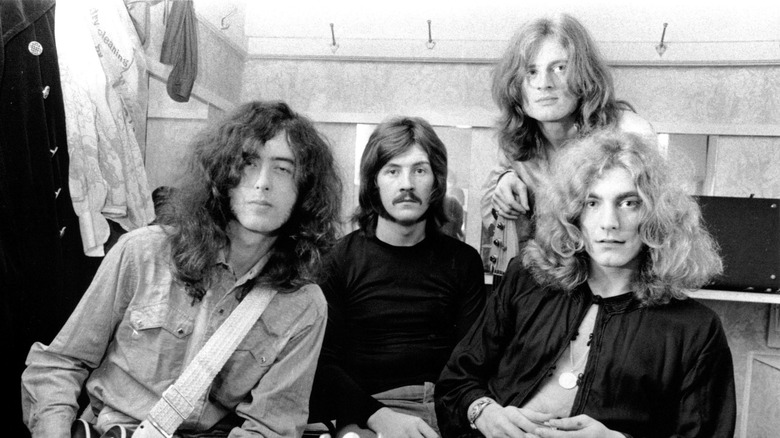
It has been said that Led Zeppelin was to the 1970s what The Beatles was to the 1960s: a seismic British band that conquered the world of rock music, changing it forever. But Zeppelin's story actually began in the 1960s, with the band assembled from the remnants of the defunct blues rock outfit The Yardbirds. Led Zeppelin is famous for its four self-titled studio albums, and for many listeners the band really hit its high point with "Led Zeppelin IV," which remains Zeppelin's most celebrated record. However, the band released both their debut and sophomore albums in 1969, the latter of which contained one of their finest cuts: "Whole Lotta Love."
Undeniably based on Willie Dixon's classic "You Need Love," the song is one of Zeppelin's most overtly sexual tracks, which progresses from a rocking, headbanging groove to a strange, unstructured climax before locking back into the groove. It was a huge hit single in the U.S., became the theme song of "Top of the Pops" in the U.K., and has been frequently covered by artists who see it for what it is: a straightforward blues-rock number that still has the power to get audiences going.
The Guess Who – Undun
The Guess Who was one of Canada's hardest-working rock outfits, a Winnipeg institution that went on to have a string of international hits that made the band members heroes in their home country. The band had plied its trade throughout the 1960s, but 1969 was its pivotal year, when back-to-back studio albums saw it repeatedly crack the Billboard Hot 100 with a number of eclectic, well-written singles that now stand among the finest rock releases of the period.
The Guess Who enjoyed three U.S. Top 10 hits in 1969: "These Eyes," "Laughing," and "No Time," with the latter two also hitting No. 1 in Canada. But arguably the coolest track the band released at the tail end of the hippie decade was "Undun." The track performed worse than the others the band released in 1969, failing to crack the Top 20 in either market. However, listen to it now and it sums up everything that was appealing about the music of the decade, with the band's growing jazz influences on full display.
"Undun" is a sophisticated number in the vein of the music of '60s luminaries The Zombies — specifically, it recalls its 1964 hit "She's Not There" – that remains as evocative of the era as a whiff of patchouli. The musicians involved with the song also think highly of the track, with one-time Guess Who guitarist Randy Bachman telling Guitar Player magazine: "It just has a unique quality like no other song." Surprisingly, the solo, which was performed on a flute to differentiate the song from the well-known Zombies sound, was performed by Burton Cummings, a singer, keyboardist, and saxophonist who had no prior experience with the instrument.
Joni Mitchell – Both Sides, Now
Folk rock legend Joni Mitchell's masterpieces, such as "Blue" and "Court and Spark," were to arrive in the '70s, but she took a major step towards them with "Clouds," her sophomore 1969 LP that saw her develop her poetic style of songwriting. The album's closer, "Both Sides, Now," has proven to be especially popular, a fan favorite that has enjoyed wider exposure and acclaim despite not being released as a single by Mitchell herself.
Mitchell began composing the song after she witnessed a vista of clouds while on a plane journey, an experience that chimed uncannily with a passage in the book she was reading at the time, Saul Bellow's "Henderson the Rain King," in which the protagonist observes clouds while on a plane journey to Africa. Mitchell developed the idea of clouds as a metaphor for the obstacles that one encounters in life: "But now they only block the sun/ They rain and snow on everyone/ So many things I would have done/ But clouds got in my way," she sings.
The song's theme of universal struggle has reverberated down the years. Mitchell's surprise appearance at the Newport Folk Festival in 2022, during which she sang "Both Sides, Now," led to another wave of appreciation for the song, and it is now counted among the songwriter's most-loved compositions.
The Who – Pinball Wizard
An overblown rock opera about the life of a nonverbal boy born deaf and blind may not chime with many modern music fans, but The Who's "Tommy," which was a phenomenon upon its release in 1969, is now counted as a classic despite its dated format. "Pinball Wizard" is arguably the album's highlight, which, despite its bombastic themes — the turning of the title character into a superstar thanks to his incredible ability to play pinball — is artfully underpinned by driving acoustic guitar, providing the perfect frantic foundation for the song's iconic lead guitar lines.
Unusually, the song was written to the specifications of one critic: Nik Cohn of The Guardian, with whom songwriter Pete Townshend shared a great deal of material from what would eventually become "Tommy." At the time, the album was an overt reflection of Townshend's explorations of spiritualism. But Cohn, with whom Townshend would often play pinball, prompted Townshend to incorporate the pinball theme, making what would be Tommy's spiritual journey more digestible to listeners at the time. It still sounds fresh and urgent, and while the lyrics may seem unfashionably direct today, it is one of the defining songs in The Who's discography — much to Townshend's chagrin.
The Velvet Underground – What Goes On
The Velvet Underground may be most famous for its debut album "The Velvet Underground & Nico," which was said to have been the inspiration for a raft of alternative bands after its release in 1967. But by 1969, the Lou Reed-led band was still in its classic period, having indulged in Reed and collaborator John Cale's hard-rocking instincts in the 1968 album "White Light/White Heat."
The band's self-titled third album saw the notoriously boundary-pushing outfit turn more generally to conventional songwriting and softer compositions, but "What Goes On" ranks among the band's most upbeat offerings. Held together by Reed's relentless rhythm guitar playing, the song showcases the songwriter's exceptional ability to derive poetic effects from the most simplistic lyricism. "Lady, be good, do what you should/ You know it'll work alright," he extols on the chorus, while on the verse he delves into his own existential turmoil to great effect, singing: "One minute born, one minute doomed/ One minute up and one minute down." The words on the page don't do justice to the effect of the song, which chugs along, managing to be tense and melodic at the same time. Live versions of the song, such as that captured on the 1974 album "1969: The Velvet Underground Live," were stretched to almost nine minutes.
Santana – Soul Sacrifice
Carlos Santana's virtuoso band had made a reputation for itself in the late 1960s as one of the era's greatest jam bands, and the end of the decade saw two foundational releases that would see it become a legend. The first was Santana's self-titled debut album, on which the band would fuse Latin rhythms with the rock music of the day, creating a broad, expansive soundscape that allowed for post-psychedelic sonic exploration. The other was "Woodstock: Music from the Original Soundtrack and More," which chronicled the more notable performances from the mythic Woodstock festival in August 1969.
"Soul Sacrifice," a high-tempo masterpiece that showcased Santana's generous use of percussion and call-and-response instrumentation, featured on both. The song was the centerpiece of the band's incredible set at the festival, and the place to start is with footage of that performance. The band members deliriously push the song as far as they can take it, which is based on a simple groove that nevertheless allows the band to shine.
David Bowie – Space Oddity
Future rock legend David Bowie's first true flush with fame came in 1969, with the release of his single "Space Oddity." Just 22 when he wrote it, Bowie had spent his early years laboring for recognition in a number of dead-end bands, all of which struggled to gain commercial traction. But this song represented a new direction for the singer, with the space themes of the lyrics — inspired by the film "2001: A Space Odyssey," and a theme to which he would return throughout his discography — resonating with the public thanks to that era's Apollo 11 space missions.
Bowie's portrait of an astronaut "spinning in a tin can far above the world" highlighted the unfathomable loneliness of those venturing into space, humanizing the incredible civilizational achievements of the age. Released to coincide with the Apollo 11 moon landing, the song was used by the BBC in their coverage of the event, which helped it crack the Top 5 of the U.K. singles chart. A rereleased version hit No. 15 on the Billboard Hot 100 in 1973.