

5 Songs From 1971 That Are So Underrated
1971 was a hell of a year for music. A meager sample of what came out that year tells the story: "Led Zeppelin IV" by Led Zeppelin, "Sticky Fingers" by the Rolling Stones, "What's Going On" by Marvin Gaye, "Who's Next" by The Who, "Pearl" by Janis Joplin, "Master of Reality" by Black Sabbath, "L.A. Woman" by the Doors, "Imagine" by John Lennon, etc., etc. These albums, plus loads more, make it seem like the year produced one giant catalogue of masterpieces containing colossal, generationally beloved hits. It's kind of true, and that's not even taking underrated songs into account.
On a whole, the early '70s marked a continuation of, and also a break from, '60s counterculture in that the counterculture became the culture. Musically grown out of '60s rock and the rise of soul and R&B, with a dash of disco toward the end of the decade, the '70s proved an extremely fertile and vibrant artistic time, including on the film front. Those of us who weren't alive at the time can't help but gaze backward at the whole era as though glimpsing a mythical, mystical unicorn.
Amidst a vast sea of amazing music, it's easy for certain songs and artists to get overlooked and underrated. We're going to highlight several such songs from 1971 in this article, focusing on lesser-known tracks from either lesser-known or well-known artists, from King Crimson to Miles Davis and even the Beach Boys. Some fans will have intimate knowledge of each of our picks, but our choices refer to general public awareness of the songs in question, especially when pitted against songs on big-name albums like those listed above. Our picks also embody the bleeding-edge musical energy of the time.
King Crimson's Sailor's Tale
"This is the best group in the world," Jimi Hendrix said of King Crimson in 1969 (per Guitar.com), in an often-cited quote that makes Crimson fans' hearts swell with pride. That year, King Crimson released "In the Court of the Crimson King," the OG prog album for all prog albums to follow. And when we say "prog," we really do mean "progressive," i.e., progressing beyond genres, including the already rapidly-paced changes of the musical mid-'60s through early '70s. King Crimson's identity and sound mutated from one album to the next, even one song to the next, incorporating loads of non-rock instruments, building on jazz, folk, and blues influences, and developing unconventional, layered compositions that make them sound as sui generis now as they did in the '60s and '70s.
In 1971, King Crimson released "Islands," their fourth album in three years of tremendous creative output and nuts-and-bolts productivity. While "In the Court of the Crimson King" tends to get all the attention for its initial impact, semi-accessibility, and hits like "21st Century Schizoid Man" (as well as ranking 25 out of over 57,000 albums on the ratings aggregator Best Ever Albums), we'd be remiss to neglect "Islands." Even more instrumentally complex than its predecessors, abiding by not a single musical convention, "Islands" contains several noteworthy, overlooked tracks, particularly "Formentera Lady," "Sailor's Tale," and the title track, "Islands."
We're going to give our underrated track nod to "Sailor's Tale." Its absolutely brain-busting polyrhythms (try counting time to it) and incessant bassline underscore shifting horn solos and zipping guitar riffs, strange synth sections, and killer, syncopated drum work. It's an awesome King Crimson song, an awesome early '70s song, and an awesome song, period.
Miles Davis' Inamorata and Narration By Conrad Roberts
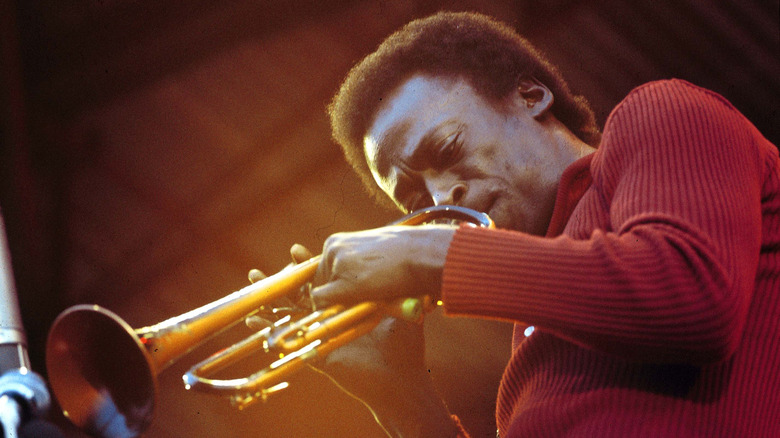
Even those who know nothing about jazz have probably heard of Miles Davis. Online articles will rightfully cite his technical achievements, like how he was a cool jazz pioneer (a smoother counterpart to bebop) or how he tuned his trumpet to have a human voice-like timbre. This is all completely true, but also: Forget all that and just go listen. Even though Davis' music is a herculean accomplishment of virtuosity, it's all about closing your eyes and jamming. This is especially true when it comes to his 1971 album, "Live-Evil."
Though Davis started recording music in the 1940s, he entered his phase of peak power around the mid-'60s, leading to his performance at the 1970 Isle of Wight Music Festival with his new band, B****es Brew. That year, he also embraced some of the musical influences that played alongside him at that festival, like folk and rock. The following year, in 1971, he released "Live-Evil," a defiant, brazen, and awe-inducing jazz fusion album that is staggeringly cutting edge, even for him.
"Sivad," the album's first track, is probably its most ostensibly groovy track. The hurried tempo of "What I Say" winds up, counterintuitively, creating enough space on top of the rhythm section for Davis to fool around at will on his trumpet, and it's incredible. But if you want to go for the throat, head to the end of the album for the 26-minute-long "Inamorata and Narration By Conrad Roberts. (We've included an abbreviated version above.) Just imagine yourself sitting in a small club of several hundred listening to the jam session unfold and evolve. And then realize that this one, nearly half-hour track was an entirely improv effort.
Genesis' The Musical Box
In the beginning there was Genesis, originally headed by the very biblically-named and bizarrely-costumed singer Peter Gabriel. What began as a proggy, dreamy rock effort in the late '60s with 1969's "From Genesis to Revelation" (biblical, see?) radically changed gears by the time it reached 1983's self-titled "Genesis," with its simple but well-written, poppy mega-hit "That's All." Listeners will notice the very recognizable Phil Collins singing on that song and not Gabriel. This evolution from Genesis' genesis to its ultra-successful period in the '80s and '90s started at the juncture of 1971 with the band's third album, "Nursery Cryme."
It's incredibly jarring to go back to "Nursery Cryme" after hearing a Genesis song like 1986's "Invisible Touch." You might as well be listening to a different band. That being said, "Nursery Cryme" contains the seeds for Genesis' future form in its more straightforward sections, largely thanks to the addition of Collins as drummer and Steve Hackett as guitarist. A mere three years later, Genesis released the grand and intricate "The Lamb Lies Down on Broadway," after which Gabriel left the band for his solo career, same as Collins would later do. That album and Gabriel's exit were presaged by "Nursery Cryme," an easily overlooked album in the band's discography that more than stands on its own, especially its first track, "The Musical Box."
It's most accurate to think of "The Musical Box" as a mini-symphony with various standout sections and an overall ebb and flow that culminates in a highly theatrical ending that, at moments, echoes Queen. It's an easy winner for a highly underrated song from the year it came out.
Leonard Cohen's Avalanche
At this point, multiple generations were probably introduced to Leonard Cohen through swarms of covers of his biggest song, "Hallelujah." This might make Cohen fans die a bit inside, but it's worth it to bring listeners past Cohen's folk contemporaries, like Bob Dylan and Joan Baez, and into his dark, occasionally oddball and even playful, troubadour heart. Not only is Cohen's catalogue often overlooked, but so are certain albums and songs within it. "Avalanche" off of 1971's "Songs of Love and Hate," his third album, is one such song. The album wasn't well received when it was released, but to certain fans it stands out as the best Cohen ever offered. It's a brilliant piece of music from 1971 or otherwise.
"Avalanche" is as understated as it is intense, authentic, completely hypnotic, and vibrantly poetic. It accretes and swells over its length into a crushing mass of darkness, as though each plucked note is one snowflake in a maelstrom. Played on a solo acoustic guitar live, and with minimal accompaniment on the album version, the song's rippling flamenco tells a grim folk tale of a hunchback living at the bottom of a goldmine — at least symbolically.
"When I am on a pedestal, you did not raise me there / Your laws do not compel me to kneel grotesque and bare," one couplet says, before the song descends into an obsessive love story that ends in, "It is your turn, beloved / It is your flesh that I wear." True to the title of the album, "Songs of Love and Hate," the listener can take "Avalanche" as a depiction of the agony of unfulfilled love or the pain of love's all-consuming nature. Either way, be prepared.
The Beach Boy's Surf's Up
Who could have possibly guessed that a boy band who sang seemingly frivolous, singalong songs like "Surfin' U.S.A." and "California Girls" would transcend their own image so mightily that their work stands as some of the most finely composed music of its era (and beyond)? Similar to how the Beatles' explosive evolution took them from "Love Me Do" in 1963 to "Eleanor Rigby" in 1966, the Beach Boys went from "Be True to Your School" in 1963 to "Good Vibrations" in 1967. Much of this absolutely bananas leap in creative output falls at the feet of Beach Boys co-founder and producer Brian Wilson, whose insane work ethic, perfectionism, and vision released all the music potential that was visible right at the Beach Boys' beginning.
By the time the early '70s came around, the Beach Boys' mid-'60s heydey was already gone and the zeitgeist had moved on to rockier fare. That, however, was arguably when the band's music reached its most complex and honed phase. The seemingly bizarre and incongruous cover for 1971 "Surf's Up" says it all, a painting of the superb and moving 1918 "End of the Trail" bronze sculpture by James Earle Fraser currently residing at the Metropolitan Museum of Art. The choice of this work for the album cover signified an end to the Beach Boys' previous era.
The final track of "Surf's Up," the song of the same name, stands as a masterwork of composition. The Beach Boys' famed harmonies act like instrumental parts in an orchestral piece, interwoven with actual orchestral instruments, and building toward its stunningly beautiful "Ch-ch-child" coda that will probably leave your jaw on the floor.