

5 Classic Banger Songs That Will Give Boomers Instant Party Flash Backs
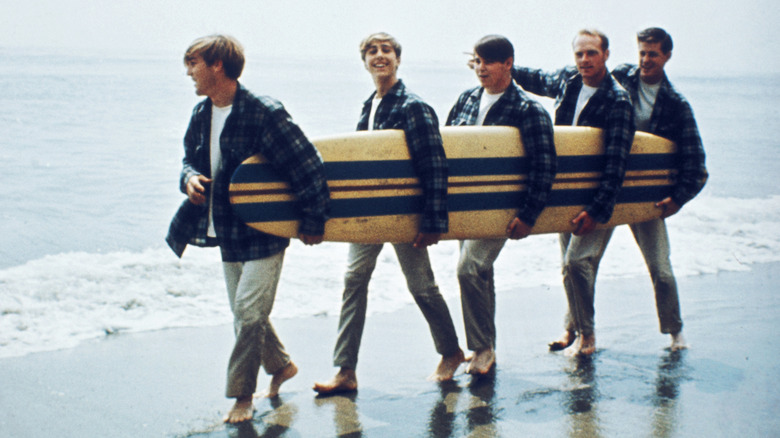
As boomers grew up, so did pop music. Coming of age in the late '50s to '80s, boomers saw unprecedented economic growth and social change. They saw rock 'n' roll, country, soul, and R&B take over the airwaves, and disco and hip hop emerged. This generation gave us Beatlemania and Woodstock, solidified Elvis and Bob Dylan as legends, and made Motown Records an institution. In addition to teaching Americans to fight for civil rights, the boomers taught us how to party, and you can hear that in the music. This generation rocked out, shook, stomped, and twisted to some serious dance songs that still get even Gen Xers out of their seats.
So named because of a boom in births after World War II (between 1946 and 1964), baby boomers were and are a massive audience for music. As of 2024, they're about one-fifth of the U.S. population, just behind Gen Z (born 1997 to 2012) and millennials (1981 to 1996). Thanks to radio and TV, the mass culture of their time bent toward, catered to, and became dominated by the youth. No doubt this is why the boomers witnessed an explosion in party-boosting pop music. There's no shortage of songs sure to transport boomers back to the sock hops, groovy parties, and disco nights of their youth.
A short list like this could never capture every banger for an entire generation — there's too much to choose from. In assembling it, we tried to include a range of musical styles and focused on songs from the late '50s to early '80s, when most boomers were in their peak party years: Their teens and 20s to early 30s. We looked for songs that sound distinctly of their time and remain special to boomers while still filling dance floors.
Isley Brothers — Shout, Pt. 1
Few made as many bangers for boomers as Motown Recordings. Unlike any before it, this Black-owned Detroit label brought the R&B and soul sound to the mainstream. White boomers fell in love with Black music, and party soundtracks changed forever. With the company's assembly line approach to hit-making, the label produced no less than 110 Billboard Top 10 hits from its founding in 1959 to 1971. With Diana Ross & The Supremes, The Temptations, Smokey Robinson, Stevie Wonder, and many more on the roster, it's hard to pick one song. However, as any wedding guest can attest, few tunes have as much dance floor pull on the boomer generation as the Isley Brothers' "Shout, Pt. 1."
"Shout, Pt. 1" may not have sold as much as other Motown singles, but it was an early hit for the label. Reaching No. 47 on the Billboard Hot 100 in 1959, it became the first Isley Brothers single to sell over 1 million copies. Unlike most Motown songs, which were written by house songwriting teams, "Shout, Pt. 1" was penned by the three Isley brothers themselves: O'Kelly Jr., Rudolph, and Ronald. Interestingly, the "shout" call and response that drives the song comes from a live performance of Jackie Wilson's "Lonely Tear Drops." "The energy level was so strong that I didn't want to end the song yet," Ronald told The Wall Street Journal. "I began to ad-lib ... and the band picked right up on it." With "Shout," the Isley Brothers took the gospel they grew up singing, dressed it in party clothes, and took over the dance floor.
Beach Boys — Surfin' USA
From its opening guitar line to the final crash out, The Beach Boys' "Surfin' USA" is a good time. Taking the surf rock style of musicians like Dick Dale mainstream, this anthem celebrates freedom, waves, and, of course, surfing. On top of the tight vocal harmonies that defined the group's sound, Mike Love's vocals paint a picture of the emerging surfing subculture of the day, and the song is a love letter to California. You can tell it was written and performed by kids that grew up on the beach. Even though only one of the Beach Boys, Dennis Wilson, was an actual surfer, the band became synonymous with surfing and the good times that come with that lifestyle.
For the Beach Boys, "Surfin' USA" was the coming-out party. Released in 1963, it was the group's first top 10 hit, peaking at No. 3 on the U.S. Billboard charts and putting the band — and California's burgeoning surf scene — on the map. There's some drama with it, though. For the guitar and vocal lines, The Beach Boys' lead songwriter, Brian Wilson, reworked Chuck Berry's 1958 hit, "Sweet Little Sixteen." Under the threat of a lawsuit, the copyright was given to Berry's publisher, and he's credited as a co-writer of the song. No hard feelings, though: As Beach Boy Carl Wilson recalled (via Far Out Magazine), "We ran into Chuck Berry in Copenhagen and he told us he loves 'Surfin' in the USA.'" Legal issues aside, what Wilson — by way of Berry's guitar work — caught with this tune makes it a nostalgic party classic.
Earth, Wind & Fire — September
By the late '70s, boomers liked to party so much that they ushered in the disco era. With roots in R&B, funk, and soul, this underground dance music exploded into the mainstream, thanks to movies like "Saturday Night Fever" and the chart success of groups like the Bee Gees and ABBA. Earth, Wind & Fire released "September" in 1978, and it's the sound of disco hitting its peak. With its horns, funky bass, four-on-the-floor beat, bright guitar, and sometimes falsetto vocals, the groove is undeniable. On a bed of tender lyrics and grooves, this Earth, Wind & Fire gem continues to transport boomers back to the clubs, pads, and FM and AM stations of their youth.
A new song added to their "Greatest Hits, Vol. 1" album, "September" was a collaboration between Earth, Wind & Fire's lead vocalist Maurice White and guitarist Al McKay and young songwriter Allee Willis. During recording, Willis didn't like that one of White's signature phrases, "ba-dee-ya," felt like filler. She begged him to change it, but he refused, something she came to appreciate. "I learned my greatest lesson ever in songwriting from him, which was never let the lyric get in the way of the groove," she told NPR. No doubt, "September" was played at a lot of parties in the late '70s: It hit No. 1 on the U.S. R&B charts and peaked at No. 8 on the Billboard Hot 100.
Stealer's Wheel — Stuck in the Middle with You
Stealers Wheel's "Stuck in the Middle with You" isn't just a catchy, upbeat folk-rock tune to play at a party — it's about being trapped at a party. "It was a boisterous evening, but I was sandwiched between two rather boring label executives and their wives," Gerry Rafferty, the song's singer and co-writer with Brian Egan, told Record Collector. Music industry characters like these became the "clowns to the left of me" and "jokers to the right" of the infectious chorus. Despite the alienation and paranoia in the lyrics ("Trying to make sense of it all / But I can see it makes no sense at all"), the song begs you to clap along and boogie to the walking bass and slide guitar.
When "Stuck In the Middle With You" was released in 1973, it was a massive commercial success, peaking at No. 6 on the U.S. singles charts. However, it was the only hit for Stealers Wheel: This one-hit wonder broke up in 1975. Still, the song gained new life and some Gen X fans in 1992, when filmmaker Quentin Tarantino used it in a scene of his debut feature film, "Reservoir Dogs." With a mellow sound that was already nostalgic in the early 70's, "Stuck In the Middle With You" gets boomers singing, clapping, and dancing.
Darryl Hall & John Oates — I Can't Go for That (No Can Do)
By the time "I Can't Go for That" became a U.S. No. 1 in January of 1982, the oldest boomers were in their mid-30s. Both Woodstock and disco were in the rearview, and the Reagan era was in full swing. Things were changing again, but Darryl Hall and John Oates were never averse to change. Recording and releasing soul-inflected pop rock since 1971, the duo entered the '80s like many boomers and boomer musicians: embracing new technologies and techniques.
The second single from 1981's "Private Eyes" album, "I Can't Go for That (No Can Do)" kicks into motion with a beat that came pre-set on a Roland drum machine. Aside from bits of guitar for emphasis, the synthesizers truly carry the song forward and make it catchy. A collaboration between Hall, Oates, and songwriter Sara Allen, lyrics like "You've got the body / Now you want my soul" make it sound like it's about a relationship. However, when speaking with The Philadelphia Inquirer, Oates said they actually address the music industry — it's "really about not being pushed around by big labels, managers, and agents and...being true to yourself creatively." Whatever the meaning, "I Can't Go for That (No Can Do)" is infectious, inventive, and as much a banger today as the day it first hit dance floors.