

The Most Controversial Songs Of 1969
While there are songs from the 1960s that aged poorly in the decades following their release, there are also those that caught the wrong kind of attention right off the bat, or at most, shortly after they were first played on the radio. And there are few better years for rock 'n' roll controversy than 1969, a year in which several musicians, amid a backdrop of heightened sociopolitical tension and greater sexual freedom, continued pushing the boundaries of what was socially acceptable. But even when they weren't pushing those boundaries or outright crossing the line, some of these artists found other ways to get people talking.
When choosing songs for this list, we put a premium on those that made a significant impact on pop culture and are well-known to most modern-day listeners. We also kept things varied by listing tracks that became controversial for distinct reasons from each other; for example, both MC5's "Kick Out the Jams" and Jefferson Airplane's "We Can Be Together" contain the word "motherf***er(s)" in the lyrics, but we only listed the former as it arguably had a greater impact on the cultural zeitgeist and is, without question, MC5's signature song. And while many of these songs were banned or censored due to their content, not all of them were; in one case, the controversy centered on an alleged case of plagiarism. Having said that, let's look at five songs that stood out as the most controversial of 1969.
Je t'aime... moi non plus (Serge Gainsbourg and Jane Birkin)
Here's a song that must have led to many awkward moments between young people and their parents whenever it played on the radio during the car ride to school. That is, if it was even allowed on the radio. You don't need to know basic French to have an idea of what "Je T'Aime ... Moi Non Plus" is about — Jane Birkin's erotic moaning and panting coupled with then-romantic partner Serge Gainsbourg's amorous, deep-voiced crooning make it obvious that the tune is about two people being intimate with each other. The song was banned in Birkin's native U.K. and several other countries, and it was so risque that even Pope Paul VI condemned it. You just know you're courting controversy when you earn the ire of the most powerful person in the Catholic Church.
Nowadays, "Je T'Aime ... Moi Non Plus" sounds almost wholesome (emphasis on almost) compared to other, more modern songs that ruffled feathers for similar reasons soon after their release. But by 1969 standards, the song was both absolutely shocking and on-brand for Gainsbourg, who had multiple other compositions that were seemingly designed to hit a nerve with polite society. And while moral guardians were far more concerned by the overt sexuality of "Je T'Aime...," it's fair to say that they largely missed the point.
Apart from the title literally meaning "I love you ... me neither" in English, Gainsbourg himself called it an "anti-f*** song" (via The Rake), a warning of sorts that physical intimacy and love are not to be confused with each other.
Kick Out the Jams (MC5)
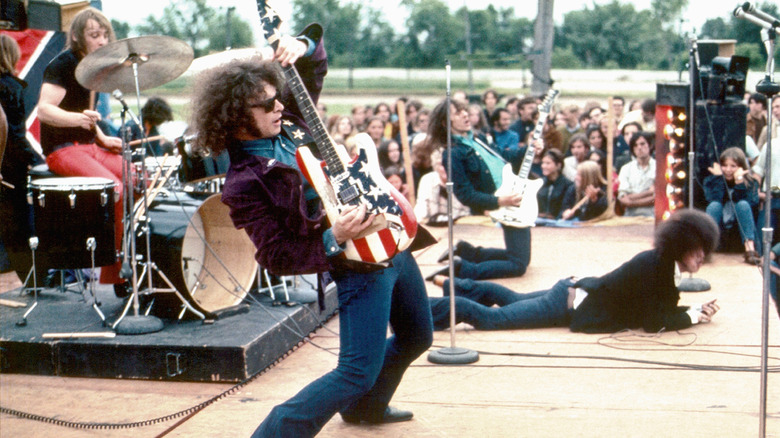
It seems almost ubiquitous these days — that 12-letter (or 13-letter in plural form) mother of all profanities that makes its way into many a song, especially in the rock and rap genres. But back in 1969, when Detroit proto-punkers MC5 opened the title track of its debut album, "Kick Out the Jams," with frontman Rob Tyner yelling out the word "motherf***ers" after the song's title, it was definitely a cause for concern. As a result, copies of the album were pulled from some stores, the title track's intro got a slight tweak, and subsequent pressings had Tyner asking the audience instead to "kick out the jams, brothers and sisters." It's arguably not as impactful, and one could even say that it sounds canned and generic.
Still, it was what it was; in the late '60s, the F-word and its many variants were not a part of most everyday, informal conversations as they are today, and "Parental Advisory" stickers were still more than a decade and a half away from appearing on albums. But it's interesting to think what could have happened if those stickers were a thing in 1969. Given how teenagers tend to gravitate toward music their parents don't want them listening to, it's not outside the realm of possibility that "Kick Out the Jams" — both the song and the album — would have fared much better on the charts had "Parental Advisory" stickers already existed.
The Ballad of John and Yoko (The Beatles)
For most modern listeners, "The Ballad of John and Yoko" may sound perfectly innocuous. Aside from being the only Beatles song recorded by just John Lennon and Paul McCartney without their bandmates, the tune documents the mad rush of events that took place before and after Lennon and Yoko Ono's March 1969 wedding. It's a catchy, mid-paced song with a wry sense of humor to it, and it's been covered by well-known acts such as Hootie & the Blowfish and Teenage Fanclub. But it has one simple word in the chorus that caught the attention of censors on both sides of the Atlantic.
Due to the mere mention of the name "Christ," "The Ballad of John and Yoko" was either banned or censored by several radio stations in the U.S. and the U.K. upon its release; this was despite the fact that there was nothing mocking or insulting about how the Beatles used the name in the song. It didn't help matters either that the song debuted just a few years after Lennon's "more popular than Jesus" comment led to massive Beatles boycotts. Thankfully, that didn't stop "The Ballad of John and Yoko" from cracking the Top 10 in the U.S. in July 1969, a notable achievement for a song that didn't get as much airplay as it should have because of its supposedly blasphemous chorus.
Space Oddity (David Bowie)
Unlike most of the other songs in this list, David Bowie's "Space Oddity" got banned for a reason that didn't involve supposedly vulgar or sexually charged lyrics. As it was released just days before the Apollo 11's historic moon mission, the BBC felt it might not be appropriate to play a tune about a space mission that doesn't go according to plan.
As such, the network temporarily banned "Space Oddity," only playing it again once the Apollo 11 crew returned safely to Earth. Despite that brief absence from the BBC's playlists, the song still reached the top five on the U.K. singles charts, though it wouldn't be another four years before it found success across the pond and reached No. 15 on the Billboard Hot 100.
Decades after that short ban, it seems almost absurd to imagine BBC programmers getting panicked over the lyrics of "Space Oddity," which make no outright mention of actual tragic consequences. If anything, Bowie deserves credit for writing a song that describes how astronauts feel while on space missions, thousands of miles away from their families and loved ones. There's something about the sheer defeatism of a couplet like "Planet Earth is blue/ And there's nothing I can do," letting listeners know that being an astronaut isn't all it's cracked up to be. But while that bleakness was enough to merit a BBC ban in 1969, it's hardly likely that first-time modern listeners would be too alarmed about a song that's become such an indelible part of pop culture that an actual astronaut covered it in space.
Come Together (The Beatles)
It's one of the few Beatles songs that even non-fans are familiar with from front to back. Many artists have covered the song; you probably know Aerosmith and Soundgarden's versions the best, but even the late Robin Williams had his own cover of "Come Together." And when a local band plays it at a club, you can bet that fans will be singing along to most of the lyrics. But what makes this second Beatles entry so controversial anyway?
This time around, the controversy didn't have anything to do with potentially offensive lyrics. Instead, it was the similarities between "Come Together" and Chuck Berry's 1950s classic "You Can't Catch Me," specifically the former's first line of the first verse — "Here come old flat-top, he come" — that prompted Roulette Records head Morris Levy, whose publishing company owned the copyrights to the Berry song, to sue John Lennon for copyright infringement in 1970. On "You Can't Catch Me," Berry sings, "Here come a flat-top," which is almost the same lyric, but in that case, the rock 'n' roll pioneer was referring to a convertible; meanwhile, Lennon was singing about a man with a short military-style haircut.
It took several years before Levy's claims against Lennon were dismissed, and if you come to think of it, those claims seem largely frivolous. Aside from the context of the "flat-top" lines in both songs being different, the similarities in melody are slight at best, and even if "Come Together" was directly inspired by "You Can't Catch Me," the Beatles clearly made the song their own. At the end of the day, "Come Together" is a shining example of how a few similarities with another tune can't keep a good song down.