

The 5 Best Rock Songs For Boomers And Their Kids To Bond Over
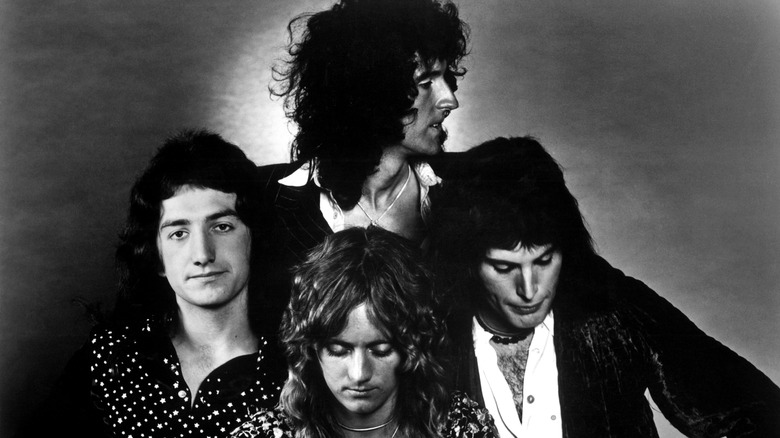
Be honest. Did you really share your parents' music tastes while growing up? The childhoods of most boomers were played out against a backdrop of beloved golden oldies like Glenn Miller or Bing Crosby, soothing sounds that were blown away by the rise of rock, especially in the 1970s. While buttoned-up moms and pops were baffled by the slew of bizarre-looking, often half-dressed, and above all noisy bands, their children recognized the freedom they represented — and could not get enough.
Alongside shattering the constraints of the three-minute pop song, the likes of "Bohemian Rhapsody" and "Stairway to Heaven" told stories, taking fans on weird, elliptical journeys. "Cherry Bomb" proved that women could deliver the rock goods too, while boomers gorged on hook-laden intros and soaring guitar riffs that lasted for days. Best of all, when their children came to them, unlike their own parents, these now-classic songs provided a way for boomers and their kids to bond — in some cases providing solid ground for communication when everything else was off the table.
Queen — Bohemian Rhapsody
Ever since its release in October 1975 as a track from "A Night at the Opera," countless people have taken a swing at exploring the meaning behind Queen's "Bohemian Rhapsody." The iconic opening questions "Is this the real life?/ Is this just fantasy?" are as well known as Shakespeare's "To be or not to be." Their answers are just as complex, and anyone — no matter the generation — struggling to find their place in the world can relate.
The nearly six-minute song doesn't stay quiet for long. The barber shop-style harmonies and Freddie's poignant "Mama, just killed a man," give way to a thundering operatic section, before kicking into a rock blizzard that eventually dwindles to a solo piano, and that crashing gong that leaves us emotionally spent. "Bo Rhap" topped the U.K. charts for nine weeks in 1975, and earned a creditable ninth place on the Billboard Hot 100.
The truth is, we'll probably never really know what it's all about. Although magnificent in its entirety, "Bo Rhap" is a piecemeal confection, ideas cobbled together by Freddie Mercury in the late '60s and driven by his vision, according to Brian May. Boomers who loved the rock section can thrash alongside their kids, while the lyrics are a springboard to deeper conversations. Mercury told people to listen and figure out what it meant for themselves. Perhaps that's why the song speaks to multiple generations — it's as fluid as they need it to be.
Ram Jam — Black Betty
Say what you like about this 1977 rock hit – and there are lots of opinions out there — "Black Betty" went hard then and slaps just as much today. Boomers hooked by Bill Bartlett's visceral riffs spent years air-guitaring along to it in their cars or kitchens, while their kids, if they weren't immediately hit by the electricity, felt the pull of "Black Betty" as they got older.
Ram Jam's version of "Black Betty" wasn't the first nor the last. Jailbird James "Iron Head" Baker and Lead Belly recorded it in the 1930s, while '60s stars Manfred Mann put its spin on it with "Big Betty." But it was Bartlett who took the song by the scruff of the neck, writing two new verses and adding that cool riff for his band Starstruck. But it wasn't quite the hit boomers and their kids loved.
Ram Jam was formed around Bartlett by New York producers Jeffrey Katz and Jerry Kasenetz, who heard Starstruck's "Black Betty" and figured they could do better. By cutting the nearly five-minute song in half and shuffling bits of it around, they manufactured the iconic hit. Bartlett also claimed his song was about tragic '50s pin-up Bettie Page, often cited as inspiration for the original. He also insisted that as long as people felt it, he didn't care what they thought it was about.
David Bowie — Heroes
Recorded in Berlin and released in 1977, "Heroes" has become the go-to anthem for every generation facing political, economic, or social adversity. Bowie's simple, repeated chorus aims to be a self-fulfilling prophecy, even if it's an ephemeral one: "We can be heroes/ Just for one day." Boomers who lived through the struggle for civil rights and anti-war protests in the United States, as well as problems further afield, from the Troubles in Ireland to the Berlin Wall, embraced the call to action.
Bowie sang "Heroes" at the Berlin Wall just two years before it was torn down, proving that it could be more than just words. The song's powerful message has been handed down to the next generation of activists, some of whom are in the same fights as their parents, while other communities face new and equally challenging struggles. Not bad for a record seen as a chart flop, particularly in the U.S., where it didn't make a dent in the Billboard Hot 100.
The irony is that "Heroes" has nothing to do with people standing up to power or showing solidarity to our fellow man. The layered music was built by Carlos Alomar, Dennis Davis, and George Murray, alongside Robert Fripp's now-legendary guitar. But those lyrics, wrung from Bowie like a plea or a promise? They're a love song, inspired after he saw a stolen kiss between his then-married producer Tony Visconti and "a German girl that he'd met whilst we were in Berlin," the singer told Performing Songwriter.
The Runaways — Cherry Bomb
While pop-loving boomers could bop along to good — but heavily produced — girl combos like Martha and the Vandellas, The Supremes, or The Shangri-Las, there was little grit or authenticity to be had. All that changed after the five-piece all-female rock band The Runaways released its self-titled debut album in 1976. The debut single, "Cherry Bomb," struck terror into the hearts of anyone over the age of 30 (this was the '70s), but it was literal music to female boomers' ears, providing a soundtrack to the era of Women's Liberation.
The song's in-your-face lyrics showed women could be just as down and dirty as the guys: "Down the streets I'm the girl next door/ I'm the fox you've been waiting for." "Cherry Bomb" also proved they were in charge of their own sexual destiny: "I'll give you something to live for/ Have you and grab you until you're sore." Parents across the United States were horrified by well, everything about The Runaways, but the band was a smash in places like Japan. Although they didn't last long, going their separate ways in 1979, The Runaways have gained fresh audiences among boomers' kids, finding a common bond with their moms who, it turns out, were just as badass as them.
Stairway to Heaven - Led Zeppelin
No list of rock songs could be complete without taking in Led Zeppelin, which towers above so-called "hair bands" in the same way that Tolkien looms over literature's dark fantasy genre. Boomers have been spoiled by the legendary band's back catalogue, which makes epic an insufficient descriptor, but there is only one song that we absolutely have to focus on: "Stairway to Heaven."
For boomers who first heard it in the 1970s, it didn't just offer an evocative musical ride; it also served up an iconic, must-learn guitar solo, one that changed rock music forever. Fast forward a few decades and, as with all stories passed on to new generations, the kids listening to "Stairway" didn't just find a connection to their parents' past, they were inspired to forge new musical futures, too.
Many have analyzed, pondered, and celebrated this behemoth of a song, which weaves its medieval-rock spell over eight unforgettable minutes. In 2014, guitarist Jimmy Page explained to the BBC how creating "Stairway" was, much like Queen's "Bohemian Rhapsody," a group effort, with "everyone chipping in." Famously never released as a single in the United States (as was always the plan, according to Page), that didn't stop it from becoming a monster hit, not to mention LZ's signature tune.