

Hidden Gem Songs That Appeared On Mediocre '70s Albums
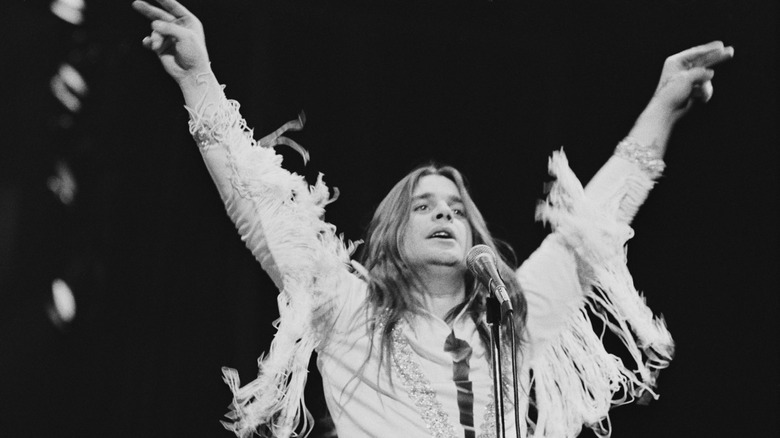
Throughout the history of rock music, it's become a sad truism that even the most brilliant of artists can make an awful album. Truly, the likes of such beloved stars as Bob Dylan, The Who, The Rolling Stones, and David Bowie have all unleashed stinkers. With that said, it's fair to say that, in toto, their overall track records still hold up pretty well.
The reasons why great acts produce lousy albums can run the gamut. Perhaps an artist has bupkis when a contractual obligation requires a release by a certain date. That can (and occasionally does) result in said artist tossing together a bunch of studio outtakes from previous sessions that were deemed not good enough to make it onto earlier albums. In other cases, the cause was simple creative burnout or any other issue that would prevent a musician's muse from paying a visit (think sex, drugs, and/or rock 'n' roll).
Occasionally, though, these subpar albums conceal a secret treasure swimming in the midst of all that sonic swill. For those who dare to plunge in, they may just be rewarded with a lone song that's actually worth listening to. They do exist — if you know where to find them, and there are indeed some terrible albums that have only one great song. With that in mind, keep reading for a look at five hidden gem songs that appeared on mediocre '70s albums.
The Kinks — Everybody's a Star (Starmaker) from Soap Opera
The Kinks had plenty of high points over a career spanning multiple decades, but the band's 1975 album "Soap Opera" is not among them. The ambitious concept album, the brainchild of frontman Ray Davies, tells the story of a rock star, Starmaker. He swaps lives with Norman, a typical everyman, to experience real life so he'll have something to write about in his songs. Interestingly, the tracks on "Soap Opera" were originally written for a little-remembered TV play called "Starmaker," written by Davies (who also stars) and produced by British broadcaster Granada TV in 1974.
It's fair to say the songs, in isolation without the dialogue and plot, don't hold together, falling flat when reduced to a collection of tracks on an album without the context of musical theater. The glaring exception, however, is the album's opening track, "Everybody's a Star (Starmaker)," which introduces Davies' Starmaker character in the teleplay. Gifted with a distortion-fueled glam-rock riff from guitarist Dave Davies — and just the right amount of cowbell — the song kicks off with an explosive, T-Rex-style bang.
Is it the best thing The Kinks have ever done? Hardly. Does it kind of fall apart midway through when saxophone, female backing vocals, and other sonic elements clutter up what began as a pretty solid rocker? You bet. Then again, a smoking guitar solo right near the end nearly makes up for all that wretched excess, so let's call it even.
John Lennon — New York City from Some Time in New York City
After leaving The Beatles, John Lennon began his solo career with the one-two punch of his raw and potent album "John Lennon: Plastic Ono Band" and the follow-up masterpiece that is "Imagine." His next release, however, "Some Time in New York City," tested the patience of even the most diehard fan. A double album in which Lennon and wife Yoko Ono share vocals, the first disc featured new studio tracks, while the second contained a collection of live performances. Some of the latter featured a supergroup comprised of Keith Moon, George Harrison, and Billy Preston, while others featured Frank Zappa and The Mothers of Invention, and still others found the Lennons backed by a band called Elephant's Memory (which, ironically, nobody remembers).
With wife Ono serving as his full collaborator on this one, the thrust was far more political than musical. Among the subject matter was freeing imprisoned activist John Sinclair, conditions within Attica State Prison, and, most notoriously, the Ono-sung soul ballad "Woman is the N***** of the World." The sole standout from all this detritus is "New York City," a Chuck Berry-style rocker that is essentially a sequel to Lennon's Beatles classic "The Ballad of John and Yoko." Lyrically, he offers listeners a journalistic rundown of what he'd been up to since moving to Manhattan. The compelling story-song demonstrated Lennon could rock out with the best of them when the opportunity arose.
Black Sabbath — Never Say Die! from Never Say Die!
"Never Say Die!" was the final Black Sabbath album to feature frontman Ozzy Osbourne before his infamous departure from the trailblazing metal band he co-founded (here's the real reason why he left). The album is not great. Production-wise, the sound is reverb-heavy musical sludge, while the hodgepodge song selection indicates Sabbath was unmoored during this period. This is evidenced by unfortunate explorations into jazz fusion, plus the unnecessary inclusion of a brass section, undistorted guitars (the horror!), and cheesy synthesizer.
The exception is the title track, a straightforward rocker built upon a simple, grimy three-chord Tony Iommi guitar riff that explodes with energy. The vocals on "Never Say Die!" feature Osbourne at his Ozzy-est, with his trademark double-tracked vocals bolstering the chorus. Meanwhile, the rhythm section of Geezer Butler on bass and Bill Ward on drums locks into place as a powerfully heavy unit to propel the song like a freight train.
Given the fraught circumstances in recording the album, the fact that even one decent song emerged is miraculous. Ozzy was MIA most days, forcing Iommi to enlist former Savoy Brown singer Dave Walker to help write material — only for Osbourne, on those rare occasions when he could remember to make it to the studio, to refuse to sing anything Walker had written. "The situation was a mess," Iommi told Loudwire of the album. "I think there was some good stuff there, but it's hard to keep your footing when you feel like things are falling apart," he later added.
Credence Clearwater Revival — Sweet Hitch-Hiker from Mardi Gras
Part of the untold truth of Credence Clearwater Revival is that the band split up shortly after releasing the "Mardi Gras" album in 1972. In hindsight, the record can now be seen as a musical time capsule of the band coming apart at the seams amid a clash of egos. Guitarist Tom Fogerty had already left, leaving his brother (and chief songwriter) John Fogerty to hold down the fort with bassist Stu Cook and drummer Doug Clifford as a three-piece. The latter Fogerty, who'd been responsible for singing and writing the band's string of hits, only contributed three songs to the album — the rest were either covers or songs that Cook and Clifford had written.
Neither demonstrated any talent for songwriting, resulting in a lame album of third-rate material that barely sounded like Credence. One bright spot is Fogerty's "Sweet Hitch-Hiker," a swampy rocker that was unmistakably CCR — even if it does sound identical to most of the band's other hits. Speaking with The Guardian more than 50 years after the album's release, Fogerty explained the others had grown jealous of all the attention heaped on him, so he challenged them to write their own songs for "Mardi Gras" — never expecting they'd actually do it. "It was something I had been putting off, or pushing back against, because I thought they were incapable and it would mean career suicide," he said of the album that utterly fulfilled that prediction.
Bob Dylan — Quinn the Eskimo (The Mighty Quinn) from Self Portrait
Examining the untold truth of Bob Dylan, it's clear he was once untouchable — the king of folk music — before his hard left turn into rock made him a legend. However, everything all came to a screeching halt with the release of his 1970 double album, "Self Portrait." Critics were universally appalled, although Rolling Stone's Greil Marcus summed it up best with his pithy four-word review: "What is this s***?"
Featuring a few Dylan originals (including the bizarre-yet-intriguing "Wigwam" and a half-baked instrumental jam called "Woogie Boogie"), most of the songs are covers. The curious selection includes the likes of Gordon Lightfoot's "Early Morning Rain," Paul Simon's "The Boxer," and even the old standard ballad "Blue Moon." The sole flash of electricity comes with "Quinn the Eskimo (The Mighty Quinn)," a shambolic, jangly rocker with nonsensical lyrics that may or may not have been inspired by seeing Anthony Quinn portray an Eskimo in a movie.
The song has considerably more energy than anything else in the collection — because it's actually a live recording of Dylan backed by The Band at the 1969 Isle of Wight Festival, boasting a killer Robbie Robertson guitar solo. By the time the album came out, though, "Quinn" was hardly new. British singer Manfred Mann, having heard a version recorded in what would come to be known as the "Basement Tapes," had recorded his own hit version of "The Mighty Quinn" two years earlier.