

5 Songs From 1973 That Define Rock History
In 1973, rock music was in a period of both flux and dominance. The Beatles had broken up at the beginning of the decade, and the upstart bands of the '60s were growing up and getting bigger. In May, Led Zeppelin broke concert attendance records playing to 56,800 fans in Tampa, Florida, and while legendary albums like Pink Floyd's "Dark Side of the Moon" hit No. 1 on the U.S. Billboard chart, Deep Purple's "Smoke on the Water," and Jim Croce's "Bad, Bad Leroy Brown" were radio fixtures.
On and off the charts, 1973 saw rock music expand into new territory and explore new sounds. With "Search and Destroy," Iggy and the Stooges paved a scorching road for the coming punk movement, and Suzi Quatro carved out a space for aggressive, female-led rock with "Can The Can." Taking glam rock to the gutter, the New York Dolls' "Personality Crisis" seeded the ground for the glam metal that would sprout in the '80s. At the same time, with "Sabbath Bloody Sabbath," Black Sabbath found a new direction for heavy metal. And in Germany, the mechanical jamming of Can's "Moonshake" forged a new path for electronic-influenced musicians and rockers.
It's impossible to capture what 1973 did for music in five songs. We tried to include songs that reflect the diversity of rock at the time and left an indelible mark. Whether or not they made a splash in their own era, we sought tracks that influenced the popular music that followed. In our view, these five songs from 1973 transcend their time and help define rock history.
Iggy and the Stooges – Search and Destroy
"Search and Destroy" off the "Raw Power" album was a rebirth for Iggy and the Stooges. Having been dropped by their label after 1970's "Fun House" failed to catch on, the band dissolved. But when David Bowie invited singer Iggy Pop to record in London in 1972, he reformed The Stooges with former bandmates James Williamson and the Asheton brothers, Ron and Scott. "Raw Power" barely grazed the charts, peaking at No. 183 on the Billboard 200, and by early 1974, the band broke up for a second time. Still, few albums are as influential as this one, and few songs are as fierce as "Search and Destroy."
While it's common to think of The Ramones or Sex Pistols as the "inventors" of punk, the sound they were going for — gritty, distorted, and driving — had already been perfected by The Stooges. "Search and Destroy," which Iggy co-wrote with Williamson, was inspired by news coverage of the still-smoldering Vietnam War. Evoking the nihilism that would define punk music, the lyrics bristle with alienation and rage. "And I'm the world's forgotten boy" Pop moans in the chorus, "The one who's searchin', searchin' to destroy."
Fueled by excess, drug misuse, and ferocious live shows, Iggy became a legendary if chaotic figure in the '70s, which is why he had developed a spotty reputation in the music industry. It's hard to find a punk, hard rock, or alternative rock musician who isn't inspired by Iggy and The Stooges. "Raw Power" showed Sex Pistols' guitarist Steve Jones how to play guitar and was Nirvana front man Kurt Cobain's favorite album, while the words "Search and Destroy" are tattooed across Black Flag singer Henry Rollins' back.
Suzi Quatro – Can the Can
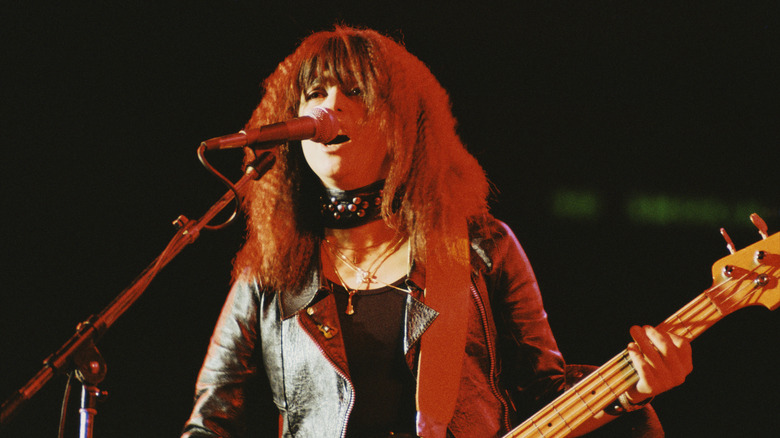
Suzi Quatro paved the way for countless female-fronted bands. A bassist, singer, and songwriter, she first found success after leaving a Detroit-based all-female garage group, The Pleasure Seekers, to pursue a solo career in England. With its wailing vocals and crunchy guitar work, "Can the Can" — off her debut album — is an aggressive, glam rock anthem of monogamy. As Quatro told The Independent, "Can the Can means 'can it'. Put your man away somewhere safe for future use." Centering a female perspective, it's the song's infectious swagger that makes it timeless.
Despite being an accomplished songwriter, Quatro didn't pen her first hit. It was written for her by songwriters Nicky Chinn and Mike Chapman, known for their work with glam rock band The Sweet. But on the back of "Can the Can," Quatro carved out a space for herself in the male-dominated music industry. Though the single took longer to hit in the U.S., reaching No. 56 on the Billboard Hot 100 in 1976, it topped the charts in the U.K., Australia, and Germany.
More importantly, with "Can the Can," Suzi Quatro blazed a trail for countless female artists and female-fronted bands. As she told Uncut Magazine (via Yahoo News), "... by doing what I did, I gave permission to women all over the world to be different." Among the many inspired to be different by this rock star are The Runaways' Joan Jett, Blondie's Debbie Harry, and Talking Heads bassist Tina Weymouth.
Black Sabbath – Sabbath Bloody Sabbath
It's hard to overstate the shadow that Black Sabbath continues to cast over metal music and hard rock. When they adopted their name in 1969, the quartet's heavy, pounding music and occult-themed imagery were ahead of their time. But the world soon caught up, and by 1973, the band had four successful albums under their belt, toured constantly, and were an institution. With "Sabbath Bloody Sabbath," off the album of the same name, they took their bombastic sound further.
On the heels of a world tour promoting "Vol. 4," the band had been struggling to write and record the follow-up, even moving from LA to a haunted castle in the English countryside for inspiration. With the opening guitar riff of "Sabbath Bloody Sabbath," guitarist and bandleader Tony Iommi finally burst through a bad case of writer's block. Hearing it for the first time, bassist Geezer Butler recalled, "it was almost like seeing your first child being born. It was the end of our musical drought, the beginning of our new direction" (via Louder).
"Sabbath Bloody Sabbath" has heavy moments, but it's far from the heaviest Black Sabbath song. What gives it staying power is its inventiveness. In the vein of emerging prog rock bands like Yes, the song features musically complicated, jazzy breaks (Yes' keyboardist, Rick Wakeman, played on another song on the album, "Sabbra Cadabra"). What emerged laid the groundwork for the death, doom, stoner, and sludge sub-genres of metal music. Bands like Cannibal Corpse, St. Vitus, and Sleep are among the countless shaped by "Sabbath Bloody Sabbath."
New York Dolls – Personality Crisis
The New York Dolls combined the drive of bands like the MC5 and The Stooges with the androgynous, glam look of David Bowie or T. Rex's Marc Bolan. Often performing in spandex and high heels, the band — behind flamboyant front man and singer David Johansen — delivered high-energy live shows, dripping with sweat, attitude, and downtown New York decadence. Off a self-titled debut album that featured the quintet in heavy make-up and drag on the cover, "Personality Crisis," penned by Johansen and guitarist Johnny Thunders, is three and a half minutes of unvarnished and dangerous rock 'n' roll.
"Personality Crisis" depicts the psychic anguish of losing one's sense of self and identity. "Well, it sure got to be a shame when you start to scream and shout," Johansen belts out, "you got to contradict all those times you butterflyin' about." Though it features classic rock 'n' roll flourishes, including Jerry Lee Lewis-like piano lines, "Personality Crisis" sounds ahead of its time. Snotty and loud instead of pretty, it's a song that grabs you by the collar and shakes you.
Likely due to the band's shocking look, the "New York Dolls" album didn't perform well commercially, peaking at No. 116 on the U.S. charts. But you can draw direct lines from "Personality Crisis" to the Ramones, Sex Pistols, and punk rock of the late '70s. On top of that, the band's iconic look and attitude inspired hair and glam metal bands in the '80s, including Hanoi Rocks and Guns N' Roses. Any artist that provokes and pushes boundaries — while wearing glitter make-up — is at least somewhat indebted to the New York Dolls.
Can – Moonshake
The '70s saw rock get more experimental and ambitious, with bands like Pink Floyd, Rush, and King Crimson leading the charge. Formed in 1968 by avant-garde and jazz musicians in Cologne, Germany, Can sought to break down the rules of rock and pop music. Considered an essential "krautrock" band along with Neu! and Faust, it ditched traditional song structures and opted for often-extended, repetitive, and atmospheric jams. "Moonshake," and the "Future Days" album it appeared on, represent Can at a creative peak.
Clocking in at just over three minutes, "Moonshake" is the shortest song on an album that has only three other tracks, which range from about nine to 20 minutes in length. Over a driving, mechanical beat, funky bass line, and effected guitar flourishes, Damo Suzuki's vocals, oscillating between being piercing and wispy, give it a hypnotic quality. Over 50 years later, "Moonshake" still sounds like it comes from the future and sets the table for electronic music. The song sounds even cooler today than it did then.
"Moonshake" didn't find broad commercial success, but that was never a goal of Can's. The band rarely charted, with only 1971's "Spoon" reaching the top spot in Germany and 1976's "I Want More" hitting the U.K. Top 40. But the list of those inspired by this experimental rock group is long and crosses genres. Everyone from the Talking Heads and ambient musician and producer Brian Eno to hip-hop band Tribe Called Quest has found something in their music. Redefining what rock was and how it was supposed to work, Can created a sonic blueprint that artists follow to this day.