

Actually, Toto's Africa Isn't A Rock Classic
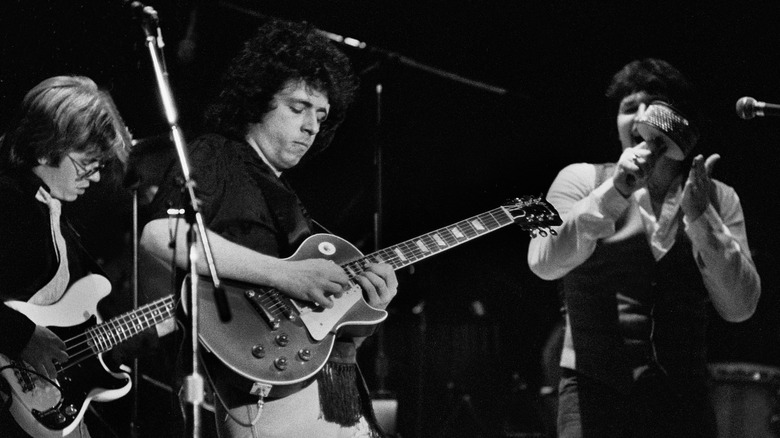
Toto spent exactly one week at the top of the pop chart, and it did so in February 1983 with "Africa." Despite ascending to the peak of the Billboard Hot 100, "Africa" became regarded not as a disposable pop hit but a rock classic. Toto, a band made up entirely of esteemed and respected session musicians who had played on thousands of classic recordings, is itself remembered as a great and versatile band. But despite harder rocking and way more fun songs like "Rosanna" and "Hold the Line" that still get some classic rock radio airplay today, Toto seems to be known to the general public almost entirely as the band that recorded "Africa." That song has been certified for sales of 10 million units by the RIAA, making it one of the most popular singles of all time.
With stats like that, it's almost universally agreed upon, or it's nearly a statement of fact, that "Africa" is a classic rock song. It isn't. It's simply been catapulted by marketing, nostalgia, and sheer persistence to make its way into the collective mind, where it burrowed in and spread like an audio parasite. Here's why you might be wrong about "Africa" by Toto — it's not a rock classic, but rather a middling song that doesn't deserve its continued success.
The words of Africa are silly, not mind-blowing
The lyrics of Toto's "Africa" read like a poem written by a middle school student who has never written a poem, and has seen maybe one National Geographic documentary about supposed life in Africa. The words may initially sound deep and cool, but even a cursory examination reveals that they're inane and nonsensical.
First and foremost, cliches are proudly presented as if they're profound. For example, the narrator in "Africa" encounters an "old man," from whom he of course seeks the wisdom this aged one must certainly possess, but who instead utters the eye-rollingly cryptic and leading statement, "Hurry, boy, it's waitin' there for you."
Not-quite-evocative nature imagery abounds in "Africa," all of it random fragments that don't connect to one another or even an overarching narrative. These make for some of the corniest lyrics in all of "Africa." Along with "moonlit wings" and wild dogs that "cry out in the night" (because they paradoxically wish for "solitary company"), singer David Paich compares a correct choice to be "as sure as Kilimanjaro rises like Olympus above the Serengeti," in what is perhaps the most ham-fisted and definitely the most hilariously syllabically overcrowded line in rock history.
Toto's Africa is exceedingly dull

The music of "Africa" bolsters an inaccurate view of Africa. It's described in the song as mystical and treacherous, where one might hear generic tribal musical styles, which "Africa" vaguely and embarrassingly approximates with wind instruments and hand-slapped drums. But that's not even the worst thing about "Africa."
It's confusing and just plain wrong that a song as slight and ephemeral as this one — it's got two verses and a short chorus played almost endlessly — is heralded along with classic rock songs we'll be blasting on repeat forever, like Lynyrd Skynyrd's transcendent guitar odyssey "Free Bird" or Queen's epic "Bohemian Rhapsody." There's nothing fun or exciting in "Africa" — merely one bland synth riff on repeat, vocals that alternate between whisper and whine, and a dull instrumental break. It's just lazy work from Toto, which was otherwise on point until it broke up.
And that is precisely why "Africa" never died. Its viral resurgence in the 2010s and 2020s wasn't because of a newfound appreciation. Audiences think they like it because it happened to exist when they were any level of "young" between the years of 1983 and today. It was never explicitly championed after its brief chart run, but rather fell into the void of inoffensive background music that serves as the anesthetizing soundtrack to mundane activities. Toto's "Africa" was instantly adopted by — and forever remained — a staple of hold music, dentistry offices, and grocery store speakers. It's the ultimate boring song — and definitely not a classic rock song.