

If Tom Petty Was Still Alive, We'd Sit Him Down To Ask These Burning Questions About His Music
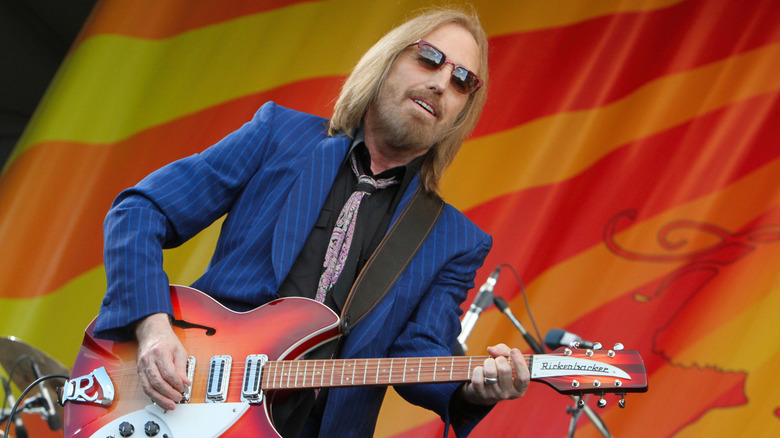
When Tom Petty died in October of 2017, we lost one of our best songwriters. He left behind an unparalleled body of work: four decades of classic rock songs that make you tap your foot while getting pleasantly stuck in your head. In the vein of Bruce Springsteen or Bob Seger, they grapple with the highs and lows of American life: the dreaming that drives us, the loss that burns us, the love that redeems us, and the resilience it takes to get through it all. Sounding even cooler today than they did when they were released, Tom Petty's songs are timeless.
In interviews, Petty has always maintained that he was an intuitive songwriter. "Songs are kind of mystical and magical, there's not a formula that brings them around," he told Billboard, "It's just something I was born with, mostly." No doubt, this is why his music sounds so natural and why you don't need a thesaurus to appreciate the brilliance of his lyrics. Tunes like "Refugee", "American Girl," and "Mary Jane's Last Dance" capture fans because they tell stories, paint pictures, and stir emotions, while leaving room for listeners to fill in the gaps. We see ourselves in his songs because he lets us in.
With Petty's death, we're left not just with a great musical legacy, but with burning questions about his songwriting and craft. We're not sure he'd answer straight: as he noted to the CBC, "It's kind of a dangerous business looking really deeply into the germ that creates songs ... I get a little superstitious about it" (via Far Out). Still, this is what we'd ask him if he were still with us.
Who Is Mary Jane In Mary Jane's Last Dance?
"Mary Jane's Last Dance," an original on Tom Petty and the Heartbreakers' "Greatest Hits" album, has been a source of debate since its release in 1993. Telling the tale of a summer fling with "Indiana girl" Mary Jane, the song's narrator is full of longing and heartbreak. "One more time to kill the pain," goes the chorus, "I feel Summer creepin' in and I'm / Tired of this town again." Even though she was never going to stay long, the narrator develops feelings and is left bitter and abandoned.
Who is Mary Jane? One possible interpretation is that she's Tom Petty's first wife, Jane Benyo. Their marriage was on the rocks in the early '90s, and they divorced three years after the song's release. However, "Mary Jane" might also be slang for cannabis, used to "kill the pain" and escape the drudgery of the town. Toward the end of his life, Petty was open about his use, telling Men's Journal, "I'm mostly just a reefer guy" (via Jane Street). Were this the case, it wouldn't be the only pot reference in his lyrics; in "You Don't Know How It Feels," Petty sings, "But let me get to the point / Let's roll another joint."
Petty never revealed who exactly Mary Jane was, or if there was any specific episode in his life that inspired him. That said, he did tamp down the cannabis theory, telling Performing Songwriter, "I don't think I was writing about pot."
Who Was Living Like A Refugee In Refugee?
Featured on Tom Petty and the Heartbreakers' 1979 album, "Damn The Torpedoes," "Refugee" crystallized the band's early-period, anthemic sound. A collaboration with his guitarist, Mike Campbell, Petty wrote the lyrics quickly. "It took minutes. Literally, just a few minutes ... The words came really fast," he told American Songwriter. Though the recording didn't go as smoothly — tensions got so high that drummer Stan Lynch was temporarily fired — still, the single peaked at No. 15 on the Billboard Hot 100.
The biggest mystery is in the refrain, "You don't have to live like a refugee." With lines like "Baby, we ain't the first / I'm sure a lot of other lovers been burned," the song depicts a relationship falling apart. Reflecting on it years later, Petty said it was about a legal dispute with his record label. "This was a reaction to the pressure of the music business," he told Far Out, "I was in this defiant mood. I wasn't so conscious of it then, but I can look back and see what was happening."
But if "Refugee" is about escaping a bad relationship, who is Petty addressing in the refrain? It might be the speaker's partner: the former lover (or label) that's been cast away. It also could be self-referential: the narrator reminding himself that he doesn't need to keep living on the run. Imagery in the second and third verses — "Somewhere, somehow, somebody / Must have kicked you around some" — might reflect Petty's tragic childhood growing up with an abusive father. However you see it, it's a timeless anthem.
Who Is The Mysterious 'He' In American Girl?
The song that closes Tom Petty and the Heartbreakers' self-titled 1976 debut album, "American Girl," is three and a half minutes of infectious power pop. Telling the story of a young woman "raised on promises" moving from her hometown to chase her dreams, the song quickly became shrouded in myth.
In Petty's native Gainesville, Florida, the legend emerged that lyrics about balconies and "Route 411" referred to a University of Florida student rumored to have taken too many hallucinogens and jumped from the Beaty Towers dorm. "It's become a huge urban myth down in Florida," he clarified in the "Conversations With Tom Petty book, "They could have just called me and found out it wasn't true" (via American Songwriter).
While Petty answered that question, there's still one thing we wonder about. In the final verse, after a reality check, the woman is standing by herself on her balcony at night, "And for one desperate moment there / He crept back in her memory." Is this person a former love interest? Someone left behind or even waiting at home? Whoever he is, his presence adds another dimension to the desperation and longing of the next lines: "God, it's so painful when something that is so close / Is still so far out of reach." As with many of Tom Petty's songs, this mystery makes "American Girls" even more compelling. It lets us fill in the blanks and derive our own hidden meaning, and with that driving backbeat and infectious guitar work, we're tapping our feet the whole time.
Was he really Haunted By The Legacy of Wildflowers?
Tom Petty's 1994 solo album "Wildflowers" sprouted from the ashes of a particularly tough period in his life. Not only was his 22-year marriage to Jane Banyo in free fall, but he parted ways with original Heartbreakers drummer, Stan Lynch. Despite the personal struggles — or perhaps fueled by them — he struck creative and commercial gold. With the help of Def-Jam Records founder and producer Rick Rubin, Petty produced a raw, anguished, wistful, and powerful piece of art. Featuring the singles "You Don't Know How It Feels" and "It's Good To Be King," it peaked at No. 8 on the Billboard 200 upon its initial release, with an expanded reissue topping the Billboard Rock Albums charts in October 2020.
Less rigid than Petty's usual producer, Jeff Lynne, Rubin unlocked something in Petty; the Warner Bros. label insisted on only including 15 of the 27 or so songs they recorded. Regardless, Petty said of "Wildflowers," "I think maybe it's my favorite. It's the album I'm most proud of," per his website. But Rubin told the Broken Record podcast that the album loomed almost too large for Petty. "He told me 'Wildflowers' scares him, because he's not really sure why it's as good as it is. So it has this, like, haunted feeling for him" (via Ultimate Classic Rock). If Petty had lived, we'd be curious to know if he still feels the same about the album, which was unique to his overall catalogue.
Whether or not Rubin had it right, "Wildflowers" never stopped Petty's creative juices from flowing. In his final interview in the LA Times — published shortly after his death on the heels of his final performance — he explained, "If I don't have a project going, I don't feel like I'm connected to anything ... I like to get out of bed and have a purpose." Through his undeniable body of work, his daily dedication to his craft lives on.