

The Strange And Tragic Story Behind The Beach Boys' Album Smile
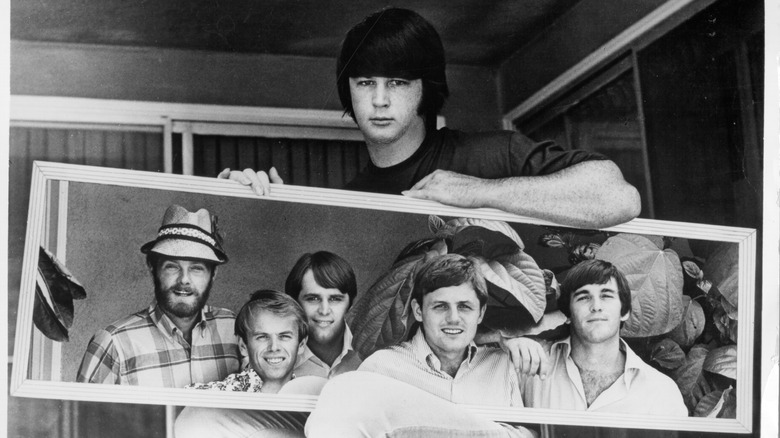
In the ever-expanding annals of rock history, there are certain albums that have gained mythic status for having never been released. Neil Young, for example, shelved his "Homegrown" album back in the mid-1970s. "It was too personal," Young told Rolling Stone of why he chose not to release the album, ultimately released in 2020. "It scared me." Others in this category include the likes of David Bowie's "The Gouster" (which morphed into "Young Americans"), and Prince's "The Black Album," which he pulled from release at the last moment, ordering his label to destroy a half-million albums that had been pressed. Of all these, however, the most fabled has become "Smile," the aborted Beach Boys album that was intended to be the follow-up to "Pet Sounds."
Over the decades, the legend of "Smile" (stylized as "SMiLE") has grown to legendary proportions, a lost masterpiece that could have changed the course of rock music. However, after months of recording, The Beach Boys' creative visionary, Brian Wilson, pulled the plug. Since then, that legend has only grown, with Wilson's abandoned concept album finally exhumed decades later.
So how did this mythical masterwork, once assigned to the junk heap of music history, become the rock equivalent of the Holy Grail? It's a wild ride, a key chapter in the messed-up reality of The Beach Boys, and all will be revealed by reading on to uncover the strange and tragic story behind The Beach Boys' album "Smile."
The unexpected success of Good Vibrations paved the way for Smile
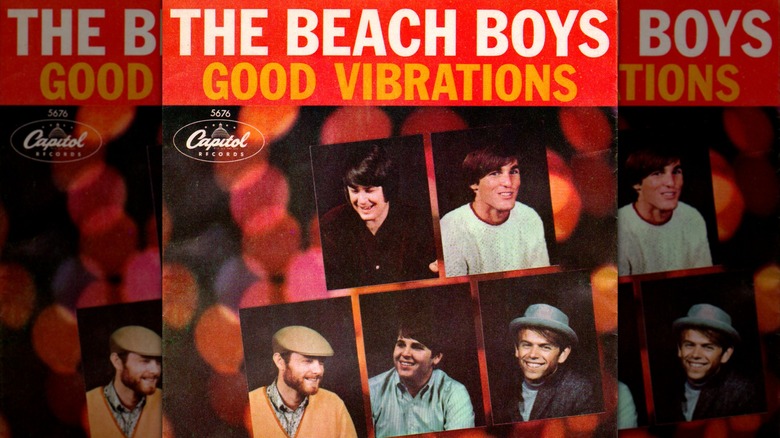
After years of churning out California-themed fun-and-sun pop hits, the 1966 release of The Beach Boys' "Pet Sounds" album was a monumental evolution for the band. By then, Brian Wilson — the band's chief songwriter and creative visionary — was no longer touring with the band, instead focusing his efforts on recording while the rest of the group performed live for fans.
Riding high on critical reception to "Pet Sounds," Wilson was working on a song — initially begun during the "Pet Sounds" sessions — which crystallized his studio experimentation with modular recording, creating various sonic snippets — using a bizarre assortment of instruments, with sessions taking place in multiple studios — that were then edited together. Wilson's unorthodox methods, however, left the rest of the band befuddled. "Instead of creating a single instrumental backing track at one session, [Brian] produced short, seemingly unrelated snatches of music and then pieced them together," singer Mike Love wrote in his memoir, "Good Vibrations: My Life as a Beach Boy." "It was like working with a vast jigsaw puzzle ..."
The band members couldn't argue with the result when that 1966 single, "Good Vibrations," became the band's first million-selling single. Wilson knew he was onto something and became determined to continue this experimentation on the band's next album.
Brian Wilson felt the pressure to produce a masterpiece
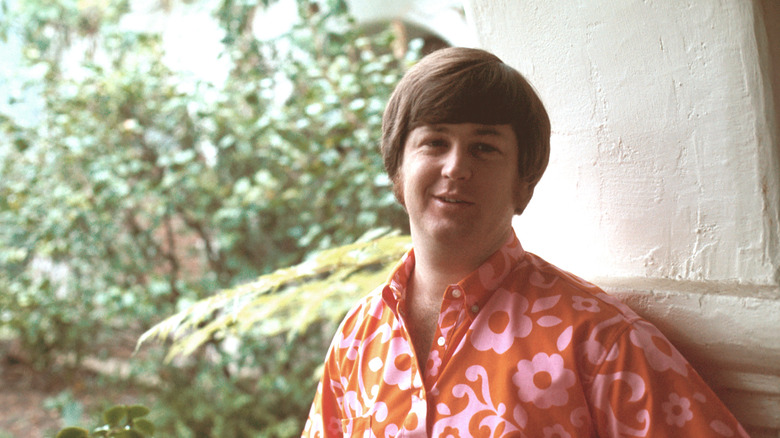
The undeniable success of "Pet Sounds" and "Good Vibrations" proved to be a double-edged sword for Brian Wilson, as any inclinations he may have had to bask in the acclaim were overwhelmed by the looming deadline to release a new album — and he felt intense pressure to produce an even greater achievement. He envisioned that album, dubbed "Smile," as an ambitious concept album that would encompass various themes while incorporating an array of musical styles.
"I'm writing a teenage symphony to God," Wilson told friends, as reported in a 1967 feature that ran in Cheetah magazine (later excerpted in Rolling Stone). "We wanted to make it sound like it all went together," Wilson told Paste in 2004. The idea, Wilson explained, was for an uninterrupted musical suite comprised of different parts. "We wanted it to sound like a continuum, because I like it when music flows," he added. "Bach's music did that."
The challenge that Wilson faced was in transferring the transcendent sounds he heard in his mind to tape. "I heard the instruments in my head as I wrote the music," he told Paste of beginning the creative process to record "Smile."
Brian Wilson enlisted Van Dyke Parks to help produce
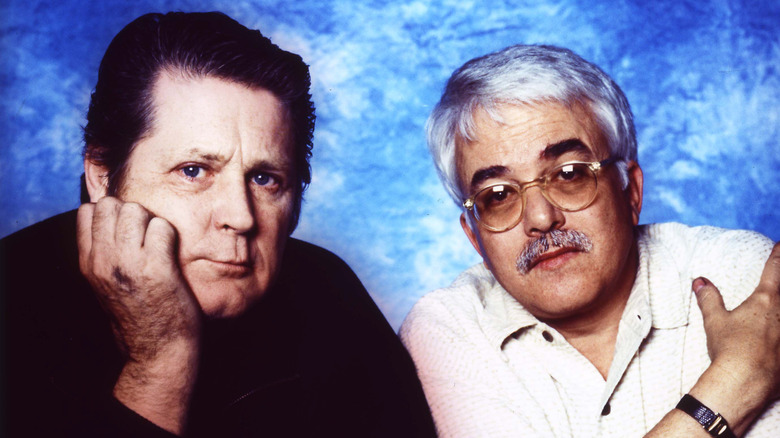
When embarking on "Smile," Brian Wilson wanted to work with a collaborator who wasn't a member of The Beach Boys. He realized he'd found a kindred spirit when he met Van Dyke Parks, whose musical experience ranged from studying with famed classical composer Aaron Copland, to a brief stint with Frank Zappa's Mothers of Invention.
They began writing together, with Parks providing lyrics for Wilson's melodies. When they began, Wilson banged out a song he'd been working on, while Parks scribbled down lyrics. Before long, they'd completed their first song, "Heroes and Villains." "And that gave ignition to the process. The engine had started," Parks told Peter Ames Carlin for his book, "Catch a Wave: The Rise, Fall & Redemption of The Beach Boys' Brian Wilson."
As they continued, more songs emerged. Their collaboration, however, didn't go over well with the other members of The Beach Boys — particularly Mike Love, who resented being shut out of the creative process, and felt the lyrics were psychedelic gobbledygook. "I once asked Van Dyke, 'What do these lyrics mean?'" Love recalled in his memoir. "He said, 'I haven't a clue, Mike.'" Ultimately, Love claimed that his complaints about the material were ignored. However, as weird as they thought the songs were, it was nowhere near as strange as the process of recording them would be.
Brian WIlson's recording process was way off the wall
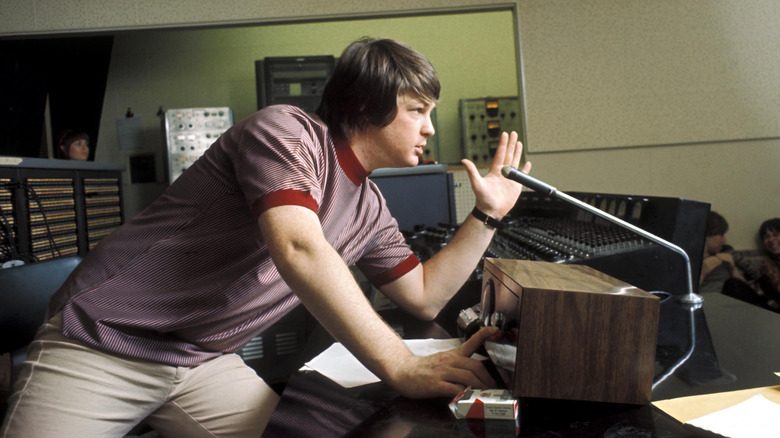
Brian Wilson's ambitions for "Smile" were grand. With the high bar he'd set with "Pet Sounds" and "Good Vibrations," he was keen to further push the boundaries of pop music by incorporating multiple musical genres for a sound that had never been heard beyond the confines of Wilson's imagination. Capturing that sound, however, took some twists and turns that can charitably be described as weird.
"Brian asked us to do some bizarre things," singer Mike Love wrote in his memoir. "In the studio, he had us lie on our backs, with a microphone above us, and make strange guttural sounds." In another infamous moment, Wilson instructed all the musicians to wear firefighters' helmets while recording a song inspired by the Great Chicago Fire of 1871, "Mrs. O'Leary's Cow." Meanwhile, Love also wrote about the time Wilson brought a full orchestra into the studio, had them do a single take, and then sent everyone home. Interviewed by Mojo (via Love's book), bassist Bruce Johnston recalled the unpleasantness of submitting to Wilson's increasingly strange demands. "Brian degraded us, made us lie down for hours and make barnyard noises, demoralized us, freaked us out," Johnston griped.
Suddenly, after several months, Wilson halted work on "Smile," leaving his fellow Beach Boys both confused and concerned. In his book, Love recalled Carl Wilson telling him, "Brian's not well."
Brian Wilson's escalating drug use and mental instability led to delays
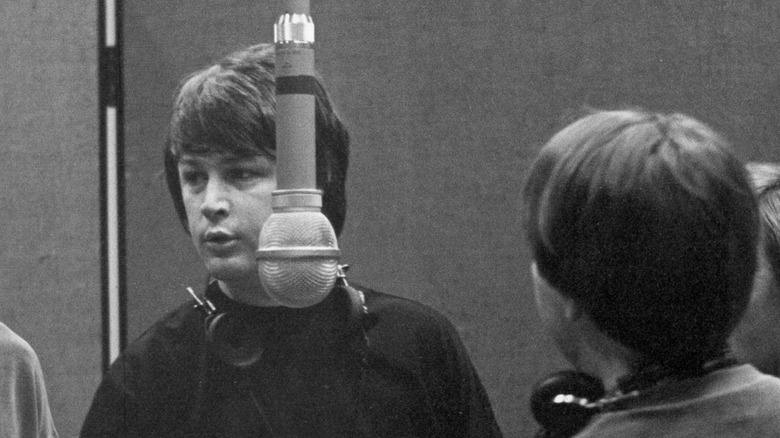
During the "Smile" sessions, Brian Wilson's experimentation with LSD and other drugs began to impact him in ways that may not have been evident to him but certainly were to others. That was certainly the case with Wilson's then-wife, Marilyn. "I think the drugs he was taking had started to confuse him," she told BBC 1 (via Mike Love's "Good Vibrations" ), admitting that she'd become concerned and fearful about his increasingly erratic behavior. "I slept with one eye open because I never knew what he was going to do," she added. "He was like a wild man."
Looking back on that chapter in The Beach Boys' tragic real-life story, Wilson himself later concurred that he'd gone over the edge due to his prodigious intake of illicit substances. "We overdid the drugs, we went too deep into the drugs," he told BBC News, confirming that his drug use was the key reason for delays in the recording process. "It took us so into the music we couldn't finish it," he recalled.
Meanwhile, combined with the drugs was the crushing stress of the album's approaching deadline and Wilson's own perfectionist nature, all of which eroded his already fragile mental health. "'Smile' was killing me," Wilson once wrote, via CNN.
Van Dyke Parks lost patience with Wilson's antics and quit the project
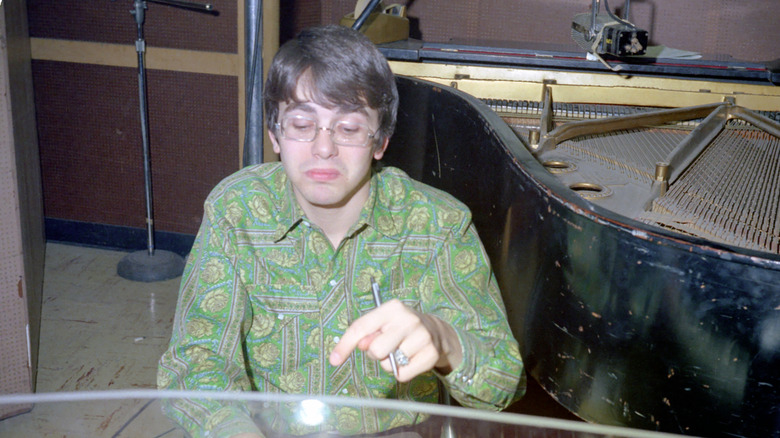
As the "Smile" sessions dragged on, what had began as a fruitful musical partnership began to wear on Van Dyke Parks, who could see Brian Wilson deteriorate in front of his eyes. "I will say, though, that I knew Brian was headed for disaster, psychological collapse. A lot of that had to do with drug experimentation," Parks told Paste. Meanwhile, the opposition the two were receiving from Mike Love was also taking its toll. "I was also intimidated by Mike Love; I was physically afraid of him ..." Parks admitted.
Ultimately, it was an angry confrontation with a belligerent Love that proved to be the proverbial straw that broke the camel's back. "That's when I lost interest," Parks said, via "Catch a Wave." "Because basically, I was taught not to be where I wasn't wanted, and I could feel I wasn't wanted."
Finally, Parks decided his only option was to walk away. Feeling he'd contributed enough to "Smile," he decided to up and quit. Decades later, his ignominious exit from "Smile" was still a sore point for him when he told The Guardian, "It's a dull issue. I hope it doesn't need any further elaboration. To have been victimized by Brian Wilson's buffoonery."
The release of The Beatles' Sgt. Pepper album left Brian Wilson demoralized
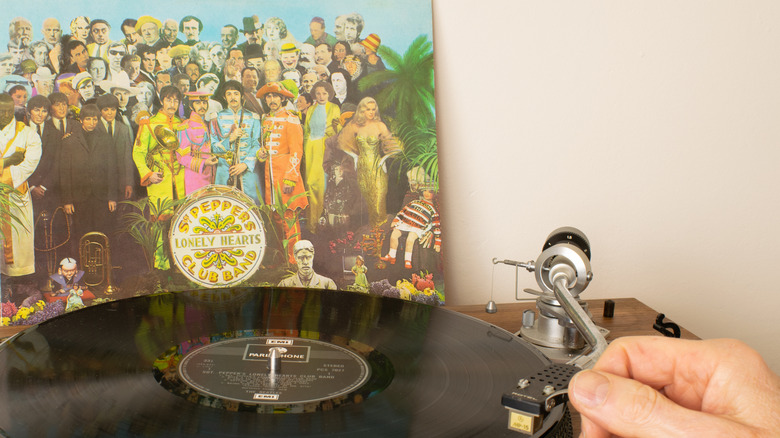
During the mid-1960s, Brian Wilson felt that he was in an intense rivalry with The Beatles, something that Paul McCartney has also acknowledged. In fact, "Pet Sounds" represented Wilson's attempt to top the brilliance of the Fab Four's sublime "Rubber Soul" album.
At the same time, The Beatles felt the pressure to try to surpass "Pet Sounds," which resulted in the 1967 release of "Sgt. Pepper's Lonely Hearts Club Band," a sonic masterpiece that became the soundtrack to the so-called summer of love. When Wilson heard "Sgt. Pepper," he was struck by its brilliance — and despondent because of it. At the same time, the "Smile" sessions had gone off the rails, Van Dyke Parks had departed, and his own psychological state was spiraling as his drug use escalated.
Ultimately, the end result could be seen in how The Beatles and Beach Boys' rivalry inspired and eventually broke Brian Wilson. As Wilson recalled in the 2004 documentary "Beautiful Dreamer," he was so stunned when he first heard "Strawberry Fields Forever" (which had been intended for "Sgt. Pepper" but was released as a single a few months earlier) that he pulled his car over to the side of the road. "I listened to it and I said, 'I've never heard anything like this in my life,'" Wilson said. What he wanted to do with "Smile," The Beatles had beat him to it.
Brian Wilson decided to shelve Smile
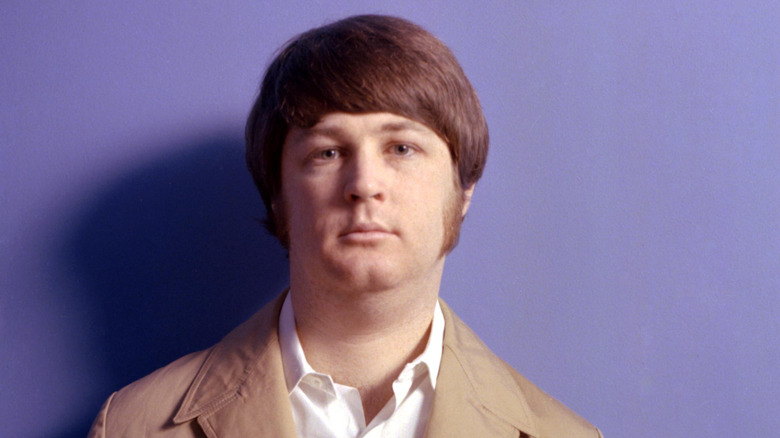
With Capitol Records' deadline looming, and very little in the way of completed tracks, Brian Wilson saw what should have been his magnum opus slipping away. "I knew I needed at least a year more to work on it, and I figured no one would give me a year to complete it, "Wilson said in "Beautiful Dreamer." Connecting his modular recordings was becoming maddening. "It was just putting together a jigsaw puzzle on a wall instead of a tabletop," Wilson wrote in his memoir, "I Am Brian Wilson." "It kept falling."
Finally, Wilson pulled the plug on "Smile." "I just got tired of it," Wilson explained, adding, "In 1967, the reasons why I didn't finish 'Smile' was Mike [Love] didn't like it, I thought it was too experimental ... I thought that people wouldn't understand where my head was at at that time." Looking back on what he'd attempted all those years earlier, in 2011, Wilson told BBC News, "We thought we were too far ahead of our time. It was too advanced, too much for people to understand ..."
Yet there was more behind his decision to abandon "Smile" than that, particularly Wilson's fear that he'd never be able to surpass what he'd already achieved. "I wanted to top 'Good Vibrations,'" he admitted in an interview with The Telegraph. "I tried to, but I couldn't. And I just felt bummed out that I couldn't continue on with that streak."
Some unfinished tracks were reworked for a new album, Smiley Smile
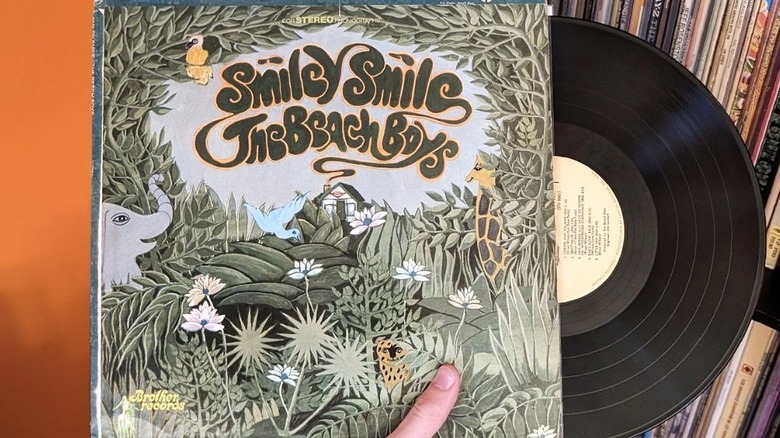
With Brian Wilson having abandoned work on "Smile," The Beach Boys were still contractually obligated to release an album. "Heroes and Villains," the sole track from the sessions to be completed, had been released as a single in the summer of 1967. It would be the focal point of the band's next album, "Smiley Smile."
Apart from "Heroes and Villains," the tracks on "Smiley Smile" were hastily recorded versions of some of the songs from the "Smile" sessions. "So in the middle of all this, Brian just said, 'I can't do this. We're going to make a homespun version of it instead. We're just going to take it easy. I'll get in the pool and sing. Or let's go in the gym and do our parts.' That was 'Smiley Smile,'" said Beach Boys guitarist Carl Wilson in 1982, via Paste. "A lot of 'Smile' songs were on 'Smiley Smile,' but they didn't sound the same at all ... I've always said 'Smiley Smile' was the bunt, and 'Smile 'was the home run."
As a follow-up to "Pet Sounds," "Smiley Smile" — a lo-fi effort recorded mainly at Wilson's home studio — was underwhelming; The Beach Boys' worst-selling album at that point, it didn't even make it into the top 40. "'Smiley Smile' bombed," Wilson wrote in "I Am Brian Wilson." "It was such a different sound for us — for anybody, really. The public wasn't ready for it."
His failure to complete Smile sent Brian Wilson on a downward spiral that lasted decades
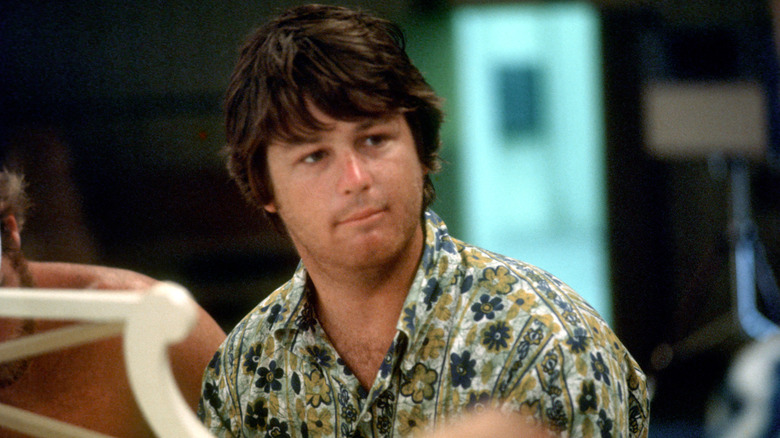
At the time, Wilson's bandmates and associates could see how much "Smile" had stripped from him, while the experience had halted his musical evolution dead in its tracks, leaving him unsure of what direction to go. "He didn't want to go back and make more surf songs," Stephen Desper, an engineer who'd worked on the sessions, told Peter Ames Carlin for "Catch a Wave." "He knew he wanted to move on, but he didn't know the direction."
Yet what people didn't understand — even Wilson himself — was that his drug use and the trauma over "Smile" were exacerbating his mental illness, something that didn't become apparent until far later. "Brian is mentally ill," Wilson's second wife, Melinda Ledbetter, told The New York Times. "He suffers from depression and he was never treated — and when somebody is mentally ill from that early on and it goes untreated, then it makes it more difficult." Wilson was subsequently diagnosed with schizoaffective disorder.
Looking back on the "Smile" debacle, in hindsight it can be viewed as the first chapter in the downfall of Brian Wilson, the beginning of the psychological deterioration that led him to controversial therapist Dr. Eugene Landy, who controlled his affairs for decades and profited from keeping Wilson mentally unstable, ultimately becoming a major player in Brian Wilson's life.
Brian Wilson rerecorded Smile in 2004, and performed the entire album live
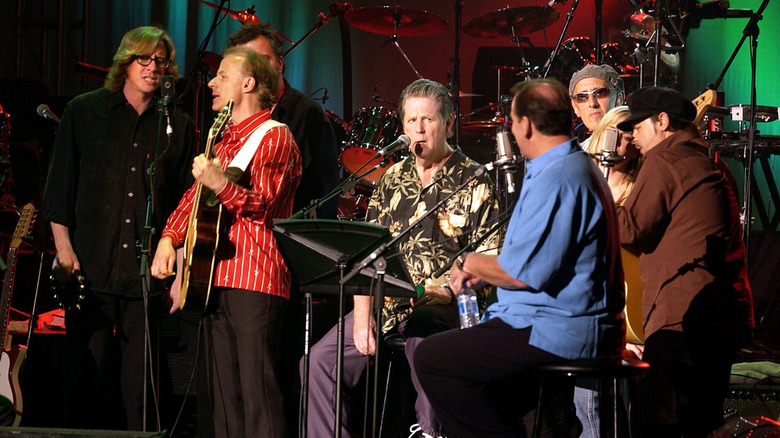
For years, Brian Wilson was reluctant to discuss "Smile." While its legend grew with each passing year, Wilson had a different perspective on his abandoned child. "When we didn't finish the album, a part of me was unfinished also, you know?" Wilson wrote in his 2016 memoir, "I Am Brian Wilson." "Can you imagine leaving your masterpiece locked up in a drawer for almost 40 years?"
In 2004, Wilson made a somewhat shocking decision: he would return to the studio to record a new version of "Smile" — with the assistance of original collaborator Van Dyke Parks — and then perform the entire thing live. By then, Wilson had long separated from The Beach Boys, and this revived "Smile" was a solo project, on which he could call the shots, without any pushback.
Wilson debuted the piece at London's Royal Albert Hall, with "Smile" receiving a 10-minute standing ovation from the rapturous audience. "Then at the end, the standing ovation was indescribable," recalled Darian Shanaja, the project's musical director, in an interview with Crutchfield. "I had never seen anything like it as an audience member or a performer.
The project was finally completed in 2011 as The Smile Sessions
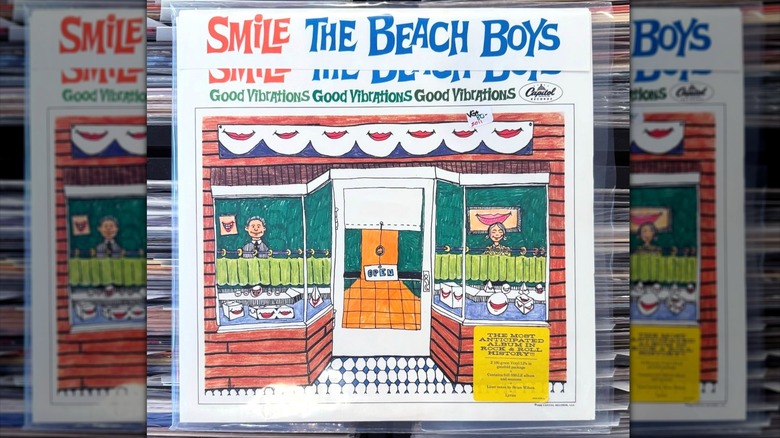
After the triumph of Brian Wilson's 2004 resurrection and performance of "Smile," he returned to his original source material. The result was a new Beach Boys box set, titled "The Smile Sessions." Finally, the album that Brian Wilson had envisioned in his mind was completed — or at least as completed as it would ever be — more than 40 years later. As a bonus, the set also includes many of the modularly recorded pieces and Wilson's original demos.
According to Wilson's longtime engineer Mark Linett, Wilson was able to piece things together thanks to the framework that he'd created when revisiting "Smile" in 2004, separating the pieces into three individual musical movements. "Without that blueprint or whatever changes he wanted to make with it, all this would have been a lot of bits and pieces," Linett told Elsewhere.
Speaking with All About Jazz, Wilson advised listeners to listen to "The Smile Sessions" in the order in which they appear on the album, as opposed to shuffling the tracks. "They should leave it as is," he said. "Because it's the adventure I want them to take, the order it is now." When Wilson died at 82 in June 2025, the long-lost "Smile" album and its eventual resurrection continued to loom large in the legend of his life.