

5 Smash Hit Rock Songs That Just Couldn't Land The No. 1 Spot
How do we measure success in the music industry? Is a song successful only if millions of people love it? What about if a small, dedicated fanbase loves it? What if an artist is satisfied with a song and doesn't care about quantity of listens? What about sales? How high is high enough? And do sales 100% coincide with chart placement? And does either public reception in the moment, sales, or chart placement equate with value over time? These kinds of questions ought to illustrate that there's no guarantee that a hit song will reach No. 1 on the Billboard Hot 100.
Some colossal bands have never had No. 1 songs, like Led Zeppelin. In fact, only one song of theirs, "Whole Lotta Love," even breached the Top 10. A band like Creedence Clearwater Revival, meanwhile, reached No. 2 five times in two years, but never hit No. 1. Other bands have No. 1 songs, but it might not be the ones you think or the ones that are remembered over time, like Fleetwood Mac ("Dreams" was their No. 1, not "Go Your Own Way"). That's because if a song caught the zeitgeist, there's no guarantee that it'll continue doing so moving into the future.
In some cases, a song was such a hit — or at least left such a musical and cultural footprint — that you'd assume it reached No. 1, but didn't. Such is the case with "Smells Like Teen Spirit" by Nirvana, a song that razed the ground of rock and forged it anew. Same goes for Journey's perennial hit to end all hits, "Don't Stop Believin'," as well as songs by Bruce Springsteen, Boston, and No Doubt.
Smells Like Teen Spirit — Nirvana
It's impossible to overstate Nirvana's impact on the course of musical history, especially rock. "Smells Like Teen Spirit" from 1991's masterpiece, "Nevermind," stormed through popular culture like a maelstrom, scouring the musical landscape of spandex, frizzy hair, and flashy guitarwork. In its place, Nirvana and their Seattle scene compatriots poured a gritty mixture of rough and ragged, post-punk meets metal grunge. And when Kurt Cobain died in 1994, he created a loss that we'll never get over. With such a pedigree, the reader might be shocked to know that "Smells Like Teen Spirit" never made it past No. 6 on the Billboard Hot 100.
That's right. No matter that the "Smells Like Teen Spirit" has almost 2.8 billion listens on Spotify, no matter that its album, "Nevermind," sold 30 million copies, and no matter that "Smells Like Teen Spirit" spearheaded a musical and cultural revolution, their lynchpin song only got to No. 6. It's also their highest-charting song, which makes sense, but other singles from "Nevermind" like "Come As You Are" and "Lithium" only reached No. 32 and No. 64, respectively.
To understand the nature of this freakish cosmic injustice, we can look to the top songs of 1991. The biggest song from the year was Bryan Adams' "(Everything I Do) I Do It For You," which stayed at No. 1 for seven weeks. The next biggest songs in order were "I Wanna Sex You Up" by Color Me Badd and "Gonna Make You Sweat" by C+C Music Factory. In other words, no matter the impact of "Smells Like Teen Spirit" and Nirvana, grunge was still an out-of-nowhere musical movement. The normies had very different tastes.
Don't Stop Believin' — Journey
There's no way there's any humans left on Earth who wouldn't instantly recognize the opening piano line from Journey's "Don't Stop Believin'," right? Or, who wouldn't be able to sing along, at least drunkenly at karaoke, to lines like, "Just a small-town girl, livin' in a lonely world" — like "a singer in a smoky room," let's say. Well, strange as it might seem, this most overplayed of '80s hits barely breached the Top 10 in the Billboard Hot 100 when it was released in 1981. It went to No. 9, while "Open Arms" from the same album, "Escape," went to No. 2. Now, "Open Arms" has 322 million listens on Spotify, while "Don't Stop Believin'" has over 2.7 billion. Meanwhile, the entire album went to No. 1 on the Billboard 200.
So what happened with this very strange chart history? Did the public somewhat not hear how grandiose and moving (if shmaltzy) "Don't Stop Believin'" was when it first came out, and then took notice over time? Kind of, yes. "Don't Stop Believin'" got a second, third, fourth, etc., wind via TV and movies, particularly shows that feature people belting the song like Journey vocalist Steve Perry. This means shows like "Glee" and movies like "Rock of Ages." Over time, "Don't Stop Believin'" became the most digitally downloaded '80s song ever, at 7.3 million by 2021, per Billboard Pro.
As for those shower-singing fans who've elevated "Don't Stop Believin'" to legendary status, you can do as Perry did and insert whatever key phrases into the song that you like, such as "streetlight people" and "South Detroit." It's all vague enough to inspire people, on and on and on and on, for some time to come.
More Than a Feeling — Boston
Even if you know nothing else about Boston, you've heard "More Than a Feeling." The monster hit single from the band's self-titled 1976 debut album (or rather, Tom Scholz's debut solo basement project) sold half a million copies in the first few weeks following its release and led to the album selling over 20 million copies. This makes Boston's debut one of the best-selling debuts in rock history. And yet, "More Than a Feeling" only reached No. 5 on the Billboard Hot 100 when it was released.
It's a little hard to suss out why "More Than a Feeling" didn't reach No. 1 even though its album was such a hit. But the truth is, Boston, itself, is a strange case of a band. Scholz — an MIT graduate and engineer — wrote, played, and produced the entire album, top to bottom, like a "mad scientist," per Louder Sound. He was vehemently anti-establishment, highly controlling, and said that the music business "attracts the lowest form of life." He had to rush Boston's 1978 follow-up, "Don't Look Back," swore to never do the same, and fell out of step with the zeitgeist as future albums took forever to release. As a result, Boston ironically slid further into the "corporate rock" label that some critics had always levied at the band (per Louder Sound). We can't say for sure, but perhaps there was some sense of inauthenticity in the music from the get-go that hindered "More Than a Feeling" from reaching No. 1.
Then again, Boston did reach No. 1 with the ballad "Amanda" from their 1986 album, "Third Stage." Even "Don't Look Back" from their second album strangely reached No. 4, higher than "More Than a Feeling."
Born in the U.S.A. — Bruce Springsteen
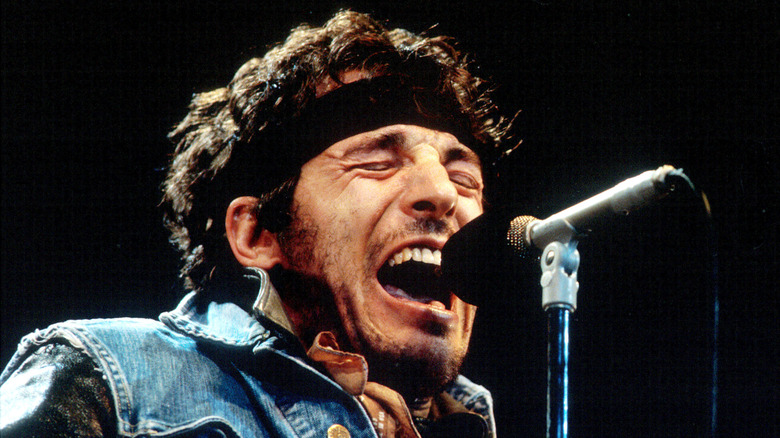
It's a little hard to imagine our musical landscape, especially rock of the homegrown variety, without Bruce Springsteen. While Springsteen came of musical age in the '70s with his 1975 hit album, "Born to Run," he hit his commercial peak in the '80s with 1984's "Born in the U.S.A.," which sold a stupendous 30 million copies. That's the album with tons of Springsteen staples like "I'm On Fire," "Glory Days," "Dancing in the Dark," and of course, the song after which the album is named, "Born in the U.S.A." But despite the album's success, its eponymous single never reached No. 1 on the Billboard Hot 100. It only reached No. 9.
To deepen the mystery: Springsteen has never had a No. 1 song, ever. "Dancing in the Dark" was the highest at No. 2. And yet, Springsteen has had 11 — yes, 11 — No. 1 albums, one of which was "Born in the U.S.A.," which sat at No. 1 for seven weeks. How does this strange chart distribution happen? We really can't say or do anything beyond conjecture. Two of Springsteen's No. 1 albums are compilations, which might indicate that folks are buying his albums based on Springsteen's reputation rather than individual tracks. Something similar might have happened for "Born in the U.S.A."
Springsteen isn't happy with "Born in the U.S.A.," either, but not because of the album's chart history. Springsteen wanted an album that was overtly "darker," as Louder Sound quotes, like 1982's "Nebraska." But of course, none of that album's songs landed on the Billboard Hot 100. Then there's the whole problem with "Born in the U.S.A.," the song, being notoriously misunderstood as a patriotic, pro-American anthem.
Don't Speak — No Doubt
No Doubt's acoustic ballad "Don't Speak" presents a unique case for a song that couldn't land the No. 1 spot on the Billboard Hot 100. Looking at their chart history, the band's highest charting song is "Underneath It All" from 2001's "Rock Steady" (at No. 3), which is weird enough. "Just a Girl" from the band's 1995 smash hit album, "Tragic Kingdom," only reached No. 23. And when we say smash hit, we mean that the album stayed at the No. 1 position on the Billboard 200 for a stunning nine weeks. So, where is "Don't Speak," the biggest song from that album that consumed the airwaves and recently joined Spotify's elite 1 billion listens club? Nowhere. It's nowhere in the Billboard Hot 100, not even No. 100.
Yes, this should seem completely impossible to anyone who was alive in the mid-90s. It's absolutely B-A-N-A-N-A-S, as Gwen Stefani might say. Well, No Doubt fans and those who heard the song a kajillion-bajillion times back in the day: there's a reason for this reality-shattering madness. "Don't Speak" was ineligible for entry into the Billboard Hot 100 because of a dumb technicality. It never received an official, physical release as a single and so wasn't allowed onto the chart. That's it. We can't say for sure, but if the song did get a shiny, official release, it might have stayed at No. 1 for approximately, let's say ... 672 weeks.
If it's any consolation, "Don't Speak" did spend 10 weeks at No. 1 on the Pop Airplay chart and 15 weeks at No. 1 on the Adult Pop Airplay chart. Whatever those charts are.