

The Truth Of Keith Richards And Mick Jagger's Turbulent Relationship
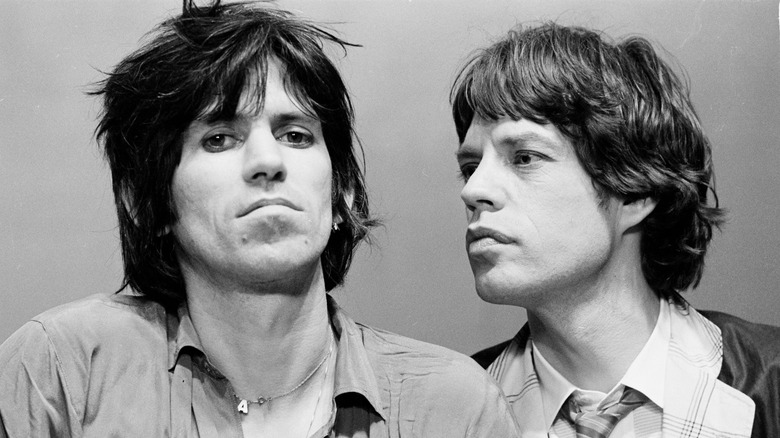
There is arguably no musical partnership that's been more successful than that between singer Mick Jagger and guitarist Keith Richards. When exploring the history of the Rolling Stones, it's clear that the band owes its success to this pair — who dubbed themselves the Glimmer Twins, and have been the band's primary songwriters for decades.
Since forming in 1962, the Rolling Stones have remained enduringly popular, even well into the 2020s, and it's become clear why there will never be another rock star like Mick Jagger. Thanks to these two, the Stones have become one of the biggest acts of all time, selling nearly 250 million albums, while the band's concert tours have continued to generate huge profits; when the Stones hit the road in 2021, it became the top-grossing tour of the year, and became the first act in history to gross more than $10 million per concert. More than 60 years after the band was founded, the Stones enjoyed critical acclaim with the 2023 album "Hackney Diamonds" — their first album of original material in nearly two decades.
That said, that relationship has also been among the most volatile and tumultuous in rock history. Asked by GQ where Jagger would be without him, Richards replied, "Nowhere! He'd be just another wannabe. And so would I. There is an incredible chemistry with the Stones. I don't want to analyze it." To find out more about this legendary duo, read on for the truth of Keith Richards and Mick Jagger's turbulent relationship.
They were friends as children but reconnected randomly as teenagers
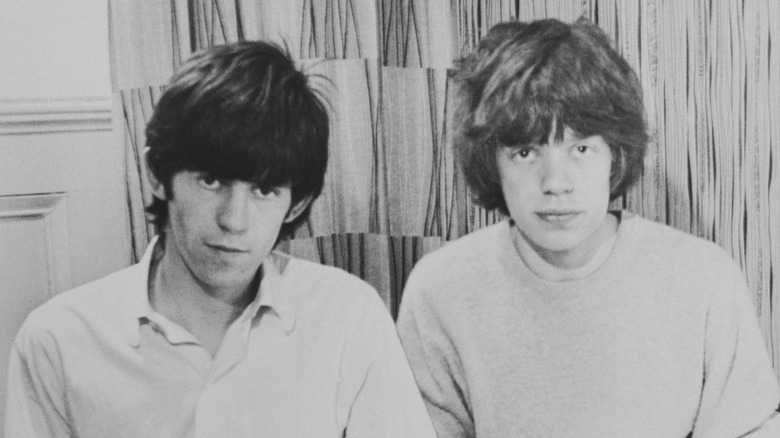
Mick Jagger and Keith Richards had known each other since attending primary school together in London. "I can't remember when I didn't know him," Jagger reminisced in an interview with Rolling Stone. "We lived one street away; his mother knew my mother ... We used to play together, and we weren't the closest friends, but we were friends."
The two boys had long since lost touch with each other when Jagger, then 18, bumped into 17-year-old Richards while waiting for a train as they headed to their respective schools — Jagger on his way to the London School of Economics, Richards headed to Sidcup Art College. While Richards carried his Höfner electric guitar (he'd gotten into the habit of bringing it with him everywhere), Jagger had an armful of blues records that he'd ordered from the U.S. by mail. Both were intrigued.
During that fateful train ride in October 1961, the two discovered they both had a keen interest in blues music, which sparked a new friendship. "We started to go to each other's house and play these records," Jagger told Rolling Stone. "So I said, 'Well, I sing, you know? And you play the guitar.' Very obvious stuff." Rock's most complicated and enduring partnership had begun.
They decided to form a band with Brian Jones
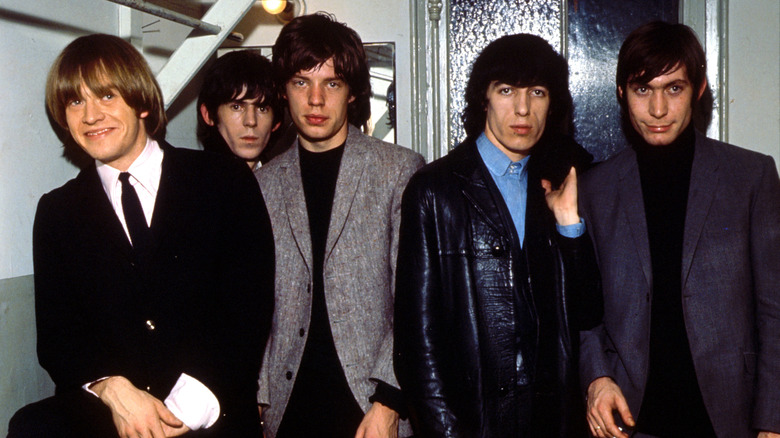
Discovering they shared a passion for the blues, Mick Jagger invited Keith Richards to join his band, Little Boy Blue and the Blue Boys. Meanwhile, Jagger and Richards had started following Alexis Korner's Blues Incorporated, a musical collective of sorts that featured a rotating roster of talent. "They went everywhere together; you never got Mick without Keith," Korner said in Bill Wyman's book, "Stone Alone."
The two took in one performance, accompanied by pal Dick Taylor (who would later go on to form the Pretty Things), and were impressed by the slide-guitar ability of Brian Jones, who was sitting in. "It didn't take long to get talking with him and it wasn't long before he, in turn, heard Jagger sing and poached him for his band," recalled Taylor in a 1999 interview with journalist Rob Chapman for Mojo. "Mick took Keith along ..."
That band was named the Rolling Stones, taken from Muddy Waters' song "Rollin' Stone." "The band is really an amalgamation of two bands," Jones wrote in a letter to a fan (via Far Out). "The one being an R&B band I formed about a year ago, and the other being a group run by Mick and Keith in S.E. London. I was introduced to Keith, and we decided to pool our resources, so with Stu [pianist Ian Stewart] from my band, and Mick from Keith's, we became the nucleus of the Stones."
They began writing songs together that became hits for others
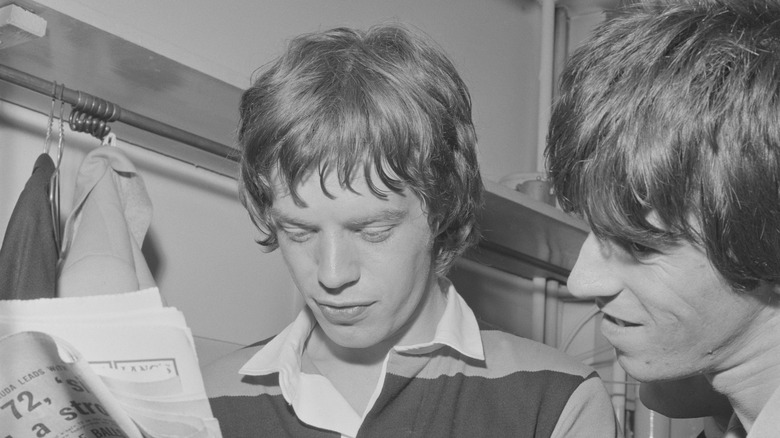
The Rolling Stones quickly gained a following as the lineup evolved to comprise guitarists Brian Jones (the band's leader) and Keith Richards, Mick Jagger on vocals and harmonica, Bill Wyman on bass, and Charlie Watts on drums. As their popularity grew, they hooked up with a new manager, Andrew Loog Oldham, who envisioned big things after getting them a record deal.
Initially, the Stones' repertoire consisted entirely of blues covers. Oldham could see how limiting that would be to the Stones' future success. Realizing the band needed original songs, Oldham locked Jagger and Richards in a kitchen and refused to let them out until they'd written one. "I mean, songwriting is something I got thrown into out of necessity," Richards told Guitar Player. "That was such a flatulent idea, a fart of an idea, that suddenly you're gonna lock two guys in a room, and they're going to become songwriters."
But Oldham was right. When they emerged, they'd composed their first song: "As Tears Go By," which ultimately became a hit — not for the Stones, but for Marianne Faithfull. They began writing more songs, resulting in more hits for other artists, including Gene Pitney, Jimmy Tarbuck, and Tracey Dey. "We were writing these terrible pop songs that were becoming top 10 hits," Richards added, recalling that it wasn't until writing "The Last Time" that they'd finally come up with a song that would suit the Stones.
Brian Jones' deterioration forced them to take control of the band
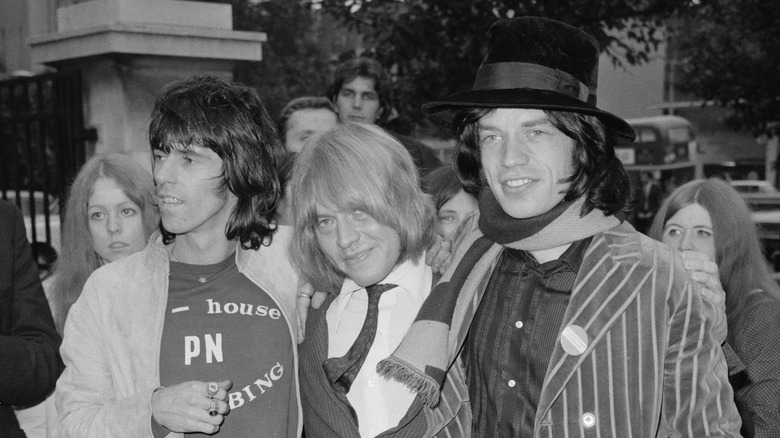
As the 1960s progressed, the Rolling Stones' success grew in leaps and bounds; before long, the band's popularity approached that of the Beatles, driven largely by the hit songs composed by Mick Jagger and Keith Richards. As the pair emerged as a formidable songwriting team, the band's erstwhile leader, Brian Jones, found himself increasingly pushed to the background.
Jones had been heavily using drugs and had been arrested on drug charges twice in the late 1960s. His drug abuse contributed to Jones' role in the band becoming increasingly passive, to the point that he barely showed up for recording sessions. "We didn't even expect him to be there," Richards said in the documentary "Crossfire Hurricane." "By then he was already in Bye-Bye Land." As Jagger added, on those rare occasions when Jones did turn up, they had no idea what condition he'd be in. Fed up and needing another guitarist, Richards and Jagger confronted Jones. "It's never pleasant, firing people," Jagger told Rolling Stone of kicking Jones out of the band. "But it had to be done because we felt we needed someone, and he wasn't there."
Jones died under murky circumstances, drowning in his swimming pool less than a month later. He was replaced by guitarist Mick Taylor, who made his debut with the Stones at a concert in London's Hyde Park that became a tribute to Jones.
The Glimmer Twins created their most legendary work during the early 1970s
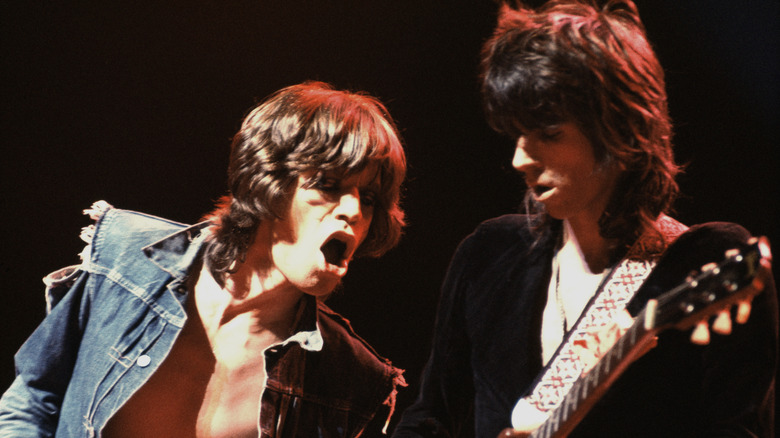
Moving forward after the tragic death of The Rolling Stones' Brian Jones, Mick Jagger and Keith Richards propelled the Stones to the band's most vaunted era. With the addition of Mick Taylor, Jagger and Richards led the band through a period considered their most creatively fruitful, thanks to their two most acclaimed records, "Sticky Fingers" and "Exile on Main Street" (even if the latter is the Rolling Stones album that Jagger thinks is overrated).
As Jagger told Rolling Stone, the band was firing on all cylinders, and the addition of Taylor had lit a fire under everyone. Meanwhile, "Sticky Fingers" was also the band's first album after ending its restrictive contract with Decca Records and launching its own label, Rolling Stones Records. "A whole new world, an era away from 'Beggars Banquet,'" Jagger recalled for Rolling Stone Magazine.
While the Stones were finally making real money, it coincided with a period in time when Britain taxed its highest earners at a rate of up to 98%. They famously relocated to France, becoming tax exiles, and recording "Exile" at a home Richards was renting in the South of France. "It was called 'Exile' because we were basically booted out of England," Richards told Classic Rock. "A lot of the songs started off with an idea," he added. "Mick's playing harp, you join in and before you knew it you had a track in the making and an idea working."
Keith's descent into heroin addiction fundamentally changed their relationship
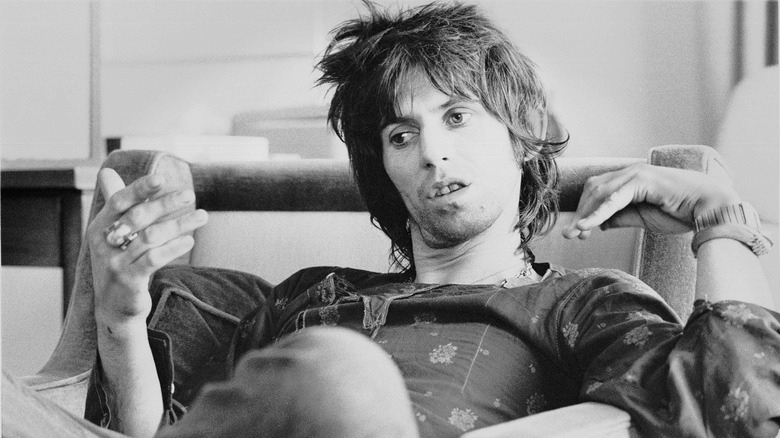
While the brilliance of "Exile on Main Street" is undeniable, Mick Jagger recalled making the album as an unpleasant experience. "I didn't have a very good time," he told Rolling Stone, adding, "I went with the flow, and the album got made." During that time, Keith Richards had been dabbling with heroin, and what had started as a flirtation eventually blossomed into full-fledged addiction.
Meanwhile, Jagger had recently gotten married, having tied the knot with Nicaraguan model Bianca Perez-Mora Macias in 1971. The couple became part of the so-called jet set, palling around with the likes of Princess Margaret and her ilk. It soon became impossible to ignore that they were on two increasingly divergent paths as Jagger reveled in the perks of international stardom while Richards became a hardcore junkie. Richards could function, at least from a musical perspective, but when it came to the nitty-gritty of band business, he'd checked out.
With these various forces at play, the Glimmer Twins' relationship was becoming distant. It all came to a head in 1977, while the band was on tour, when Richards was arrested in his Toronto hotel room with a hefty supply of heroin. He was charged with trafficking and faced a potential seven-year prison sentence. That posed an existential threat to the band.
After Keith kicked heroin, he battled with Mick over control of the Stones' direction
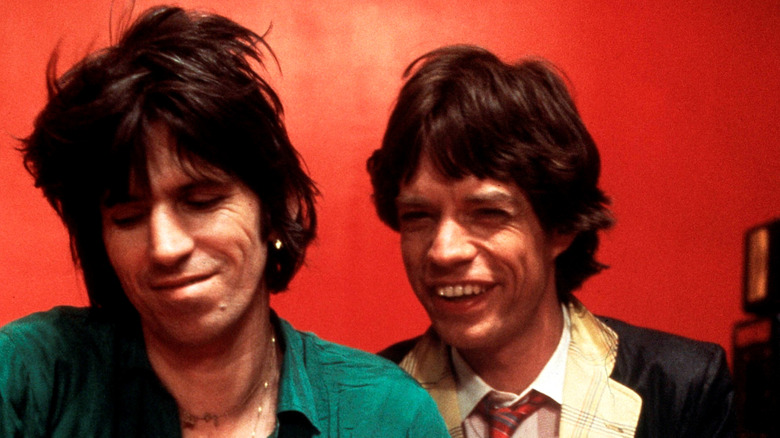
Keith Richards pled guilty and was able to dodge jail when the judge hearing his case instead ordered that he play a benefit concert. That close call became the impetus for Richards to get clean, and he was finally able to kick his heroin habit in 1978. Clear-headed for the first time in nearly a decade, he was keen to regain the control of the band that he'd relinquished to Mick Jagger.
As Richards wrote in his memoir, "Life," "there was a bitter current beginning to flow between Mick and me. It dated from the time I finally kicked heroin." As he wrote, Richards came to realize that Jagger had "quite enjoyed one side of me being a junkie. The side that kept me from interfering in day-to day business."
Richards had naively anticipated his renewed interest in band business would be welcomed by Jagger. That, however, was not how it went down. "I expected a burst of gratitude. But what I got was, I'm running this s***," Richards wrote. "And I realized that Mick had got all of the strings in his hands and he didn't want to let go of a single one." This marked the beginning of a particularly fraught period in their relationship, one that nearly broke up the band for good.
Their relationship chilled as Richards consistently publicly sniped at Jagger
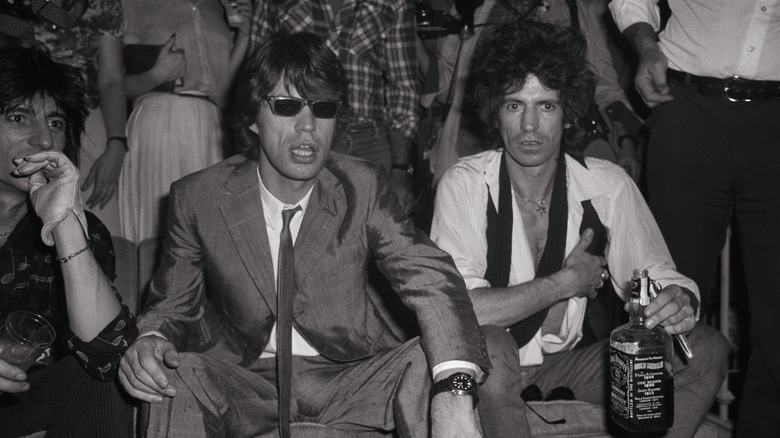
With Mick Jagger and heroin-free Keith Richards engaged in a power struggle over control of the Rolling Stones, their relationship hit an all-time low. "It was the beginning of the '80s when Mick started to become unbearable," Richards wrote in "Life." Richards had come across "some lurid novel" written by a woman named Brenda Jagger — and he now had an unflattering nickname to use. "That's when he became Brenda, or Her Majesty, or just Madam," he recalled of Jagger.
Richards began slagging Jagger behind his back, and then openly in the press. Looking back, he'd come to regret that period. "But there's a terrible thing that starts, and it's very much the way Mick and I behaved towards Brian [Jones]," he wrote. "Once you release that acid, it begins to corrode."
Their deteriorating relationship was evident in the albums that the Stones made during the 1980s, "Dirty Work" and "Undercover." What listeners didn't realize was that the two were no longer collaborating together; the relationship had become so frayed that they couldn't stand to be in the same room together, and had recorded their parts separately. "They specifically avoided each other," producer Chris Kimsey told The Times of his experience making "Undercover." "That was the worst time I'd ever experienced with them."
Their feud nearly broke up the band
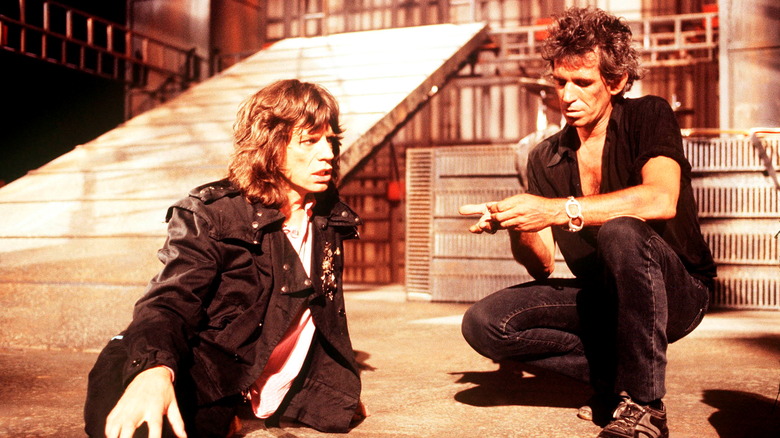
As the rift widened between them, Keith Richards became infuriated when Mick Jagger signed a record deal as a solo artist. That particular chapter in Jagger's troubled history resulted in his debut album, 1985's "She's the Boss." That was followed by "Primitive Cool" in 1987. Meanwhile, Jagger spoke flippantly of the band's future. "It's ridiculous," Jagger told Q magazine in 1987 (via The Guardian). "No one should care if the Rolling Stones have broken up, should they? I mean, when the Beatles broke up, I couldn't give a s***."
With the band in a holding pattern while Mick Jagger focused on his solo albums, in 1988, Richards embarked on a side project of his own: recording his first solo album, "Talk is Cheap." As Richards told Rolling Stone, it was a project he'd taken on reluctantly. "It was not something I wanted to do," he said. "The only reason I would do a solo album was because I couldn't keep the Stones together."
While Richards' album was beloved by critics, Jagger's efforts were not. In a 2015 interview with GQ, Richards offered a brutal and dismissive assessment of Jagger's solo work when explaining why Jagger's solo album almost destroyed The Rolling Stones. "[Jagger's solo work] had something to do with ego. He really had nothing to say ..." added Richards of how Jagger had become one of those rockers whose egos got in the way of almost certain success.
They let bygones be bygones when they reunited for Steel Wheels
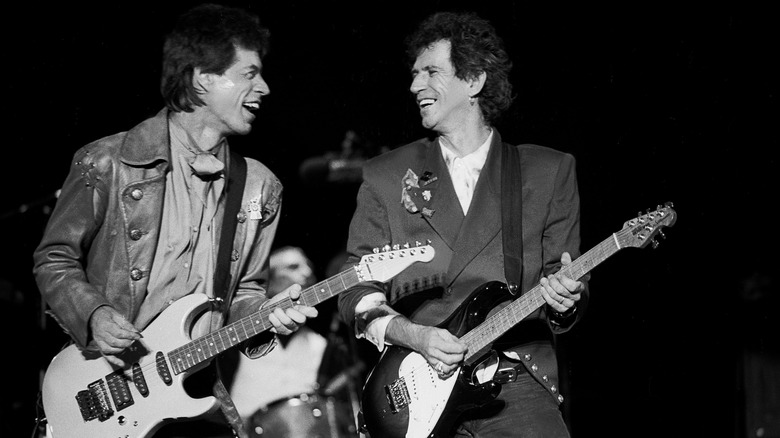
While Mick Jagger's grand solo ambitions fizzled, Keith Richards had proven with "Talk Is Cheap" that there was still an audience who wanted a Stones album that sounded like the Stones. Having not performed live in seven years, in 1989 the band announced plans to tour in support of their new album, "Steel Wheels." A return to form, the album also represented a thaw in the frigid relationship between Jagger and Keith Richards.
In the years that followed, the Stones kept rolling. Speaking with Rolling Stone Magazine in 1995, Jagger insisted that his relationship with Richards was quite solid at that point in time. "But it's a different relationship to what we had when we were 5 and different to what we had when we were 20 and a different relationship than when we were 30," he said. "We see each other every day, talk to each other every day, and play every day. But it's not the same as when we were 20 and shared rooms."
They've set aside their grievances so the Stones can keep rolling — but it took some apologies
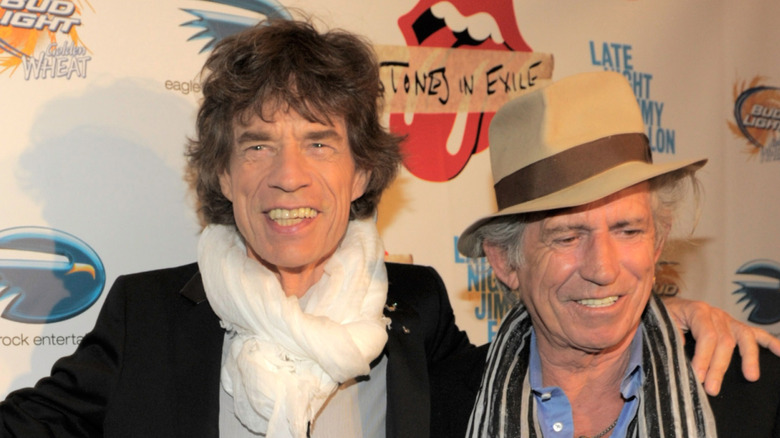
The 2010 publication of Keith Richards' memoir, "Life," offered many candid — and often unflattering — observations of Mick Jagger, including an infamous reference to the singer's "tiny todger." "Yeah, we had a bit of a doo-dah, but I expected it," Richards told the Daily Mail of Jagger's irked response to "Life," adding, "We resolved it, in our own way, you know?" According to Richards, he fully expected Jagger to be peeved by the book. "As I told Mick, 'You should have seen what I left out!'" he quipped.
In fact, Richards revealed that Jagger had demanded an apology. "He did," Richards confirmed, "and I said that I regret if I caused you any, you know, inconvenience or pain, or something. It was... I'd say anything to get the band together, you know? I'd lie to my mother."
Several years later, another apology was in order. After Jagger had welcomed his eighth child in 2016, at the ripe old age of 73, Richards jokingly suggested Jagger get a vasectomy. "It's time for the snip — you can't be a father at that age. Those poor kids!" Richards told WSJ Magazine. Richards, who'd apparently received a tongue-lashing from Jagger, subsequently issued a statement to E! News. "I deeply regret the comments I made about Mick in the WSJ, which were completely out of line," he said. "I have of course apologized to him in person."
As octogenarians, Mick and Keith are brothers and bandmates — but not friends
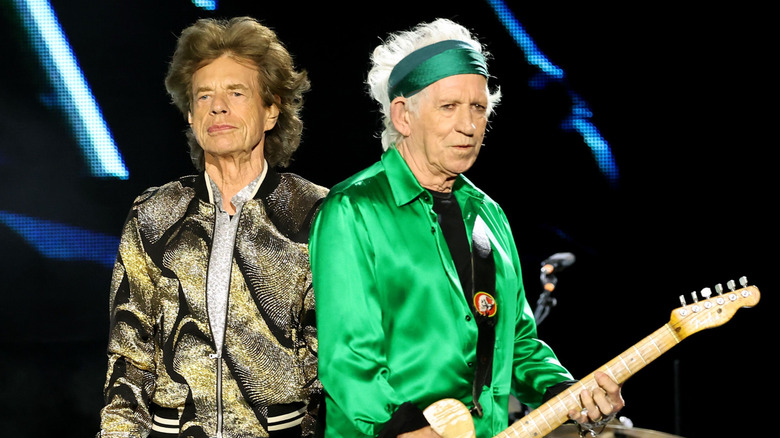
In 2025 — the same year that Mick Jagger and Keith Richards each celebrated their 82nd birthdays — the Rolling Stones reunited with "Hackney Diamonds" producer Andrew Watt for a new album, set for release at some point in 2026. In their twilight years, their relationship had evolved considerably since 1961. "Mick and I may not be friends —too much wear and tear for that," Keith wrote in his memoir, "Life." "We're the closest of brothers, and that can't be severed. How can you describe a relationship that goes that far back? Best friends are best friends. But brothers fight."
In his controversial 2018 interview with WSJ Magazine, Richards said he believed that the volatility of his relationship with Jagger had been artistically beneficial. "Mick and I live off of this fire between us," he explained.
When the band was interviewed by Jimmy Fallon in 2024 about their "Hackney Diamonds" album, Jagger and Richards were asked about the secret behind their long relationship. "Not speaking too often!" Jagger joked, with Richards adding, "How to say shut up politely."