

5 Rock Songs From 1989 That Sound Even Cooler Today
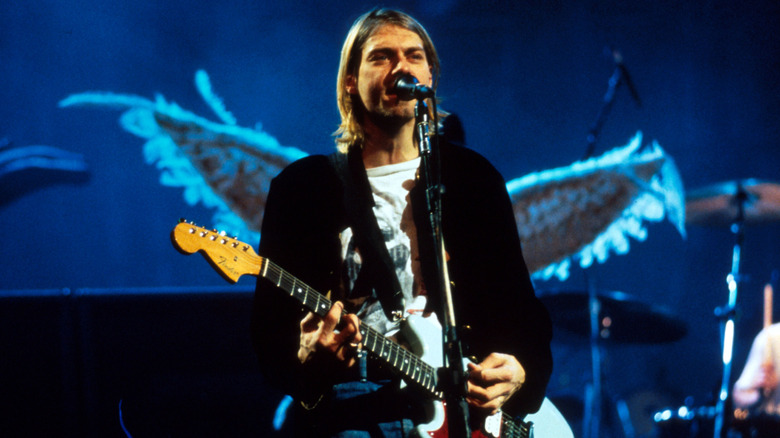
As the final year in the '80s, 1989 was the de facto farewell tour to a legendary era for rock music. Dominated by the tugs of war between glam metal and new wave, and then glam metal and synth pop, the '80s saw rock music become as big, bright, and attention-grabbing as the hairstyles behind it. Guitars and keyboards were cranked to 11 throughout, making the '80s an undeniable statement in the power and presence of rock. Even by '89, however, the cracks in the decade's hairsprayed coif began to show, revealing glimmers of the genre's future.
In picking what sounds cool, we chose songs that bucked some trend of the time and instead forged their own path. These are songs that signaled something to come — a shift in the sonic landscape, the remixing of established elements into something new, or simply the emergence of an iconic group. In looking back, these tracks gain a new level of cool for being guideposts, signs that led listeners to a brave new world known as the '90s. To show what we mean, here are five songs from 1989 that sound even cooler today.
Nirvana - Blew
A lot was changing in the landscape of rock music leading into 1989, but nothing as momentous as the debut of Nirvana, a band that would come to be hailed as one of the greatest of all time and perhaps the single most defining feature of the 1990s in music. Even before their astronomical success in 1994 with "Nevermind," Nirvana's 1989 debut "Bleach," which cost only a few hundred dollars to produce, makes a strong case for how they were able to do it.
The opening track on their debut and a single off the album, "Blew" is the first Nirvana song a great many people heard, and it lays out their mission statement clearly. After a decade of rock musicians trying their hardest at everything — the clothes, the hair, the mystique, the special effects, the lightspeed solos, the glass-breaking high notes — Nirvana arrived, seeming almost lazy.
Throughout the verses in "Blew," the bass and guitar merely double Kurt Cobain's vocal melody, though they fall just short, almost seeming like they couldn't be bothered to get it right, and that is just classic rock-star cool. Likewise, Cobain almost seems to wink at the audience about his own lyrics, with the chorus "Is there another reason for your stain? / Could you believe who we knew stress or strain? / Here is another word that rhymes with shame." "Blew" made it immediately apparent that Nirvana wasn't here to dazzle, but to make rock messy and wry, and that has aged the song quite well.
Pixies - Monkey Gone to Heaven
There is no band like the Pixies. That's a somewhat ironic statement, given how many bands have listed them as influences, or in the case of Nirvana, outright admitted to trying to copy them. (A quick comparison between the choruses of Nirvana's "Smells Like Teen Spirit" and the Pixies' "U-Mass" would prove the connection, regardless.) Yet the Pixies stand alone for a number of reasons, not least of which is their use of intense quiet/loud dynamics, a feature of which they're often cited as pioneers. Sitting smack in the middle of the 1989 masterpiece "Doolittle," "Monkey Gone to Heaven" is a perfect representation of the band, their influence, and just how darn cool they are.
Compare two points in "Monkey Gone to Heaven": the beginning of the first verse and the end of the third. In the former, singer Black Francis speaks more than sings over an unadorned bassline and a drum beat so simple it almost sounds like a click track. In the latter, Francis screams over and over and over again, sounding as though he were in actual pain while recording. The difference between the muted verses and crunchy choruses is tremendous, but so is the difference between verses, demonstrating an ingrained kineticism that would later define much of the grunge movement and '90s music in general.
Lou Reed - Dirty Blvd.
Despite bursting onto the scene in the late '60s as a part of the Velvet Underground, one of the bands that invented punk, Lou Reed was still reinventing music as late as 1989 (and beyond). Just as the year began, he released "New York," an album that is quintessentially Reed and yet its own, entirely new vibe. Unlike many of Reed's earlier, more art-rock albums, and unlike the excessiveness of so much rock at the time, "New York" is a thoroughly stripped-down, simplified rock album, and yet its lyrical cohesion makes it halfway to a concept album.
The most successful single to come from "New York," "Dirty Blvd," is a perfect encapsulation of the album as a whole. The guitar is high, bright, and cheerful, the kind you'd expect from a John Mellencamp hit, and it is of course contrasted by Reed's low, smoky Sprechgesang, which stubbornly refuses to match the guitar's energy. Just as the lyrics to "Dirty Blvd." contrast the haves and have-nots of New York City, the instrumentation and vocals are at odds throughout. "Give me your hungry, your tired, your poor — I'll p*** on 'em," sings Reed, over chords that could otherwise accompany a friendly campfire. "That's what the Statue of Bigotry says / Your poor huddled masses, let's club 'em to death / And get it over with and just dump 'em on the boulevard." The lyrics may be on the nose, but the master that Reed is, he wraps them up in enough disparity and irony to get them down smooth, and even more so as time goes by.
Fugazi - Waiting Room
Fugazi is one of those bands that musicologists, hipsters, and punks know well, not just for their music but their unique relationship to the industry, but they are still a virtual unknown to the mainstream crowd. Part of that is by design, as the band famously eschewed any major record label offers in favor of doing everything themselves and used a portion of their money to support charities rather than reinvest in the band as a capitalistic venture. Fugazi are underground by choice and chose ethics over fame and fortune, and there is very little cooler than that.
The first track off of their first full-length album "13 Songs," "Waiting Room" seems like a deliberate mission statement. The second verse reads, "I don't sit idly by / I'm planning a big surprise / I'm gonna fight for what I wanna be / And I won't make the same mistakes / Because I know how much time that wastes," both a declaration of independence and a warning from the jump not to try to force the band into a cage. The ending implores the listener to live the same way, reminding them that they might be "Sitting in the waiting room (Tell me why?) / Because they can't get up." Fugazi got up and became punk legends, all without sacrificing their integrity or their freedom, and it makes songs like "Waiting Room" cooler the more you think about it.
For a primer on the influential post-hardcore band, read our feature on the untold truth of Fugazi.
They Might Be Giants - Birdhouse in Your Soul
They Might Be Giants also might have the strangest career of any successful rock band, which is befitting of a strange group of musicians. Despite being a staple of the alternative rock scene for decades, the band is still known just as much for their children's music and as the band behind the "Malcolm in the Middle" theme song. They're an exceptional group of musicians as well, though, and their twee, almost-novelty style is at its best on "Birdhouse in Your Soul," released as a single just a couple of weeks before the decade closed.
As singer-songwriter John Linnell told The Guardian, the song's lyrics were "stream of consciousness... I wasn't thinking too hard," and yet they reveal an endearing story of a bird-shaped nightlight watching over its owner as their "Blue bird of friendliness / Like guardian angels it's / Always near." In decidedly They Might Be Giants style, this cutesy, intimate story is contrasted with no less than 18 key changes, somehow fitting them into less than three-and-a-half minutes without completely alienating the listener. Those wild, almost laughable contradictions are a hallmark of They Might Be Giants' music and part of what makes them increasingly cool upon reevaluation.