

How Whitesnake Turned A Massive Flop Into Its Biggest Hit
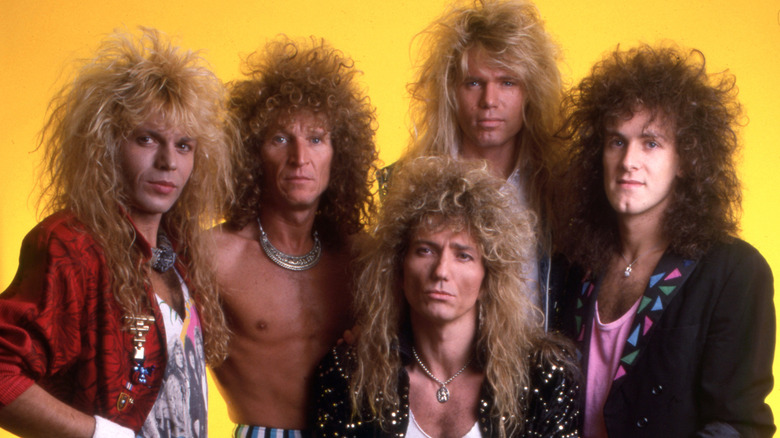
Whitesnake was a relic from the 1970s that, with a little adaptation and reinvention, became a late-1980s glam metal band that went all the way to No. 1 with its single "Here I Go Again." Previously a one-hit wonder that deserved more than 15 minutes of fame, Whitesnake hit the Top 40 in 1980 with "Fool For Your Loving" before retreating into the smaller but hospitable worlds of hard rock and classic rock. Formed by David Coverdale, the deep-voiced ex-frontman of Deep Purple, the loudest band in the world, Whitesnake recorded a slew of heavy, blues-influenced albums in the late 1970s and early 1980s that made little impact on the American album chart.
One of those largely ignored Whitesnake LPs, "Saints & Sinners," spawned the single "Here I Go Again," which peaked at a mediocre No. 34 in Whitesnake's native U.K. and not at all in the U.S. That made it fair game as far as Coverdale was concerned, and in 1987, he recorded a brand new version of it for Whitesnake's self-titled album. Benefitting from some tweaks, updates, and overhauls, it was a massive hit that positioned Whitesnake as a very contemporary act. Here's how Whitesnake took a failed song and turned it into a signature smash.
Whitesnake made Here I Go Again again and reached the top
Whitesnake agreed to remake "Here I Go Again" because Geffen Records made it — the price for David Coverdale wanting to also redo another song, "Crying in the Rain." The original "Here I Go Again" from 1982 sounds like a lost chapter from Bad Company. It's got a crisp and clapping beat, makes use of an organ and a bluesy guitar, and Coverdale's delivery is restrained and melancholy. The 1987 version sounds like an '80s hair metal song, what with the thunderous drums, synthesizer instead of an organ, a shredding guitar solo, and Coverdale unafraid to wail and hit high notes in a noticeably faster-paced song.
The lyrics stayed largely intact, but with one key difference. In the chorus of the 1982 song, Coverdale characterizes himself as a wandering loner: "Like a hobo I was born to walk alone." Five years later, Whitesnake changed "hobo" to "drifter." Not only was Coverdale concerned that "hobo" — American slang for a 1930s train-hopper — had been misconstrued as "homo," as in "homosexual," but he'd always wanted to use "drifter" anyway. "But I'd used it a bunch of times in different songs, and I thought, 'What the f*** else is there? Hobo!'" he told The Guardian.
Bolstered by a light remix for Top 40 radio, "Here I Go Again" spent a week at No. 1 in October 1987, the only time the rock band would peak at the top of the chart.