

These Music Legends Had Surprising Military Careers
Musicians, like all creatives, are not usually seen as hard, aggressive people who are looking for a fight. Even when it comes to rap battles, at the end of the day, they mostly involve writing mean poetry about someone else. If only all conflicts could be ended in such a manner.
Despite this, a surprising number of iconic musicians served in the military. Not all of them did so by choice, of course. Some of these stars fought in major wars like World War II, Korea, and the Vietnam War, where young men were drafted to go fight.
Whether they were compelled to join up or did so by choice, the experiences of these men (and one woman) varied wildly. Some had a pretty boring time Stateside, while others saw intense battle. Some thrived in the rigid system, while others found that a military career was just not the right fit for them. Here are some music legends who had surprising military careers.
Jimi Hendrix
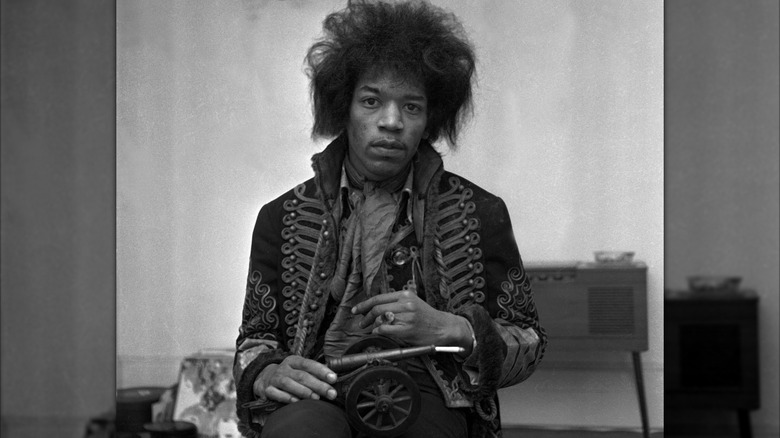
When Jimi Hendrix was arrested twice in four days for riding in two different stolen cars, he was looking at up to 10 years in prison. His lawyer managed to negotiate a plea deal for him: The future rock star would get a suspended sentence if he agreed to join the military. Hendrix took the deal and enlisted in the Army on May 31, 1961.
He trained as a paratrooper with the 101st Airborne, but he didn't take to the challenge. "The first jump was really outta sight," Hendrix later told a friend (via HistoryNet). In a letter he wrote home (per "The Jimi Hendrix Experience"), he complained, "There's nothing but physical training and harassment here for two weeks, then when you go to jump school, that's when you get hell. They work you to DEATH." Despite developing a fear of jumping out of perfectly good planes, he made five successful leaps and became a "Screaming Eagle."
Thankfully for music history, Hendrix served only one year of what was supposed to be a three-year stint before being honorably discharged for numerous infractions. The list is long and impressive in its breadth: He kept his bunkmates awake by playing guitar after lights out; he would leave to play gigs on the weekend and fail to be back on time for rollcall Monday mornings; he fell asleep on duty regularly; he was caught performing a sex act on himself while on duty; and he even pretended to be gay in an attempt to get out of serving.
Kris Kristofferson
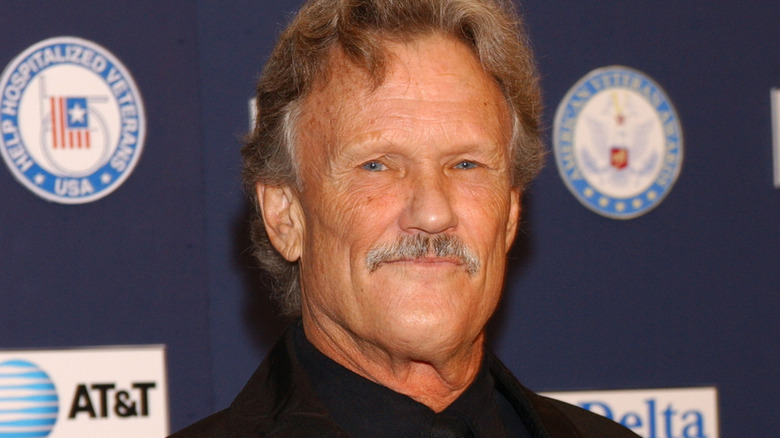
Kris Kristofferson had an illustrious academic career. He attended the private Pomona College in California, where he won awards for his writing and was a star athlete. Afterward, he earned a master's in English literature as a Rhodes Scholar at Oxford University. It made sense that, after finishing his education in 1960, Kristofferson aimed high once again when he enlisted in the Army. The future country star trained as a helicopter pilot (later he would use these skills when he landed a helicopter in Johnny Cash's yard to get him to listen to his demo tape) and then completed Ranger School and served in West Germany. Although he was offered a position teaching at West Point, he left the military to pursue his dream of becoming a musician.
Kristofferson wrote his first recorded song while in the Army — one about being in favor of the Vietnam War. But as he told Rolling Stone, he soon questioned the conflict: "I was talking to some guys coming home. The stories they were telling me were so horrible that I think it just shocked me enough to change my thinking 180 degrees. ... The notion that you could make a young person do something so inhuman to another soldier — or even worse, a civilian — convinced me that we were in the wrong. I hadn't been thinking in human terms of what that military action was." Despite this change of mind, he said he was still proud of his service and his work as a Ranger.
Elvis Presley
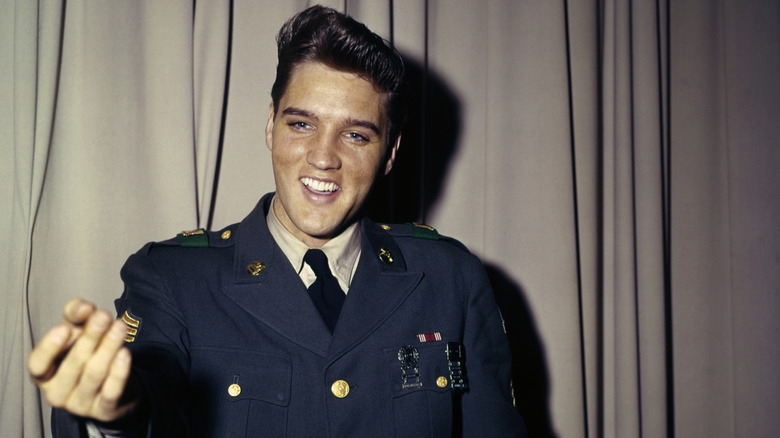
Not even his unmatched celebrity could save Elvis Presley from doing his duty for the country. On March 24, 1958, "The King" was drafted into the U.S. Army. Two days later, in front of 55 members of the press, his famous locks were shorn to a military-appropriate length by an Army barber. The idea that one of the most famous men in the world would be forced to pause his career and cut his iconic coif to help fight the spread of Communism was so unbelievable that the Soviets assumed it was a trick, possibly meant to lure their citizens to the other side of the Iron Curtain.
Elvis spent six months in Texas before being assigned to the 1st Medium Tank Battalion, 32nd Armored Regiment, 3rd Armored Division, and shipping out to West Germany. The next 18 months would be spent driving senior officers around in jeeps and trying to avoid being seen in public. He also met the 14-year-old Priscilla Beaulieu, daughter of another military man. Despite the 10-year age difference, the two started dating, and they married in 1967.
Arguably, joining the military ruined Elvis' life, if only because it was when he first started taking amphetamines. While he surprised many in the industry when he managed to revive his career once he returned to civilian life, his continued drug use would become misuse and eventually contributed to his death at age 42.
Bea Arthur
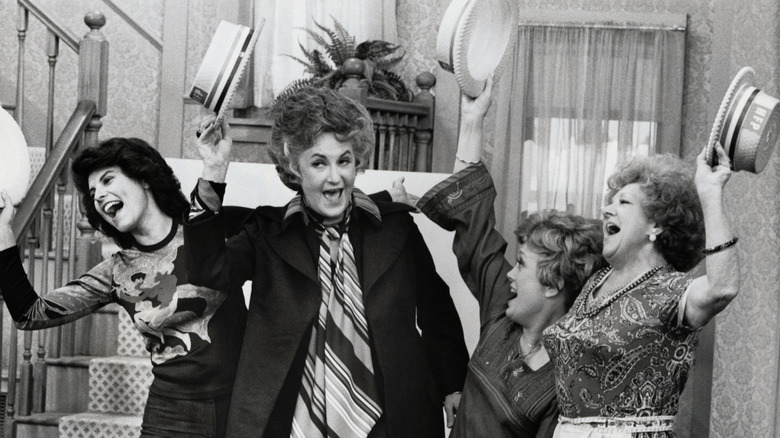
While not involved in the traditional music industry, Bea Arthur's stellar career on Broadway makes the Tony Award winner an unquestionable music legend. But before she trod the boards, she was 20-year-old Bernice Frankel, hopping from one unsatisfying job to another. When the Marines finally began accepting women into the Marine Corps Women's Reserve in 1943, the future Golden Girl was among the first to sign up for duty.
Arthur completed basic training and served as a typist for a few months before requesting a transfer to a more specialized role. She served as a truck driver at Marine Corps Air Station Cherry Point, North Carolina, until the end of the war. The future actress met and married her first husband, a fellow Marine, while serving. An exemplary "jarhead," she was promoted several times, earning the rank of staff sergeant before she was honorably discharged on September 26, 1945.
Later in life, Arthur didn't talk about her service and, in fact, would even deny that she was ever in the Marines. During a sit-down with the Television Academy (the people who run the Emmy Awards), the interviewer inquired, "I had read somewhere that you joined the Marines. Is that true?" Arthur gave a quick, "Oh no," before directing the topic back to her acting career. Despite this, the extensive paper trail leaves no doubt that she served her country.
Johnny Cash
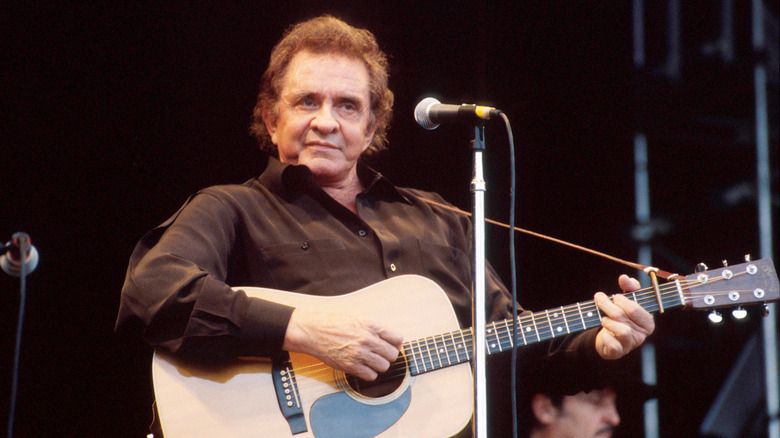
Johnny Cash served in the Air Force from 1950 to 1954. His military training focused on radio and Morse code, so he was assigned to the 12th Radio Squadron Mobile of the Air Force Security Service, which was stationed in West Germany. There, he intercepted messages from the Soviets, which was how, on March 5, 1953, he became the first American to learn that Josef Stalin was dead.
Cash met his first wife while in the Air Force, and his music career began during that time as well. While stationed in Europe, he bought his first guitar and taught himself to play. He started a band with other servicemen and performed for the troops, though this was long before anyone would recognize his name.
Once he achieved fame, Cash undertook USO tours overseas, once in 1962 and once during the height of the Vietnam War in 1969. He explained to Penthouse magazine (via "Cash on Cash"), "[I wanted] to support our guys, because I loved them so much. I knew they didn't want to be there, which is why I went over myself. I was asked to come to Vietnam and I was paid well, but right away we all got caught up in the whole thing." By the time he came back home, he had mixed feelings about the war, and worked them out in several songs, including "Man in Black" and "Singing In Vietnam Talkin' Blues."
B.B. King
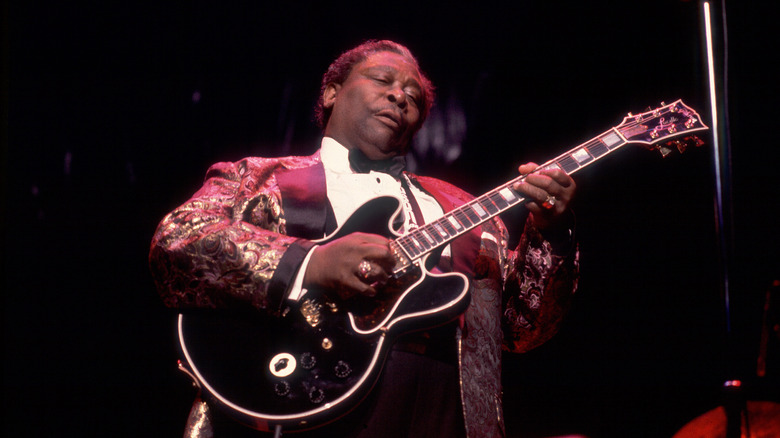
B.B. King's childhood involved a lot of moving around, bouncing between relatives in Mississippi. In the midst of this turmoil, he learned how to sing and play guitar, but he also learned how to drive a tractor. This latter skill would help him avoid serving in combat during World War II.
King was drafted into the Army shortly after turning 18 in 1943. Since he already knew how to use heavy farm equipment, he was assigned to work on a plantation near his home in Mississippi that grew cotton for military use. King also used the talents he would become known for, performing for troops at bases in Mississippi and Georgia. His time in the military, such as it was, lasted about a year.
Later in life, King remained dedicated to supporting the military. In 1996, King flew to Bosnia and Herzegovina to perform for troops stationed there as a peacekeeping force during the Balkan conflict. "This is very special to me. It's special to be allowed to do this," King told reporters (via Stars and Stripes). He added: "I'm proud to be an American. The troops here are always doing the best they can do. It's something I want to do, and hopefully they want it; and if the soldiers really want it, they're going to get a good earful."
Ice-T
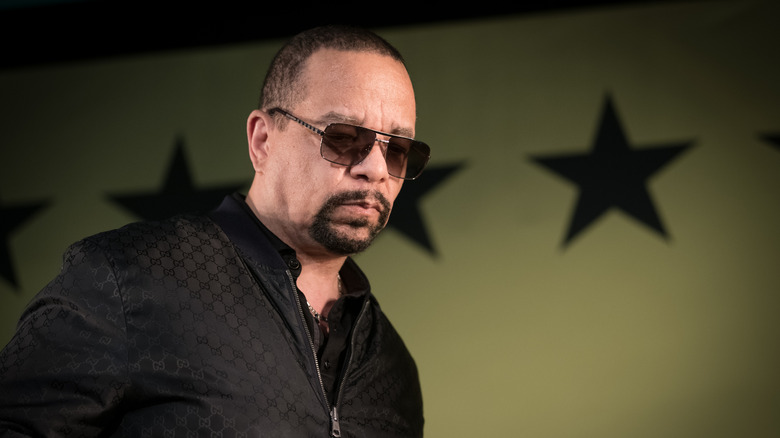
Ice-T went from an orphan to a superstar, and one stop along the way on that incredible journey was a stint in the U.S. Army. After becoming a father at age 19, he decided he needed to turn his life around. "I was testing the streets because at the time I didn't feel I had any other opportunities, you know," he told NPR. "And when I had my daughter, I was like, man, I'm going to go to jail, I got to do something, and I went to an enlistment office. Next thing you know, I'm in the military, four years infantry. I'm in Tropic Lightning Schofield Barracks."
Things did not go smoothly at first. Ice-T was involved in a minor act of theft when a group stole an infantry rug. He then made the much bigger mistake of deserting for a month. However, he was allowed to return, receive a minimal punishment, and complete his stint.
It was in the Army that Ice-T first heard hip-hop music, including the classic "Rapper's Delight" by the Sugarhill Gang. While stationed in Hawaii, he bought stereo equipment, including a turntable and mixer, and started experimenting. By the time he was discharged from the military, he had honed his musical talents, and the rest is history.
John Fogerty
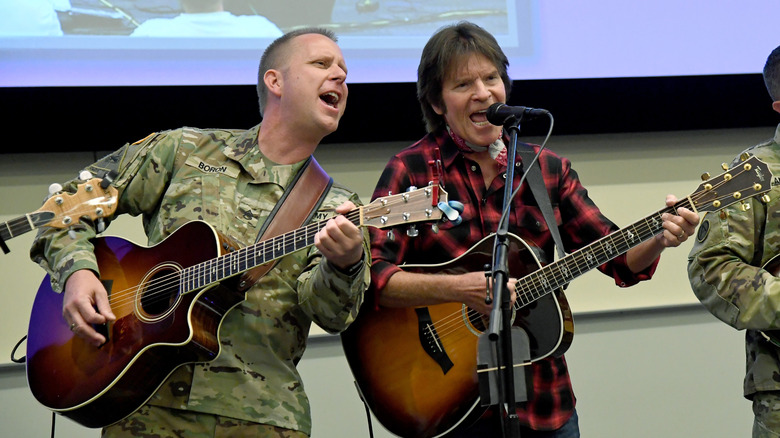
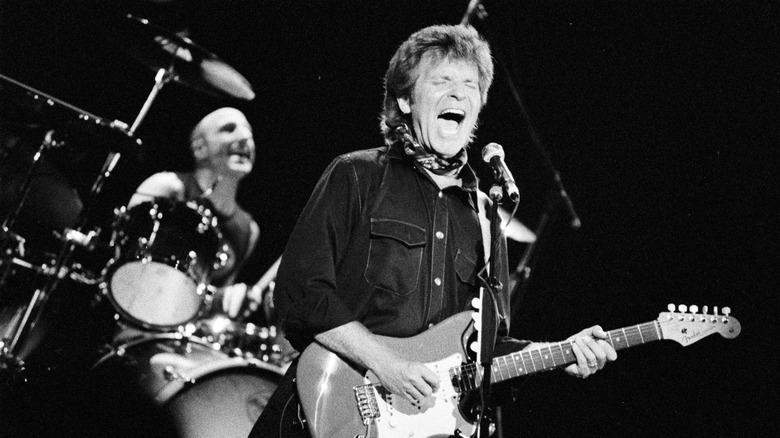
You might not know about John Fogerty's time in the Army. After all, he penned Credence Clearwater Revival's seething anti-war protest song "Fortunate Son." Surprisingly, it was during his stint in the military that Fogerty wrote the classic tune. He resented that he had been forced to serve when other men were able to escape the draft because of who they knew, how much money they had, or who their fathers were.
Not that Fogerty didn't use any means at his disposal to avoid the worst fate. When he received his draft notice, he immediately enlisted in the Army Reserve, hoping to avoid being sent to the front lines. Fogerty believes the recruiter backdated his enlistment form, allowing him to serve just six months on active duty, work in logistics, and avoid combat.
"I was just a normal kid and really didn't see myself becoming any kind of military hero," he told the Military Times. "The war was very unpopular. Even with us in the military — we weren't in love with that war. Nobody really wanted to go fight in a jungle." He also says his protests took on a different tone because of his military experience. "If you're going to protest, then protest to the people who are waging the war, not the people that are having to fight the war," he explained to Military.com.
Tony Bennett
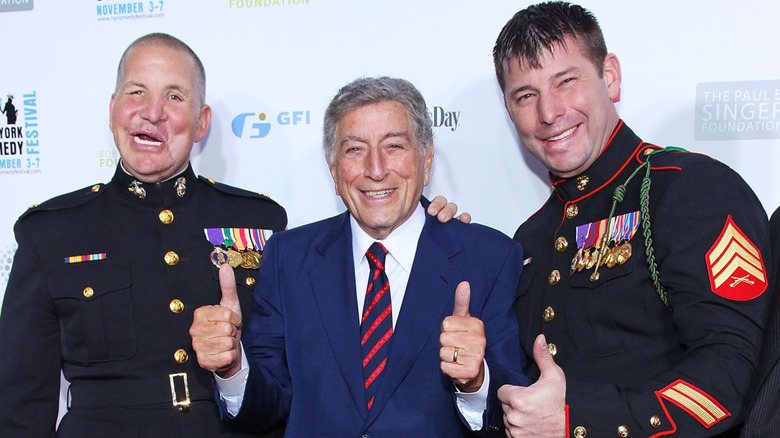
Iconic crooner Tony Bennett saw serious action in Europe during World War II, like many of his contemporaries. In 2011, Howard Stern asked the singer about being drafted when he was barely 18 and how it interrupted his budding music career. "I didn't look at it like that," Bennett replied (via YouTube). "You know, I just, everybody had to go to war; it was just one of those things."
Tony Bennett's World War II service was relatively brief but deeply traumatizing. While he only arrived in Europe as an Army soldier a few months before Germany surrendered in 1945, he saw battle and other things that scarred him for life. This included helping to liberate a prison camp that was part of the Dachau concentration camp system. Bennett remembers seeing prisoners who were so gaunt and broken that they couldn't believe the Americans were there to help them and not kill them. He also witnessed racism against Black and Jewish men in the Army, which set him on the path to being a civil rights activist.
In his autobiography, "The Good Life," Bennett summed up his thoughts on his service: "Although I understand the reasons this war was fought, it was a terrifying, demoralizing experience for me. I saw things no human being should ever have to see. ... I don't care what anybody says; no human being should have to go to war, especially an 18-year-old boy."
John Coltrane
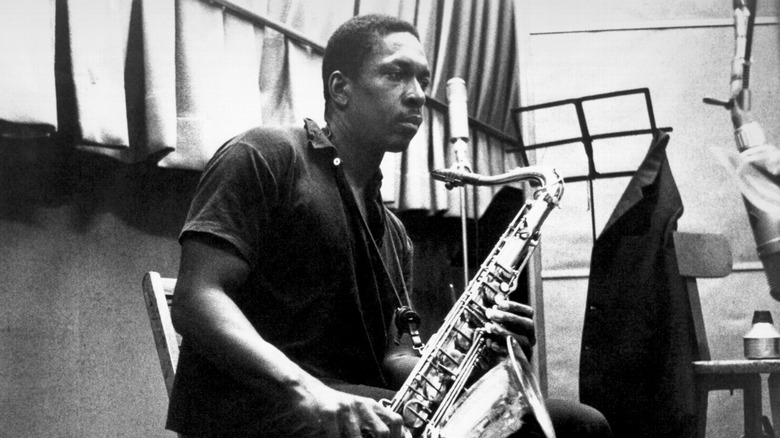
John Coltrane was 18 when Germany surrendered in World War II, but at the time, no one knew how long America would have to continue to fight Japan. Unsure when the war would end, Coltrane wanted to avoid being drafted into the Army, so he signed up for the Navy on August 6, 1945 — the same day a nuclear bomb was dropped on Hiroshima.
According to The National WWII Museum, Coltrane listed his skills on his enlistment paperwork as "Musician — played saxophone and clarinet in orchestras during various musical engagements, both part-time and full-time." While this might not seem relevant to a military career, official bands were an important part of maintaining morale. Coltrane was stationed in Hawaii, where he performed with the Pacific Fleet Ceremonial Band. However, in order to perform with the otherwise all-white band in the then-segregated military, he had to be consistently billed as a "guest performer."
In the end, serving in the military contributed to Coltrane's career in a major way. After he left the Navy, he further developed his already considerable talents by taking music classes, which he paid for with his G.I. Bill benefits. He also worked the connections he made while serving to land spots touring with bands.
George Jones
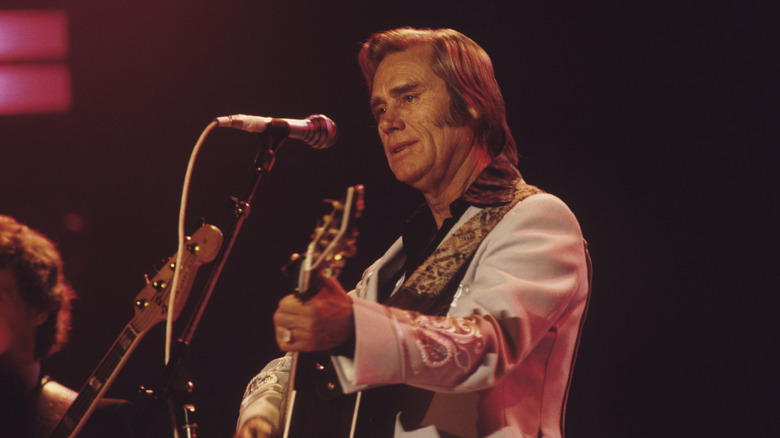
By the age of 16, future country superstar George Jones had already begun his music career by singing on the radio and performing in honky-tonks. But within a few years, that momentum was stalled thanks to several setbacks in his personal life. Jones married Dorothy Bonvillion when he was just 18, but Bonvillion filed for divorce while she was pregnant with their child because of his violent temper and misuse of alcohol. Soon, Jones was so behind on his child support payments that he served time in jail. To help the young man avoid further legal trouble, a judge recommended that Jones enlist in the Marines. He took that advice, signing up in 1951.
Jones was stationed at various bases in California for two years during the Korean War. Since he was never sent overseas, his relatively stress-free military service allowed him to keep honing his musical talents, playing in bars when not on duty. This effort paid off: Just months after he was discharged from the Army in November 1953, Jones signed his first record contract.
Shaggy
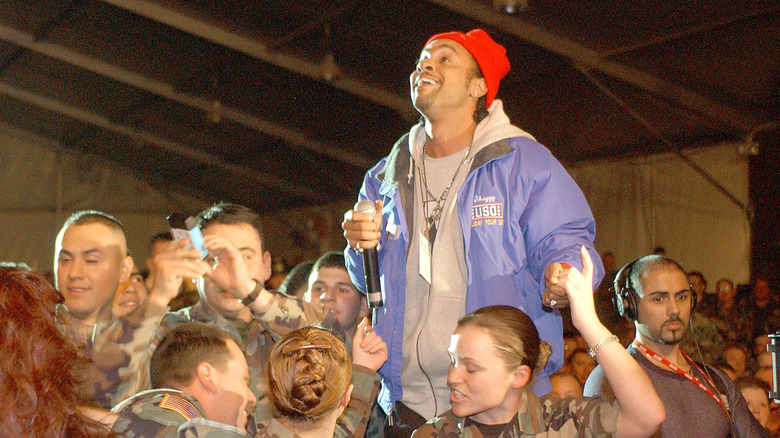
When Orville Burrell, aka Shaggy, moved from Jamaica to New York City at age 18, he threw himself into the music scene. Despite producing several successful reggae hits, he couldn't make ends meet, so he enlisted in the Marines in 1988. During his four-year stint, he spent five months on deployment to the Middle East for Operation Desert Storm. In 2019, he told The Boston Globe, "The first Gulf War was a cakewalk compared to what these guys [in Afghanistan and Iraq] are going through. That said, I saw some traumatic stuff. I can't forget that."
He didn't pause his music career, though. When stationed in North Carolina, he would drive to NYC on the weekends to record and perform. Unfortunately, he did not make it back for Monday morning roll call several times, resulting in Shaggy being demoted twice for unexcused absences.
Despite this, Shaggy credits the military for helping shape his style and develop his musical skills. "The Marines was a good setup for everything that I was about to encounter in life that I didn't know," he told Billboard. "Drill instructors ... they would call me out to sing cadences. Little did I know that that was actually vocal training because I was singing from my gut and running three miles."