

5 Flop Covers Of '70s Songs That We Actually Like
A good cover song takes a beloved tune and puts a fresh twist on it, breathing new life into the music and exposing it to new audiences. There's something extra special about a new take on a song from the 1970s. The '70s was a decade of innovation and expression, with disco, rock, and funk reaching new heights and pushing boundaries. While the original music from that decade is unmatched, it's always refreshing to hear other artists take a stab at interpreting those special moments. There's a reason why so many '70s cover tracks became high school hits for millennials, after all.
But, in all honesty, not all attempts to recreate lightning in a bottle create sparks. Instead, they flop. For context, we're defining "flop" as not being commercially or critically successful. Examples of situations that define commercial or critical failure include a song not charting well (or at all), or earning overwhelmingly bad remarks from critics or fans. Keep in mind, though, that a song could be a flop on the charts or in the eyes of others, but still hold incredibly dear spots in our hearts — that's the beauty of music's nuance. So, with that in mind, let's get into the flop covers of some of the most beloved songs of the '70s that we can't help but add to our playlist.
Summer Breeze by Type O Negative
Type O Negative has a permanent spot in the goth rock hall of fame. The group gained notoriety in 1993 following the release of its album "Bloody Kisses," with songs like "Black No. 1 (Little Miss Scare-All)" and the band's 1996 cover of "Cinnamon Girl" by Crazy Horse and Neil Young launching its distinct sound and broody vibe into the mainstream. But, not all of its songs landed, including its cover of "Summer Breeze" by Seals & Crofts.
"Summer Breeze" is a quintessential yacht rock anthem, complete with mellow melodies and a mid-tempo flow that inspires you to kick back and relax. Type O Negative turns that song on its head by making it dark, chunky, and moody. Not everyone's jazzed about the take, though, including music journalist Will Levith, who wrote in a 2013 Ultimate Classic Rock article, "Type O Negative's version sounds like it's poking fun at the original. [Peter] Steele's deep, gothy vocals and the sludgy guitar accompaniment make a mockery of a song that angels probably learn to play on their harps before 'Stairway to Heaven.'" The song didn't chart, either, but it was featured in the 1997 slasher film "I Know What You Did Last Summer."
But, let's be real: It doesn't deserve the hate. The fact that Type O Negative turned a soothing soft rock anthem into a dark ode to contentment is nothing short of impressive. And, Steele's evocative vocals give the whole song a new, eerily satisfying meaning that begs to be indulged in.
Behind Blue Eyes by Limp Bizkit
Was there a bigger band in the Y2K era than Limp Bizkit? The group was a force in the nu metal scene and scored a slew of hits in the late 1990s and early 2000s, including a 1997 cover of George Michael's song "Faith" that skyrocketed them to fame. Six years later, the band hoped to strike cover gold twice with their take on The Who's "Behind Blue Eyes," but instead experienced a much cooler reception.
The song wasn't a massive commercial flop; it charted extremely well in Europe, hitting the No. 1 spot in Sweden, and even peaked at No. 11 on the U.S. mainstream rock chart. However, it was heavily criticized by listeners as well as critics. In fact, in 2011, readers of Rolling Stone ranked it No. 2 on a list of the worst covers ever. Ouch.
Despite the blowback and Limp Bizkit being one of the most divisive bands in music, this rendition of "Behind Blue Eyes" isn't so bad on the ears. Durst's vocals add a little more drama to the tune, and for Limp Bizkit, it's a refreshing and honest attempt at a softer expression of rage, considering the group outright oozed rage for years. Plus, the Speak and Spell sample in the bridge scratches the brain in such a satisfying way.
Blitzkrieg Bop by Rob Zombie
Rob Zombie is no stranger to success. He fronted White Zombie, one of the most popular industrial metal bands of the 1990s, and his specific brand of groovy, horroresque music fueled his successful solo career before he dove into directing horror movies. Not everyone has dug what he's put out, though, especially when he covered one of the most iconic punk songs of the '70s.
In 2003, Zombie put his spin on "Blitzkrieg Bop" for a Ramones tribute album called "We're a Happy Family: A Tribute to Ramones," which he helped produce alongside Johnny Ramone. Zombie stripped away the fast-paced punk energy of the legendary tune and made it slower, noisier, and grittier. The result was a mixed bag of reactions — some fans really appreciated the fresh take, while others weren't keen on the original song being taken in a new direction. It also didn't chart or make notable waves with critics, but that makes sense, considering it was recorded for a tribute album.
While it wasn't exactly ear candy to everyone who heard it, it still deserves a spot in the song rotation. Zombie kept the chaotic energy alive — he just did it while staying true to his industrial sound. Plus, he covered it as a tribute to the Ramones and his great friend and collaborator, Johnny Ramone. That fact alone makes it a certified hit.
Go Your Own Way by NOFX
If there's one thing NOFX is good at, it's bringing the unruly punk energy to any space. The legendary punk band gained notoriety for doing their own thing and earning major success with the fun and boisterous album "Punk in Drublic" in 1994. While it's hard to predict what a band like NOFX will do, it was definitely surprising to see a cover of Fleetwood Mac's "Go Your Own Way" on their 1989 album "S&M Airlines."
This cover of "Go Your Own Way" starkly differs from the original. Fleetwood Mac's version is brimming with raw and fiery energy, while NOFX's is fast, loud, and delivers a playful rowdiness that hits in all the right ways. While it's an interesting take on the tune, it didn't exactly make a splash in the music world. It's not one of NOFX's well-known songs, and it didn't make its way onto any charts.
Sure, it may not be a smash hit, but we still love the song for what it is. NOFX took a soft rock breakup song and made it a fun, punk-infused good time anyone can enjoy. Fat Mike's nasally take on Lindsey Buckingham's angry lyrics, complete with guest vocals from Bad Religion's Greg Graffin during the chorus, is infectious; you can't help but sing (or yell) along. Plus, have you heard that epic guitar solo a minute and a half in? Incredible.
Working Class Hero by Tin Machine
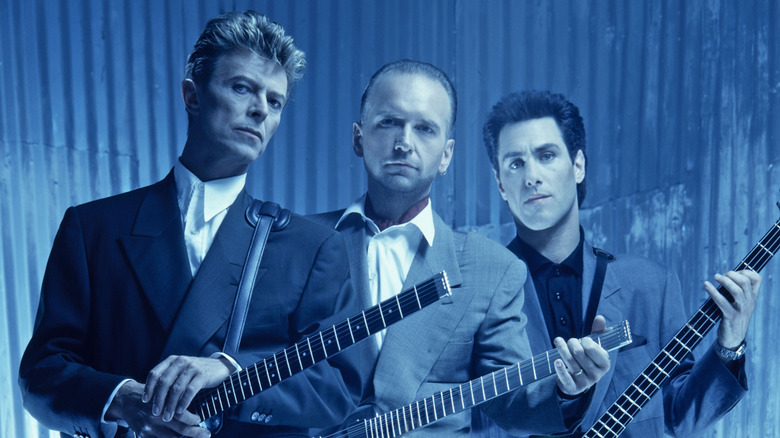
David Bowie was two decades into his epic career when he started a band called Tin Machine in 1988. The group's sound was noisy and all over the place, which was a stark contrast to Bowie's music up until that point. The group released its self-titled album in 1989, which featured a cover of John Lennon's "Working Class Hero."
The album failed to crack the top 20 on U.S. charts, and "Working Class Hero" didn't gain much steam on its own. The energy Bowie and the band bring to the song is refreshing, but the main message about the struggles of the working class seems to get lost amid the music, especially when compared to Lennon's acoustic take.
Despite its quirks, the song deserves a listen. This bluesy, gritty version of "Working Class Hero" is unlike anything Bowie's done before, and his drive to experiment with something different following decades of success is admirable. Some believe it's David Bowie's most underrated song — but we'll let you be the judge of that.