

We Bet You've Never Heard These Underrated Neil Diamond Songs
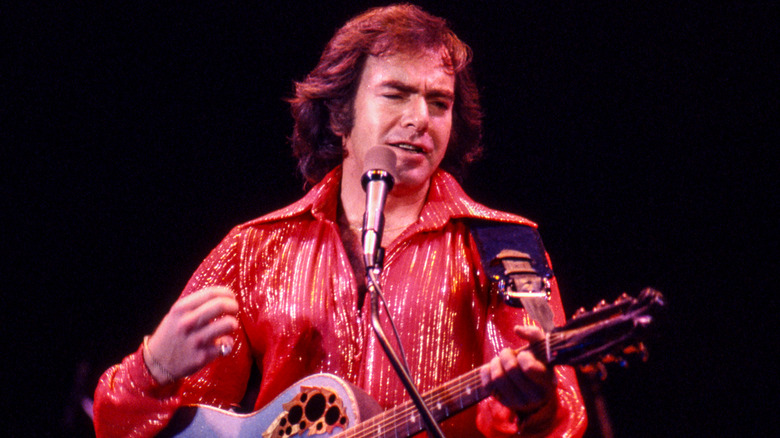
To millions of Red Sox fans, "Sweet Caroline" is the definitive Neil Diamond song, while others know his name thanks to Quentin Tarantino's use of "Girl, You'll Be a Woman Soon" in "Pulp Fiction." But this beloved Brooklyn son has a back catalogue that would make even the most accomplished artist green with envy. It is packed with bangers, from "Cracklin' Rosie" and "Soolaimon" to "Love on the Rocks" and the anthemic "America."
Those who have followed Diamond's decades-long career know there's much more to this fastidious singer-songwriter than a list (as long as your arm) of chart-topping songs, performed by him or other bands. We previously listed five of Diamond's tracks from the '70s that are so underrated, but with such a prolific output, they're not alone. Some of Diamond's most profound and interesting musical adventures have languished in the shadows of bigger, more mainstream hits, but no longer.
From an achingly beautiful 1980s ballad that proved he was still capable of great music even when his popularity was on the slide, to an under-the-radar anthem written for one of the most important figures of the 20th century, these Neil Diamond songs are absolutely worthy of your time and attention.
On the Way to the Sky
Every artist who has been around the block once or seven times experiences a dip in their output, and for Neil Diamond, that came in the 1980s. Released in 1981, the year after his hit movie "The Jazz Singer," the album "On the Way to the Sky" was a bit of a damp squib. It marked a musical change of direction for Diamond, and not everyone was convinced it was the right decision. Even in 2026, fans on social media regarded the album critically, with some suggesting it marked a downward trajectory for the singer-songwriter. Yes, the whole thing lacks oomph and all the ballads are a bit much for a single listen, but the title track is an elegant, hidden gem.
In the song "On the Way to the Sky," Diamond's gorgeous voice is as much of a draw as it ever was, while the waltz-rhythm strings and guitar soften lyrics that slowly build to a sucker punch to the soul. "We are two / And two of us are one / I'm back on my feet again / Out on the street again / Looking for love." It manages to be quintessentially Diamond, both beautiful and bittersweet. You'd have to have a heart of stone not to feel his pain.
Red Red Wine
Around 12 years ago in a Reddit AMA, Neil Diamond said the Monkees "kind of saved my career" after they recorded his song "I'm a Believer" and took it to the top of the Billboard charts in 1966. But they weren't the only band to turn one of the singer-songwriter's creations into a smash hit. In 1983, British outfit UB40 scored a domestic No. 1 with "Red Red Wine," as well as across the pond.
What not many people knew – the band included, as it turned out — was that the smash was originally written by Neil Diamond. "You could've knocked us out with a feather when we found out," Astro, aka Terence Wilson, told Billboard. In 1967, it featured among the songs on Diamond's second album, "Just for You," and, as you might expect, it has a very different vibe. It's a little slower and more melancholy, with lush strings providing a counterpoint to Diamond's lyrics.
Although the UB40 version mirrored the economic decline of Britain in the 1980s, in Diamond's hands "Red Red Wine" tells a very different story: A heartbroken man using alcohol as a way to "Make me forget that I / Still need her so." The UB40 cover remains a worldwide crowd pleaser, and even Diamond himself said it's one of his favorites. But as good as that is, we think his version stands on its own merit, too.
Dry Your Eyes
Neil Diamond is no stranger to stadium-wowing songs and often drew on his own life when writing. The two come together to incredible effect in "America," which was inspired by the singer-songwriter's immigrant grandparents, but it wasn't the first time Diamond sang about real people. In 1976, he worked with The Band's Robbie Robertson on the album "Beautiful Noise," after the pair were introduced by Bob Dylan. That collaboration also included the song "Dry Your Eyes."
In a 2014 Reddit AMA, Diamond explained how he'd started the song, but asked for Robertson's help to finish it. "I wanted it to tell the story of Martin Luther King's death, and how it affected society here in America and maybe even around the world," he said. We think Diamond and Robertson — who got joint writing credit on the album — knocked it out of the park. From the opening of brisk military drums to the soaring melody, it's an understated hymn that never fails to leave every hair on our bodies standing on end.
"And it taught us more about giving / Than we ever cared to know / But we came to find the secret / And we never let it go." It's a fair argument that "Dry Your Eyes" was overshadowed by the joyously upbeat "Beautiful Noise" title track back in the day, but we reckon that time has proved they complement each other beautifully.
Delirious Love
At 64, Neil Diamond had scored his fair share of hits, turned out some remarkable music, and filled stadiums around the world. He could quite happily have put his feet up and retired. Instead, he squirrelled himself away in the studio with producer Rick Rubin and created one of his best works: "12 Songs." Despite being his 45th studio album, "12 Songs" came straight in at No. 4 on the Billboard chart when it was released in 2005, and sitting pretty in the track list was "Delirious Love."
Described by Billboard as "jubilant," "Delirious Love" felt like a throwback to the 1960s. Given that vibe, it's no surprise that Brian Wilson, a founding member of The Beach Boys, was roped in for backing vocals duty, giving the song a summery feel. Although that was an alternative version of the song, for many people it's become their favorite.
However, we prefer the original version that features Diamond and Diamond alone. There's nothing to distract from his inimitable voice (which sounds every bit as good as it ever did), while the barely-there production reflects the pared-back feel of the rest of the album. Listening to them back to back, the solo Diamond track could have been cut yesterday, while the Wilson one, despite its popularity, feels a little dated and — yes, we dare say it — kitsch.