

We Bet You've Never Heard These Underrated David Bowie Songs
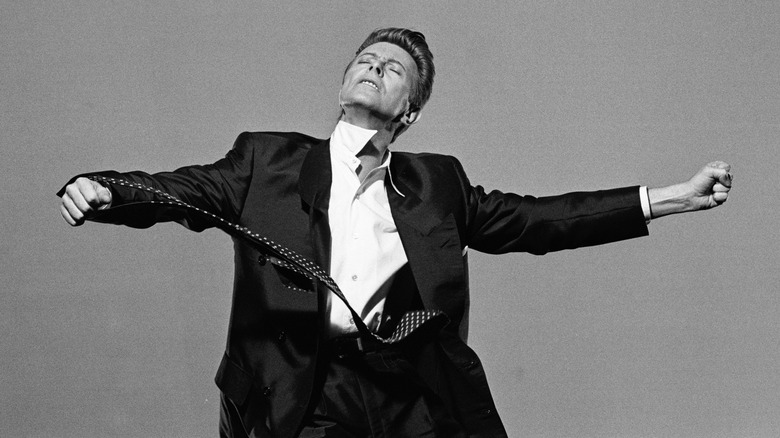
When no two albums across almost 50 years (1967 to 2016) are alike, or even any two songs, you know plenty of music is going to go under the radar. So it is with that most protean of persona-changing artists, David Bowie. For every "Space Oddity" and "Golden Years," there's a dozen underrated tracks that fans know, but casual listeners have probably never heard.
Bowie's entire oeuvre goes all the way back to when he went by Davy Jones in the mid-'60s after he finished school at age 16. With difficulty, his music career blossomed into expressive costumes, distinct eras and themes, and famous characters and looks like Ziggy Stardust. We all know the latter part of that story, plus instantly recognizable songs like "Under Pressure" and big hits like "Fame" and "Let's Dance" (both No. 1 on the Billboard Hot 100, though the latter is still one of Bowie's most underrated songs). All such information amounts to the most cursory, least developed version of the Bowie story, though. His true artistic brilliance rests well beyond the confines of his most accessible hits and most hummable tunes.
Hopefully, we can convey a bit of that depth and breadth in this article. And while we can't even begin to cover a comprehensive list of underrated Bowie songs, certain outings like the gorgeous "Lady Grinning Soul," the groovy "Secret Life of Arabia," and the suite-like "Station to Station" can provide a glimpse of what remains to explore.
Lady Grinning Soul
"Lady Grinning Soul" is a piece of lush, overwhelming, even cosmic beauty. Not to veer too much toward purple prose, but the opening piano trills and chords shimmer like crystal and establish a feeling of equal parts reverence and sensuality that carries through the entire piece. This is largely thanks to Mike Garson, the pianist who himself thanks listeners in the comment section of "Lady Grinning Soul's" YouTube video. Does this sound like we're overstating our case? Go ahead and listen. We doubt you'll think differently.
The track comes from David Bowie's 1973 "Aladdin Sane," aka "a lad insane," aka "Ziggy Stardust goes to America." As the last song on the album, it serves as a capstone to the 1972 American road trip that underpinned Bowie writing the album. With "Aladdin Sane," Bowie hyperbolized U.S. decadence to craft an album about the drug-addled, violence-filled, sex-obsessed fall of civilization told through the eyes of his character, Aladdin Sane. This implies that the beauty of "Lady Grinning Soul," and the woman it describes in lyrics like "She'll lay belief on you / Skin sweet with musky oil / The lady from another grinning soul," could be a destructive siren rather than a blissful partner.
We don't really know what Bowie intended with "Lady Grinning Soul." We also don't know how or where it fits into his American trip. We have a clue, though. Per Far Out Magazine, Bowie once said that the song "was written for a wonderful young girl whom I've not seen for more than 30 years ... When I hear this song, she's still in her 20s, of course."
The Secret Life of Arabia
It's interesting that we've got another album closer here, this time from 1977's "'Heroes'" (yes, the word "Heroes" is originally in quotes). Whether David Bowie saved his best songs for last, we don't know, although his last album, "Blackstar," is magnificent. We do know that "The Secret Life of Arabia" has the most silky-smooth bassline and funky, danceable rhythm section you could hope for, on par with that of the Rolling Stones' "Miss You," released the following year during disco's heyday.
Like "Aladdin Sane," "'Heroes'" grew directly from Bowie's personal experience. He recorded the album in Germany following a series of trips to various countries, including Switzerland, the Netherlands, Canada, and Japan. Maybe this got him thinking of other cultures and places, like those in the Middle East. "The Secret Life of Arabia" isn't too explicit about its meaning, either, aside from the allure of its music. "Never here, never seen / Secret life, evergreen," Bowie sings, and, "I was running at the speed of life / Through morning's thoughts and fantasies / Then I saw your eyes at the crossfades." Crossfade, we note, is a musical term that describes one sound fading in and another out. But perhaps the song's most telling lines are "You must see the movie, the sand in my eyes / I walk through a desert song when the heroine dies." "Heroine" could be a homophone for the drug, as Bowie used substances heavily through the '70s.
But really, all such questions only enhance the mystery of the song. And by the time you're double-clapping toward the song's end and grooving around, you'll believe the secret, too, even if you don't know what it is.
African Night Flight
We've got to include "African Night Flight" from 1979's "Lodger" in this article, if only because it's so bonkers. Coming two years after "The Secret Life of Arabia" and "'Heroes'" but continuing David Bowie's penchant for global inspiration, "African Night Flight" is probably his most gonzo, hard-to-understand work. Its wacko laser sounds, bleep-bloop percussive layers, odd psuedo-rapped vocals, and minimal melody will likely leave folks wondering whether Bowie received this song via extraterrestrial transmission from the future. In other words, it's way cooler than lots of music you'd hear today, like many Bowie songs, and highly underrated.
"African Night Flight" was inspired by a trip to Kenya where Bowie spent time with the Maasai tribe (which, back then, was much harder to visit and far more wary of outsiders). He also went on an honest-to-goodness "straightforward corny safari" with his son, as Bowie Bible quotes him, because he wanted the boy to see that animals didn't just live in zoos behind bars. Also, "African Night Flight" was apparently musically inspired by "Suzie Q." played backwards, the song that Creedence Clearwater Revival famously covered for their 1968 debut. Knowing only CCR's version, you'd never hear the connection to Bowie's song. The original 1957 Dale Hawkins version, however, has some chimy percussion that echoes in Bowie's 1979 work.
Does "African Night Flight" warrant a listen because of all this obscure music trivia? No. But, such trivia defines how much thought and effort went into a truly unique track by a truly unique artist that you probably never heard of unless you're a Bowie fan. The song is almost as odd as Bowie himself, in the best way possible.
Always Crashing in the Same Car
Probably the most radio-friendly, even typically "rock" of our choices, "Always Crashing in the Same Car" off 1977's "Low" channels Bowie's early-'70s, spacey tone and compositional features but reflects the minimally moving, looped phrases of a famous song like "'Heroes,'" which came out the same year. All in all, the song is oddly lowkey, almost trancelike, and could function as an album or concert closer. It's also got minimal lyrics that only hint at the song's true meaning.
"Always Crashing in the Same Car" operates on three different levels of meaning that showcase Bowie's natural creative instincts. There's the song's lyrical story, which describes a literal car crash: "Jasmine, I saw you peeping / As I pushed my foot down to the floor / I was going round and round the hotel garage / Must have been touching close to 94." This is an obvious allegory for Bowie, or anyone, doing something stupid again and again but being unable to change his behavior. The real-life inspiration for the song's self-destructive tale, however, involved a drug-addled escapade and "coke dealer whose car I saw on the Kurfürstendamm in Berlin one day, and I'd got it into my mind that he screwed me over a deal," as Bowie Bible quotes. To ramp up the ridiculousness, Bowie started ramming the drug dealer's car with his own car, which was a gift from Iggy Pop and Bowie's confidant, Coco Schwab.
It's all good, though. As NME quoted Bowie in 1997, "I thrive on mistakes. If I haven't made three good mistakes in a week, then I'm not worth anything. You only learn from mistakes."
Station to Station
We're going to end on a song that's taken on renowned status among David Bowie fans, much like its entire album of the same name, 1976's "Station to Station." As Bowie's longest studio song, "Station to Station" is through-composed, meaning it doesn't feature typical verse-chorus sections. The first part of the track features ambient train sounds that segue into a languorous, rolling melodic part, followed by an uptempo, syncopated rock section that mutates a bit before fading out. As the first song on "Station to Station," this is the song that introduced the public to one of Bowie's most disturbing personas, the Thin White Duke (which inspired comic book writer Grant Morrison's take on Batman's archnemesis, Joker).
Bowie clues us into the Thin White Duke's modus operandi with the very first lyric of "Station to Station": "The return of the Thin White Duke / Throwing darts in lovers' eyes." While ambiguous in Bowie's usual fashion, the lyrics allude to a destructive magic circle cast amid a scene of movement, the freedom of nature contrasted against the confines of fame and revelry, and a general sense of isolation most plainly stated in the lines "It's not the side-effects of the cocaine / I'm thinking that it must be love." Indeed, this song and its alter ego once again center on Bowie's experiences with excessive substance use in the '70s. Perhaps most pointedly of all, "Station to Station" segues into "Golden Years," a song that Bowie originally wrote for Elvis but which got repurposed into a disillusioned story about Bowie's own life.
But of course, the listener can ignore all this backstory and just soak up the music. Bowie would have probably approved of this approach, anyway.
If you or anyone you know needs help with addiction issues, help is available. Visit the Substance Abuse and Mental Health Services Administration website or contact SAMHSA's National Helpline at 1-800-662-HELP (4357).