

Musicians Who Tanked Their Careers With One Regrettable Collab
It's supposed to be an exciting or even newsworthy thing when two musicians connect for an epic collaboration — but every so often those all-star duets and joint projects wind up damaging a career instead of elevating them. It's rightfully a big deal when two or more major talents join forces, but sometimes those high-profile products don't justify the hype, or they're just plain bad. And then, what should've been a career highlight becomes the one moment that utterly destroyed the musician's career.
The reasons behind these pieces of music that were so poorly received by the public or reviled by critics and tastemakers vary. Celebrity hubris — where a famous musician is oblivious that their controversial decisions have consequences — can be blamed. Other times, the music itself just wasn't very good, or didn't measure up to previous, beloved works. Whatever the cause, it must have been shocking and humbling for these very famous and previously well-regarded stars of rock to be met with such a negative response to a song or an album because of who was partially responsible for the music. These musicians delivered fatal or near-fatal blows to their own careers and reputations with just one ill-advised collaboration.
Sting made an album with Shaggy
As the frontman of the Police, British singer-songwriter Sting was largely responsible for "Every Breath You Take," a classic rock song worth a head-turning amount of money, among other smash hits. Then he went solo, positioning himself as a craftsman of sophisticated and mature pop music, like "Fortress Around Your Heart," "Fields of Gold," and "Desert Rose." In the 2010s, he changed up his style, returning to the reggae he played around with while in the Police by teaming up with Jamaican-American reggae-R&B star Shaggy for the 2018 album "44/876." The title calls out the collaboration: +44 is the telephone calling code for Sting's U.K.; 876 is a Jamaican area code.
While "44/876" won the Grammy for Best Reggae Album in 2019, it was Sting's last such award, as of 2026. The album flopped, debuting and topping out at No. 40 on the Billboard 200, Sting's worst performance ever on that chart to that point. The showcase single "Don't Make Me Wait" didn't reach the Hot 100, petering out at No. 29 on the obscure Adult Album Alternative list. While Shaggy continued to sell lots of albums in the reggae sector, Sting seemed to lose the public's interest with and after "44/876." Subsequent albums, "My Songs" in 2019 came in at 101 on the Billboard 200 album chart, and "The Bridge" in 2021 only made it to 145, making those records two of his worst received ever.
Cher and Greg Allman fell in love and made a record
Throughout most of the 1970s, Cher was undeniably one of the most popular and omnipresent celebrities around, starring in a series of TV variety shows, both with and without her husband and musical partner Sonny Bono, and scoring three No. 1 hits. The same week that her divorce from Bono was finalized in 1975, Cher married Greg Allman, singer and keyboard player for the classic Southern rock group the Allman Brothers Band. In 1977, Cher once more musically collaborated with her spouse, the pair issued "Two the Hard Way," strangely attributed to "Allman and Woman." Promoted with the single "Move Me," which combines Allman's jangly Southern rock, Cher's dance music, horns, and the couple shrieking in unison, "Two the Hard Way" sold so poorly it never made the album chart, unthinkable for either musician in the '70s. "It's hard to imagine a more inappropriate combination than Greg Allman and Cher," Rolling Stone declared in a one-star review. "It's the bottom of the barrel."
The duo went their separate ways in 1979, the same year Cher briefly revived her career with the Top 10 hit, the disco-based "Take Me Home." Subsequent albums, "Prisoner" and "I Paralyze." didn't sell; she didn't return to the pop chart until 1987 with "I Found Someone." Around that time, Allman gave non-Allman Brothers music another shot and sold half a million copies of his LP "I'm No Angel."
Coverdale-Page didn't do much for David Coverdale
Two hard rock icons came together in the 1990s at the behest of a higher-up at Geffen Records — he thought former Whitesnake singer David Coverdale and ex-Led Zeppelin guitarist Jimmy Page could get something going. The two men barely knew one another but warmed to the idea, wrote some songs, and recorded a self-titled 1993 album under the name Coverdale/Page. While the singles "Pride and Joy," "Shake My Tree," and "Take Me for a Little While" were all massive hits on U.S. rock radio, and the LP sold a million copies, the Coverdale/Page project was publicly savaged by Robert Plant — Page's former Led Zeppelin cohort, who'd called off a reunion of that band before Page moved to Coverdale. In interviews, Plant repeatedly and unfavorably compared Coverdale's voice to his own, derisively nicknaming him "David Cover-version." "I found it difficult to understand his choice of bedfellow. I just could not get it," Plant said in "No Quarter: The Three Lives of Jimmy Page."
Coverdale/Page seemingly forced Plant's hand. In 1994, Plant and Page taped an acoustic-style concert, "Unledded," for MTV, released as the album "No Quarter," and then they toured in 1995. That completely shut out Coverdale. His next LPs didn't arrive until 1997 and 2000, and neither sold particularly well.
Lou Reed's final album was a Metallica album too
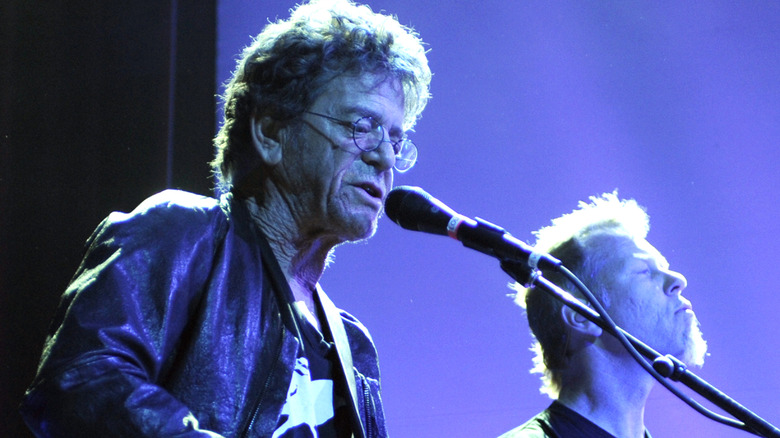
As bard of the underworld and the voice of the downtown underclass of New York misfits, Lou Reed helped create alternative rock and took popular, mainstream music to dark and seedy places with both his band the Velvet Underground in the '60s and as a solo artist in subsequent decades. In 2011, he released his first studio album in four years: "Lulu." Inspired by the works of experimental playwright Frank Wedekind, the songs consisted of Reed speaking and pointedly shouting over chaotic, loud, and heavy rock, provided by a band that made a fortune doing such a thing: Metallica.
The public greeted "Lulu" with a combination of hostility and apathy, particularly from Metallica fans, Reed claimed. "They haven't even heard the record yet and they're recommending various forms of torture and death," he told USA Today. When consumers could buy "Lulu," few did. The LP spent just one week on the Billboard 200 at the No. 36 spot in November 2011, a shockingly disappointing number for household names like Reed and Metallica. It was the last LP Reed would record before his death in October 2013. As of late 2014, "Lulu" had sold just 33,000 copies.
The third time wasn't the charm for Van Halen
Van Halen arguably got better when it replaced lead singer David Lee Roth with Sammy Hagar, but after the band managed to alienate and let slip away both frontmen by the late 1990s, it needed yet another vocalist. The man who got the job was Gary Cherone, previously the voice of the hard rock band Extreme, whose 1991 ballad "More Than Words" is among the worst No. 1 hits of the '90s. With Cherone on the mic, "Van Halen III" hit stores in March 1998 and debuted at No. 4 on the album chart. That's fine, but it was the lowest peak for a Van Halen LP in 17 years. Those relatively good times didn't last — "Van Halen III" ultimately shifted about half a million copies, the worst-selling album in Van Halen history to that point.
Cherone and Van Halen parted ways in November 1999, and neither the band nor the abandoned singer fared well in the decade or so post-split. Van Halen toured sporadically in the 21st century — sometimes with Hagar, sometimes with Roth, but never producing another studio album until "A Different Kind of Truth" (featuring Roth) was released in 2012. Cherone struggled to rebound, too. In 2002, he sang on a little-heard indie album by Tribe of Judah — made up primarily of ex-Extreme members — before reconvening Extreme for spells in 2004, 2006, and 2008.