

The 5 Most Important Classic Rock Songs For Boomers
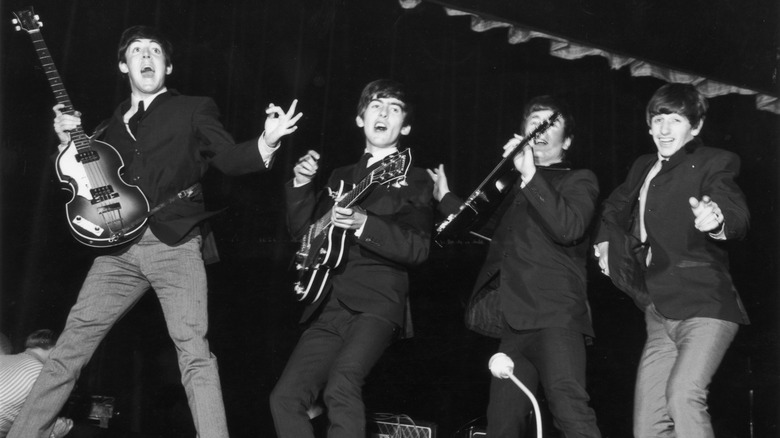
Born from 1946 to 1964, from the prosperous wake of World War II through the beginnings of Beatlemania, baby boomers lived lockstep with their music. They came of age with all manner of exceptional, genre-and-era-defining classic rock that spoke to the times, from Elvis to Bruce Springsteen. Certain songs, though, got elevated to the highest of generational standard-bearers that rank amongst the most important of boomer music.
But no matter that folks tend to lump all baby boomers together, boomers themselves are split into two sub-generations: early boomers who came of age in the '60s (born 1946 to 1954) and what's called "Generation Jones" who came of age in the '70s (born 1955 to 1964). In choosing songs for this article, we've got to hit both generations as they connect to greater social-cultural touchstones: pre-Beatles rock 'n' roll, mid-to-late-'60s Summer of Love era rock, Civil Rights and anti-war movements, '70s musical experimentation and early arena rock, and even the eventual shift towards the excesses of the '80s. That's a whole lot of ground to cover, so we've got to choose the most impactful, stand-out songs along the way.
On that note, we already mentioned the Beatles, the most influential band of the 20th century. Elvis played an enormous role in the lives of boomers before them, same as Zeppelin did after. We've also got a song from Buffalo Springfield that embodies social changes in the mid-to-late '60s, and another from Bruce Springsteen that does the same for the mid-to-late '70s.
Hound Dog — Elvis Presley
When looking to the earliest boomers' first musical experiences as young adults, the question is more, "Which Elvis song will we choose?" rather than, "Will we choose an Elvis song?" Elvis brought together country, blues, gospel, and more into something new and manifold that basically every musical listener on the planet could grok. There's a reason why he's called "The King of Rock 'N' Roll," even if he tragically died at a mere 42 years old. And while we could practically choose any of his songs as critical to baby boomers, we've got to go with "Hound Dog" for its verve, undeniable catchiness, and yes, the type of hip-shaking dancing that almost got him arrested for "impairing the morality of minors," as Ultimate Classic Rock quotes.
Released as a 1956 single along with "Don't Be Cruel," "Hound Dog" is a dancey, irrepressible, undeniably cool tune that serves as a stand-in for other '50s rock hits. Collectively, these songs laid the foundation for rock's future, including Chuck Berry's "Johnny B. Goode" and Little Richard's "Good Golly, Miss Molly." But let's be honest: Elvis' cosmically gravitational charisma and good looks went a long way to making the song a success, same as they helped make him an icon. From then on, good looks and charm remained a defining feature of top-tier rock artists all the way through the present.
Of course, credit also has to go to "Hound Dog's" writers, Jerry Leiber and Mike Stoller, who wrote the song in "like twelve minutes," as Rolling Stone quotes Leiber. But in the hands (and hips, hair, and smile) of Elvis, that's all the song needed.
I Want to Hold Your Hand — The Beatles
Beatlemania consumed the world like a firestorm following the release of The Fab Four's 1963 debut, "Please Please Me." The term "Beatlemania" already existed by the time their second album, 1963's "With the Beatles" came out, an album that displaced their debut album at No. 1 in the U.K. In 1964, this album got refashioned into "Meet the Beatles!" for a U.S. release, which contained a song that made fans shriek, howl, faint, and create fan clubs: "I Want To Hold Your Hand." The world of music, and the world, period, would never be the same.
The Beatles picked up the baton from rockers like Elvis, Little Richard, and Buddy Holly to set the standard for band-based music to come. They pushed recording technology further than it had gone before, reworked albums into entire, artistic pieces full of artwork and high concepts, and even popularized the music video. All of these factors might not be apparent in a super simple tune like "I Want to Hold Your Hand," but that song epitomizes what made the public latch onto the four young lads from Liverpool. It's an extremely hummable ditty; it featured lyrics that drove fans wild ("And when I touch you, I feel happy inside"), gave each of the four Beatles and their identical haircuts a bit of the limelight, and most importantly, cemented their fame and proved that "Please Please Me" was no fluke. There was no escaping the Beatles at that point.
And indeed, this was all engineered. the Beatles' manager, Brian Epstein, urged the Beatles to make a song targeting the U.S. market. On the 17th take they got it, and baby boomers got their next generation-defining song.
For What It's Worth — Buffalo Springfield
The counterculture of the '60s feels a long way from the advent of Beatlemania, but it was only a few short years packed with historical events that crafted the world of baby boomers and their musical tentpoles. JFK's assassination, Malcolm X's assassination, Martin Luther King Jr.'s assassination, the Civil Rights Act of 1964, the Summer of Love, the Vietnam War and anti-war protests, the Apollo 11 moon landing: It must have felt like the entire world was shifting beneath people's feet. Popular music often reflected this sentiment, particularly when it came to protest songs. And while lots of songs could suffice for this point, we feel that 1967's "For What It's Worth" by the short-lived Buffalo Springfield captures the spirit of the time the best.
The oldest of boomers would have been about 20 to 21 years old when "For What It's Worth" came out, meaning that the song also hit a swath of teens and kids. They heard the uncertainty of the times summarized in the song's opening melody and lyrics, "There's something happening here / But what it is ain't exactly clear." The music remains mellow and inviting, but also contemplative and a bit trippy, kind of like a hippie daydream.
Despite so being applicable to the entirety of the mid-to-late '60s, songwriter Stephen Stills actually wrote "For What It's Worth" in response to a single event. He was walking on Sunset Strip, Hollywood, when "three busloads of Los Angeles police" swept into a crowd of young adult protestors, as Rolling Stone quotes him. He immediately set about writing "For What It's Worth" and finished in 15 minutes. Mere weeks later, the single saw the light of day.
Stairway to Heaven — Led Zeppelin
At this point, we've all heard "Stairway to Heaven" so many times that it might seem like a passé choice for a meaningful boomer song. But if we can listen with fresh ears, remembering that the 1971, non-single track grew in acclaim naturally over time via radio, then we can maybe — just maybe — start to glimpse Led Zeppelin's electric, fresh, and immense star power. They took the rock celebrity mantle from The Beatles and reprised it for boomers coming of age in the post-'60s, when the values of the counterculture were cemented in place and already calcifying. This was the music of Generation Jones, for whom Elvis' heyday was already 15 years gone.
Buried in Zeppelin's fourth studio album after a track about "The Lord of the Rings" ("The Battle of Evermore"), "Stairway to Heaven" quickly assumed its place as music's greatest rock voyage. Every point that folks assumed would work against the song worked for it. It was a non-radio-friendly eight-minutes-long, was through-composed (written in sequential, non-repeating fashion), and featured a slow-burning, acoustic intro that took almost a minute to deliver any lyrics. But it was epic as hell, and both radio stations and the music-listening public loved it, right down to Jimmy Page's iconic solo. The song even fostered mythological stories amongst Zeppelin's fandom, including an apocryphal origin tale about the song being written in an off-the-grid Welsh cottage. Fans went so far as to travel to the region to try to locate it.
In short, "Stairway to Heaven" is the most massive song from Generation Jones' most massive stars. No other song could earmark the lives of boomers of a certain age so perfectly.
Born to Run – Bruce Springsteen
The youngest of boomers were entering adolescence in the mid-to-late '70s, in a time characterized by disillusionment, a focus on self-fulfillment over collective good, lost dreams of peace, love, and unity, and leading into '80s excesses. During this epoch, Bruce Springsteen rose to represent the waning hopes of the working-class public. His everyman ethos and lyrical poeticism reached an early peak with 1975's "Born to Run" from the album of the same name, a song that nails the meaning of life and speaks to fundamental human feelings as much as it does its time.
Jam-packed with vivid imagery typifying the restless desires of youth, "Born to Run" paints a story in vignettes: "The highways jammed with broken heroes / On a last chance power drive," "Together we could break this trap / We'll run 'til we drop, baby we'll never go back," "Oh, baby this town rips the bones from your back / It's a death trap, it's a suicide rap," etc. "Born to Run" also sounds very much like a proto-'80s track in terms of instrumentation and production, and could never be mistaken for a record from the early '70s, let alone '60s or '50s. It's quintessentially of its time while speaking to all time, sung through a down-to-earth voice different from its rock predecessors.
Springsteen didn't just write "Born to Run" as a conceptual piece. It's practically autobiographical and talks about how he felt trapped in his 20s, in terms of housing and career. And because he rose above his circumstances, so can the listener, it seems. Fewer things could be more important to young people coming of age, especially boomers who grew up with the song.