

The Best Slow Songs Of The '60s Are Simply Timeless
The remarkable thing about timeless songs is that they do what music does best: they unite people. While songs made for popular genres in different eras may help a generation bond over their shared fandom for the hot thing of the moment, the songs on this list from the 1960s were so timeless that they stayed relevant and managed to touch people across the decades. Even if they sound of their time, their messages still resonate, and the song arrangements are just so gorgeous that listening to them never gets old.
Here, we're looking specifically at the slow jams, those songs that are usually best heard alone so you can really listen and let the music take you where it leads. Their timelessness is proven by how often the songs have been covered or used over the decades in all types of media for various purposes, and their streaming numbers are still going strong. These songs are established pop-culture classics, with time putting a desirable patina on tracks that have been beloved for six decades. Let's take a closer look at these slow songs from Ray Charles, Sam Cooke, Aretha Franklin, the Beatles, and Jimi Hendrix, which came from the '60s but endured over the years to become absolute classics.
Georgia on My Mind — Ray Charles
There's something soothing about Ray Charles' "Georgia on My Mind," and that probably lends itself to the timelessness of the song. It's not just the orchestral arrangement behind Charles' soulful piano playing and singing, but also the lines in the lyrics that conjure images of "moonlight through the pines." The song, originally written by Stuart Gorrell and Hoagy Carmichael in 1930 and released by Charles in 1960, could be about the state, which adopted the tune in 1979. Or, it could be about a woman named Georgia, who stays paramount to the singer even as "Other arms a-reach out to me / Other eyes smile tenderly." Regardless, the lyrics maintain his thoughts stick with Georgia, where or whom the road always leads back to. The elusiveness of meaning works well to make this Billboard Hot 100 No. 1 hit work for any listener who understands the feeling of longing for something left behind, after finding that nothing else compares.
"Georgia on My Mind" won Grammys for best performance by a pop single artist and best vocal performance single record or track, and was nominated for record of the year. In addition to all of the accolades, Michael Lydon described the song's impact in his book "Ray Charles: Man and Music, saying, "With 'Georgia on My Mind,' Ray began to plumb not only the Black American soul, but the soul of the country." The song has been covered by many artists over the decades, from Willie Nelson to Coldplay and Kelly Clarkson. Charles' version is over 65 years old, and the song was written nearly 100 years ago, but Charles' original master recording, which has more than 153 million streams on Spotify, is still proving its appeal all these years later.
A Change Is Gonna Come — Sam Cooke
Sam Cooke's 1964 release "A Change Is Gonna Come" is steeped in deep meaning. It was a departure for Cooke, who wrote the song in 1963 after being inspired by Bob Dylan's "Blowin' in the Wind." Cooke started his career in a gospel group, the Soul Stirrers, and then went solo. His secular career in the late '50s and early '60s saw the release of radio-friendly pop songs like "Cupid," "Chain Gang," and "Twisting the Night Away," but as the Civil Rights Movement gained traction, and in part due to an escalating incident when Cooke, his band, and his wife were told they couldn't stay at a Holiday Inn in Louisiana because they were Black, Cooke penned "A Change Is Gonna Come."
Cooke's song brings in orchestral elements to bolster the lyrics, which are sung with such conviction that it's impossible not to feel the bone-weariness of its singer: "I was born by the river / In a little tent / Oh, and just like the river, I've been running / Ever since." He laments that he is unwelcome in his own community, with lyrics like "I go to the movie / And I go downtown / And somebody keep telling me / "Don't hang around" / It's been a long / A long time coming, but I know / A change gon' come / Oh, yes, it will," and in the song's lyrical simplicity, without calling out specifics, his humanity is laid bare even as the song points out societal injustices.
The song was immediately embraced by the Civil Rights Movement and has inspired more than 500 recordings by various artists, is a regular choice on greatest songs of all time lists, and is included in the National Recording Registry at the Library of Congress.
(You Make Me Feel Like) A Natural Woman — Aretha Franklin
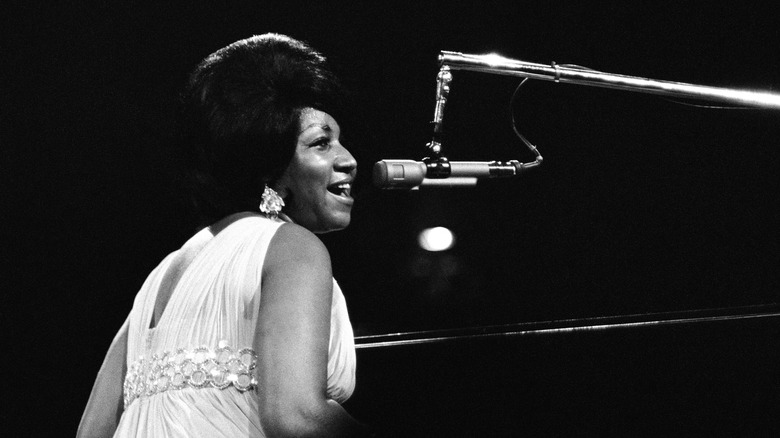
When a 73-year-old Aretha Franklin sat at a piano on stage at the 2015 Kennedy Center Honors, where prolific songwriter and singer Carole King was being honored, she began playing "(You Make Me Feel Like) A Natural Woman," and King, who wrote the song with ex-husband and songwriting partner Gerry Goffin in 1967, was visibly awestruck. By the time the song was over, Franklin had everyone on their feet, including former President of the United States Barack Obama, and she showed that her ability to move people — literally and figuratively — with her soulful delivery of a timeless song was still as powerful as ever.
The song was written specifically for Franklin at the behest of Atlantic Records' Jerry Wexler, who told King and Goffin (via the Financial Times), "I'm looking for a really big hit for Aretha. How about writing a song called 'Natural Woman'?" They had a demo by the next day, and shortly thereafter, Aretha came back with her spin on the song that would forever be remembered as one of her greatest hits.
The song went to No. 8 on the Billboard Hot 100 in November of 1967. Many others have sung it and recorded it, including Carole King, but no one touches the Queen of Soul's dynamic version. In Franklin's hands, the song grabs us and pulls us in. Even though the lyrics say "You make me feel" over and over, if we're being honest, she makes us feel with this song. That's what makes it such a timeless classic.
Blackbird — The Beatles
In 1968, the Beatles recorded "Blackbird" as a song of hope for Black women in America. "Blackbird" was one of many songs on the band's 1968 double LP best known as "The White Album," and in later years, Paul McCartney explained his inspiration for the song's lyrics. He told GQ (via TikTok) that he was aware of the struggles during the Civil Rights Movement in the U.S., and thought "it would be really good if I could write something that if it ever reached any of the people going through those problems, it might kinda give them a little bit of hope, so I wrote 'Blackbird'." He went on to clarify that in the U.K., women are often referred to as "birds."
"Blackbird" is soft and melodic with a mid-tempo rhythm. While the music was inspired by Bach, the lyrics are simple yet poignant: "Blackbird singing in the dead of night / Take these broken wings and learn to fly / All your life / You were only waiting for this moment to arise." The song is reminiscent of a lullaby, and unlike the other songs on this list, is pared down to just beautiful acoustic guitar work accompanied by McCartney's singing and the gentle tapping of his foot keeping time.
The message of hope in "Blackbird," accompanied by a gentle, melodic arrangement, makes the song one that we never get tired of hearing, and over 672 million Spotify streams prove we aren't alone in that opinion.
Little Wing — Jimi Hendrix
Of all the songs on this list of timeless slow jams, the one that has easily gotten the least acclaim is Jimi Hendrix's "Little Wing," an introspective masterpiece that leans into electric guitar and blues-based rock's most aching and mournful tendencies, but in a good way. The song was released on "Axis: Bold as Love" in 1967, and at only two minutes and 25 seconds, it leaves us wanting more.
The lyrics are about an ethereal woman who's "walking through the clouds." According to Charles Cross' Hendrix biography, "Room Full of Mirrors," Hendrix said the song was about his time in Monterey, telling a reporter, "... I take everything I see around, and put it maybe in the form of a girl ... and call it 'Little Wing,' and then it will just fly away." But he also said it was about his dead mother, Lucille, who died in 1958 when Hendrix was in high school. The second half of the song seems to speak to how he may think of her: "When I'm sad, she comes to me / With a thousand smiles she gives to me free / 'It's alright' she said, 'it's alright / Take anything you want from me / Anything'." We think that aspect of the song lends itself to the haunting yet tender beauty of the powerful piece.
As of mid-2026, Spotify shows more than 345 million streams of "Little Wing," and the song has been covered by guitar greats Eric Clapton and Stevie Ray Vaughan, both of whom used the song to stretch out, building on Hendrix's brief but bewitching original. Still, his version from the 1960s is simply timeless.