

Albums That Serve As A Musician's Heartbreaking Final Goodbye

Far too many rock stars have died tragically, and other musicians have died in the most bizarre ways ever, yet a select few were forewarned enough to be able to spend what time and energy they had left to record one final, heartbreaking album. Those last LPs are by their nature somewhere between bittersweet and tremendously sad. Ruminating on life, impending death, and the wonders and disappointments of life, those albums recorded in the final months and under harrowing emotional duress become striking artistic statements. Often, this is in no small part due to the health issues the artists were dealing with during their last recording sessions, whether old age, cancer, or other terminal illnesses.
From Freddie Mercury telling us all that "The show must go on" to Glen Campbell's "Adios," here are the musical icons of the 20th century who, with death on the horizon, mustered the mental and physical strength to say farewell to fans and the world at large with one last powerful album.
Blackstar — David Bowie

On January 8, 2016, David Bowie celebrated his 69th birthday with the album "Blackstar." Critics rated it alongside the classic albums Bowie recorded during his 1970s heyday, but the late-career affirmation wasn't altogether joyous. Two days after the album reached the public, a tragedy played out. "David Bowie died peacefully today surrounded by his family after a courageous 18-month battle with cancer," stated a post from the musician's official Facebook page. Bowie had kept his cancer treatment out of the public sphere, instead devoting much of his creative energies to building a final record.
"Blackstar" was in the works in 2014 and was complete by November 2015, when Bowie learned he was likely to die soon. As production progressed, with the aid of his preferred producer Tony Visconti, Bowie split his days between chemotherapy treatments and recording sessions. At one point, as he told Rolling Stone, Visconti exclaimed in realization to Bowie, "'You're writing a farewell album' ... He was so brave and courageous."
"Blackstar" cover designer Jonathan Barnbrook also caught on. "This was a man who was facing his own mortality," he told Deezen. The single "Lazarus" makes that explicit, opening with the lines "Look up here, I'm in heaven / I've got scars that can't be seen," and ends with "Oh, I'll be free, ain't that just like me?" "I Can't Give Anything Away" is a subtle admission, too. As Bowie sang in one lyric: "This is all I ever meant / That's the message that I sent."
Innuendo — Freddie Mercury with Queen
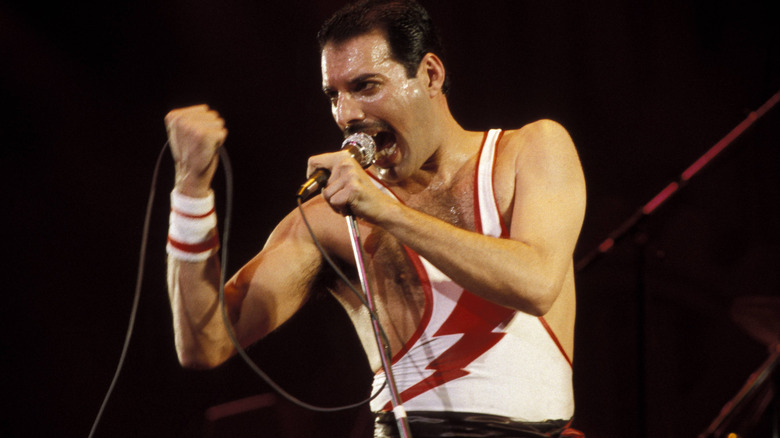
While best known for its 1970s classic rock anthems like "Bohemian Rhapsody" and "We Are the Champions," Queen kept churning out hit records into the 1990s. In early 1991, its album "Innuendo" reached the Top 30 in the U.S. and hit No. 1 in the band's native U.K. That LP also happened to be extremely difficult for Queen to record, as lead singer Freddie Mercury was very sick from complications of AIDS. The public wasn't aware of the diagnosis, but there was a sense that something was amiss after Mercury appeared emaciated in a few music videos and at an awards show. The vocalist was so ill that he had a hard time even getting to his feet to record. He did muster the effort to work with guitarist Brian May on the track "The Show Must Go On," which in retrospect very much seems like a twilight farewell from the bombastic Mercury. "The show must go on," he sings. "Inside, my heart is breaking / My makeup may be flaking / But my smile still stays on."
In November 1991, Mercury publicly disclosed that he was living with AIDS. The next day, he died; he was 45.
American IV: The Man Comes Around — Johnny Cash
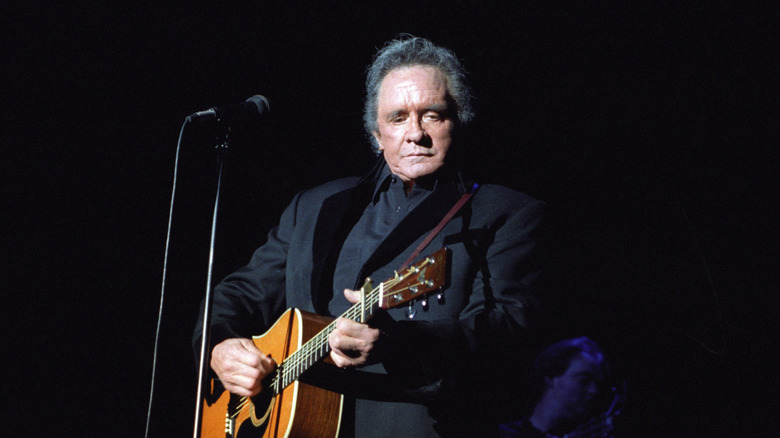
When Johnny Cash covered "Hurt" by Nine Inch Nails, his stark, dark-folk 2002 version of a noisy industrial-alternative rock song from 1994 revitalized his career and reminded the world why he'd been such a transfixing and popular musician in the mid-to-late 20th century. The song was also the headline-grabbing highlight from "Americana IV: The Man Comes Around." Cash spent the final decade of his life working on a series of "Americana" albums with hip-hop and hard rock producer Rick Rubin, all of which included new Cash songs and reinterpretations with little accompaniment besides an acoustic guitar.
"Americana IV" featured numerous meaningful and sentimental chestnuts, filtered through the soulful voice and unique point of view of Cash. In addition to "Hurt," the LP contained covers of Depeche Mode's "Personal Jesus," the Beatles' "In My Life," and Simon & Garfunkel's "Bridge Over Troubled Water." While Rubin would compile more "Americana" albums in later years, "Americana IV: The Man Comes Around" is the last album Cash completed and released while he was alive. Dealing with severe effects of diabetes in his final days, Cash died in September 2003 at the age of 71.
You Want It Darker — Leonard Cohen

One of rock's most enigmatic characters, whose works were as much poetic journeys into the darkest reaches of the soul as they were beautiful and creepy songs, Leonard Cohen was a true original. He released over a dozen studio albums, many of them adored by music critics, but he's best known for "Hallelujah," his epic, devastating, and voluminously covered ballad from 1984. By the fall of 2016, Cohen was dealing with a series of medical issues that left him essentially housebound and unable to do lengthy performances. Throughout the year, he worked on an album called "You Want It Darker," whose lyrics focused on heady concepts such as life, death, and spirituality.
At what would be Cohen's final public appearance in October 2016, a press event to promote "You Want it Darker," he implied to reporters that he felt his days were numbered. Less than three weeks after the LP was issued, Cohen had a nighttime fall and went on to die while he slept on November 7, 2016. He was 82 years old.
The Wind — Warren Zevon

Warren Zevon tended toward the snarky, satirical, and humorous across his long career, abundant on his only Top 40 hit, 1978's "Werewolves of London." Things get a lot more serious — profound and moving even — on Zevon's last studio album. The musician intended for "The Wind" to be his final creative work, written and recorded following a 2002 diagnosis of incurable mesothelioma, or lung cancer. The album is the sound of a man putting his affairs in order and recording his most pressing thoughts. "If I can let someone know what I felt about them, that's more important than passing off some bull**** insight I've had about living on the planet," Zevon told Rolling Stone.
Be that as it may, the LP's closer packs an emotional wallop. In "Keep Me in Your Heart," Zevon acknowledges that the end is near and hopes that he isn't soon forgotten or letting down his loved ones. "Shadows are falling and I'm running out of breath / Keep me in your heart for a while / If I leave you, it doesn't mean I love you any less." "The Wind" hit stores on August 26, 2003, and its artist died 12 days later at age 56.
Don't Worry About Me — Joey Ramone
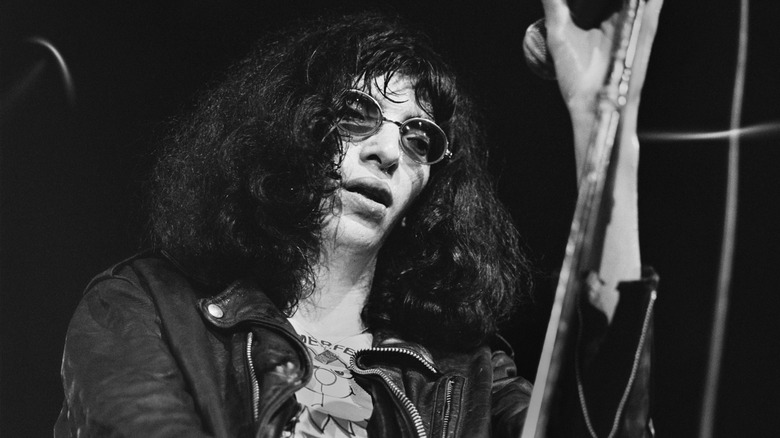
The Ramones were central to the sound of '70s punk rock in America. The Queens, New York, foursome was created in 1974 by Jeffrey Hyman, who took on the stage name of Joey Ramone. He became a snarling, crooning forefather of underground rock, fronting the Ramones until the group split up in 1996. About two years earlier, Hyman learned he had lymphoma, a form of blood cancer. Nevertheless, Hyman remained undeterred about a solo career, free of the creative strictures of the Ramones. He wanted to make music that veered away from punk and into pop, and he did just that with "Don't Worry About Me."
The album also found Hyman grappling with his diagnosis and fearing for the future. "Sitting in a hospital bed / I want my life," he sings in "I Got Knocked Down (But I'll Get Up)," "it really sucks." Another track that stands out, considering the circumstances, is the album's first song, "What a Wonderful World." A cover of the beautiful but longing ballad made famous by Louis Armstrong, it's Ramones-sounding music but with a sweetness and earnestness not usually found in the band's catalog.
The tragic real-life story of the Ramones played out when Hyman, aka Joey Ramone, died at age 49 in April 2001. "Don't Worry About Me" was released nearly a year later, in February 2002.
Equal Strain on All Parts — Jimmy Buffett
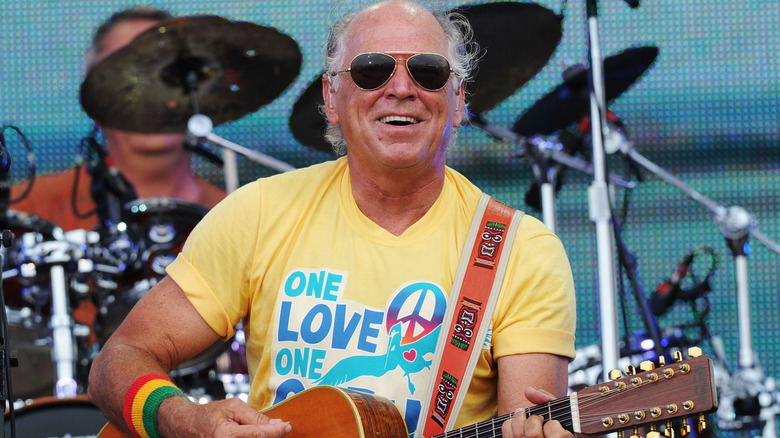
The story of Jimmy Buffett is that of a musician who was a genre unto himself. His witty story songs combined country, folk, and rock, and promised a life of tropical adventure. Buffett sold millions of LPs to his loyal "Parrothead" followers, and his 32nd studio album, "Equal Strain on All Parts," arrived in November 2023 — two months after the singer-songwriter died of skin cancer at age 76.
Buffett received his diagnosis about four years prior to his death and spent a portion of that time recording "Equal Strain on All Parts," finishing just as he grew too ill to work. The songs are laced with life lessons and wisdom. Album contributor Paul McCartney praised "Bubbles Up" in a public remembrance. "I told him that not only was the song great but the vocal was probably the best I've heard him sing ever," he wrote on Instagram. "He turned a diving phrase that is used to train people underwater into a metaphor for life when you're confused and don't know where you are just follow the bubbles."
The final song on the LP, and thus Buffett's last ever, was a cover of Bob Dylan's "Mozambique." This song about a beach carries extra weight when sung by the king of beach music as he neared death. After describing an idyllic oceanside party scene, Buffett notes that it's time "to say goodbye" and steals a last glimpse of how perfect and beautiful it all was.
Adios — Glen Campbell
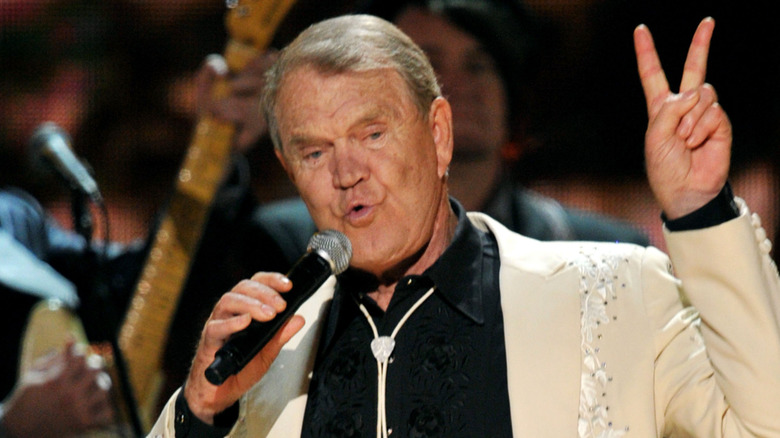
Glen Campbell led quite a few musical lives. In the 1960s, he was a session musician and touring guitarist for the Beach Boys, and in the 1970s, he turned to country and took songs like "Southern Nights" and "Rhinestone Cowboy" to No. 1. Campbell's reputation as a songwriter became legendary, and his "Wichita Lineman" is the greatest song of all time, according to Bob Dylan. After learning that he had the degenerative neurological condition Alzheimer's disease in 2011, Campbell hit the road for the self-explanatory "Goodbye Tour," then headed to a Nashville studio to record a final album, the appropriately titled "Adios."
Consisting of covers of hand-picked classic tunes that Campbell loved, the musician was assisted by Vince Gill, Willie Nelson, and his three grown children. Among the poignant modern standards Campbell tackled were "Funny (How Time Slips Away)" and "Don't Think Twice, It's All Right." By that point, Alzheimer's had affected Campbell's cognitive abilities to the point where the singer had to be fed each line individually. "Adios" went on sale in June 2017; Campbell died two months later at the age of 81.
Man Machine Poem — Gord Downie with the Tragically Hip
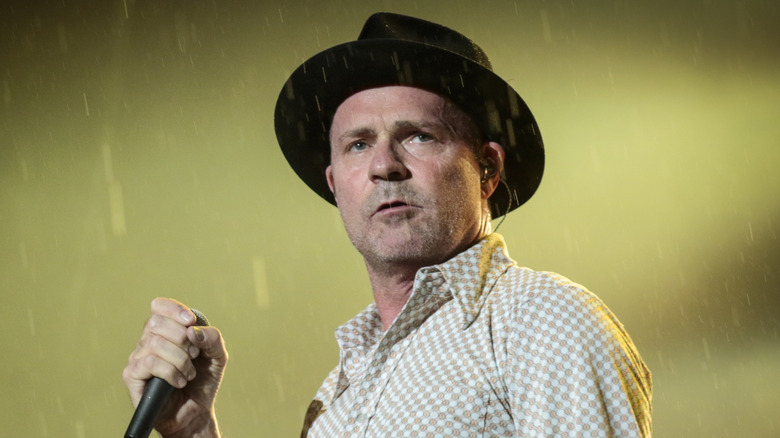
As front man of the famed Canadian band the Tragically Hip, Gord Downie's songwriting style was compared to poetry. He frequently wrote about Canadian life and culture, and so effectively that Ontario created a poet laureate position in his name, an honor sadly bestowed posthumously. In December 2015, doctors diagnosed Downie with glioblastoma, a type of brain cancer with no known cure. Downie told the public he was dying in May 2016, and the next day, announced that the Tragically Hip would play a summer tour of farewell concerts across Canada. Those concerts also showcased the then-new studio album "Man Machine Poem."
Through "Man Machine Poem," Downie took the chance to deliver emphatic, beautiful statements and cope with his approaching death. "I love you so much, it distorts my life," he sings on the love song "What Blue." And on "Great Soul," he bleakly states, "Nothing works / I've tried nothing, and I'm out of ideas ... So what's today's answer, then? / Nothing? Eternity? Nothing?"
In October 2017, Downie died at age 53. "We lost one of the very best of us this morning. Gord, was my friend, but Gord was everyone's friend," then-Canadian Prime Minister Justin Trudeau said through tears during a national address (via ABC 33/40 News).
Bouncing Off the Satellites — Ricky Wilson with the B-52s
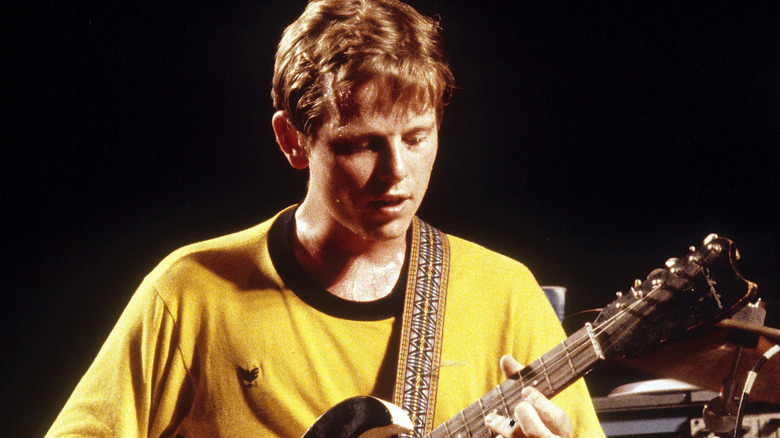
When the B-52s geared up to make the 1986 LP "Bouncing Off the Satellites," members Keith Strickland and Ricky Wilson suggested that Fred Schneider and Kate Pierson go off and write some tracks by themselves. They did, but it offended Pierson, as songwriting duties had historically been split across the band. As Pierson told Stereogum, "We felt like, 'Why is this happening? Why are we being marginalized out of the band?'" Much later, the reason became clear: Wilson was sick, ultimately diagnosed with AIDS, and he didn't have the energy to participate in full-group songwriting sessions. "Bouncing Off the Satellites" became Wilson's last musical document. In 1985, before the album's release, he died at 32 from AIDS-related complications.
Strickland was the only B-52 who was aware that Wilson was dying. The album-ender "She Brakes for Rainbows" was the first song the pair wrote without assistance, and it's based on a common memory. "The song was inspired by a woman Ricky and I met in Santa Fe, New Mexico who was selling vegetarian tacos from a food cart decorated with wind chimes, prisms and flowers, and a sticker that read, 'I brake for rainbows,'" Strickland told blogger Bill Michalski of the composition he called "very pretty and heartfelt." The lyrics suggest a figure (represented by the character "Brenda Holiday") preparing to move on to another plane. "Fly Brenda / Fly Brenda," the lyrics state. "She knows where the rain goes."
Southern Blood — Gregg Allman
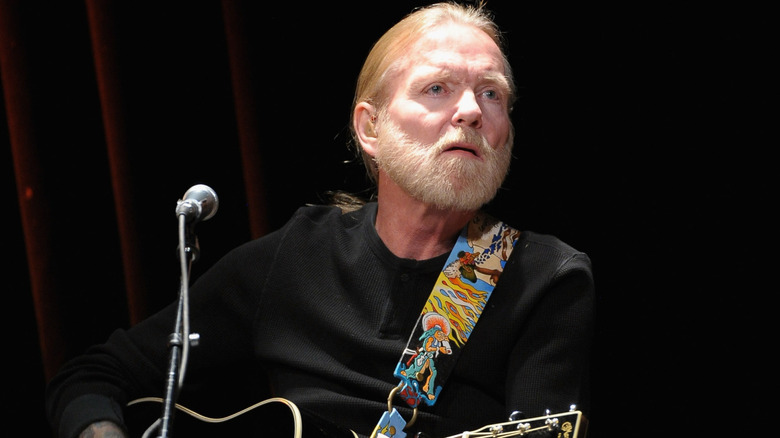
The Allman Brothers Band helped define Southern rock, with much of its sound derived from the sweet, world-weary vocals and propulsive keyboard playing of co-founder Gregg Allman. Allman was an active musician into the 2010s, at which point he developed serious health issues partly due to years of substance misuse, including a liver transplant due to hepatitis C. A diagnosis of liver cancer followed in 2012, which then traveled to a lung and left Allman with a choice: Undergo treatment, or preserve his voice. Allman chose the latter, and began production on the "Southern Blood" LP knowing he was soon to die.
Allman was too weak to compose much new material. "So we came up with the idea of picking a great selection of songs that had deep meaning for Gregg," manager Michael Lehman told Rolling Stone. "The order of the songs tells Gregg's story." Allman, with an assist from guitarist Scott Sharrard, managed one non-cover, the LP's lead-off song and single, "My Only True Friend." In this agonizing listen, Allman reflects on his time as a touring musician, confronts his last days as they come into view, and hopes he's remembered. "This river will surely flow to an end / Keep me in your heart / Keep your soul on the mend," he pleads. "I hope you're haunted / By the music of my soul / When I'm gone." Allman died at 69 in May 2017 with "Southern Blood" nearing completion. The record was released in September 2017.