

5 Neil Diamond Songs That Prove 1970 Was The Best Year Of His Career
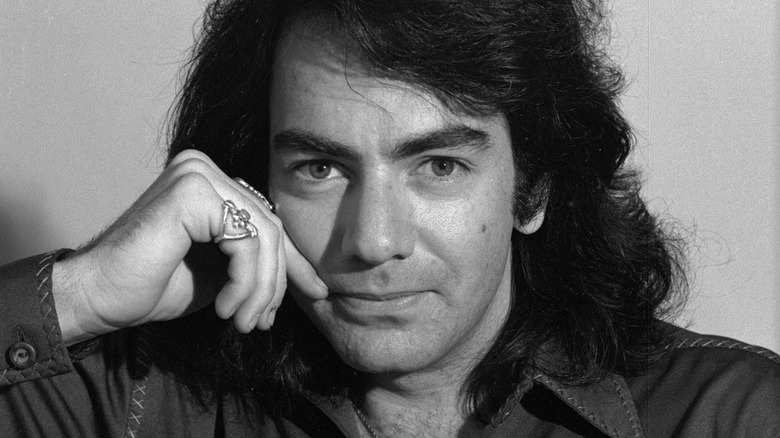
Neil Diamond's story includes some success as a songwriter and solo act in the 1960s, and he was part of the rock 'n' roll firmament by the early 1970s. As the musical sounds of one decade morphed into another, Diamond's arc hit its highest level. While he was the '70s musician who ruined a remake of "The Jazz Singer" in the '80s, Diamond was pretty much the king of rock 'n' roll at the beginning of the '70s. His illustrious career as pop and rock's finest crooner reached its height in 1970, and a handful of songs proves it.
He had many smashes that decade — and there are plenty of underrated '70s Neil Diamond songs as well — but in 1970 he did a little bit of everything that would make him such an icon. Some of Diamond's biggest hits ever were the ones he notched in 1970, and they definitively adhere to the tropes of the singer-songwriter's career. There are thoughtful forays into his own psyche, as well as a fun and catchy acoustic guitar-driven singalong kind of song. Diamond also liked to cover and transform pre-existing hit songs, and he allowed others to use his works in a similar fashion; in 1970, he checked both of those boxes. Here, then, are five songs that demonstrate how Neil Diamond gave the world the full Diamond experience in 1970 — and how he never had a better year.
Cracklin' Rosie
If one defines a pop or rock star as someone who can top the charts with ease, then 1970 is the year Neil Diamond could claim that distinction and place his name among the most successful solo acts of all time. In October, Diamond spent a week at No. 1 with "Cracklin' Rosie," the first of three times he'd top the Billboard Hot 100 as a performer. "Cracklin' Rosie," an original Diamond composition, also confirmed Diamond's viability as a major songwriter of the time, which dates back to 1966, when The Monkees took the musician's "I'm a Believer" to the apex of the pop chart.
Diamond crafted unique songs with humor, depth, and a world-weariness, and all those qualities are on display in "Cracklin' Rosie." He wrote the song after hearing a story about a remote area of Canada where the men outnumbered the women, and so the unattached guys occupied their weekend downtime with bottles of wine that they'd refer to as their partners. Rose or rosé was the wine of choice, and so Diamond came up with a tune about a man forgetting his troubles with alcohol, playfully referred to as cracking open a bottle of "Rosie." "Cracklin' Rosie" further qualifies as a Diamond signature song in that it contains wordplay (see also "Cherry, Cherry" and "Holly Holy") and it revolves around wine, just like his 1968 single "Red Red Wine."
Solitary Man
Neil Diamond spent part of the 1960s working in New York City's Brill Building as a hired songwriter alongside hit-making duos like Gerry Goffin and Carole King, and Burt Bacharach and Hal David. It was during this time when Diamond — notably by himself — composed "Solitary Man." The single was Diamond's very first issued release as a singer in 1966, and it was a bit of a flop, topping out at No. 55 on the pop chart. Diamond sang "Solitary Man" in the first person, portraying a man who details all of his fractured romantic relationships. The conclusion: He's just a "solitary man" who may not be cut out for love. "After four years of Freudian analysis, I realized I had written 'Solitary Man' about myself," Diamond told The Times in 2006.
And yet this song about loneliness and disconnection connected with a great number of people, and it got a boost when Diamond headed into his superstar era in 1970. "Solitary Man" returned to the radio, and the charts, and this time it was a whole lot more successful, reaching No. 21.
Shilo
Like "Solitary Man," another old Neil Diamond song was made new again in 1970. Diamond's early-career label, Bang Records, allowed him to record "Shilo" but didn't want to release it as a single, instead dumping it onto the 1967 album "Just for You." After Diamond moved on to a new corporate home and started to climb the charts in 1969 and 1970 with the likes of "Sweet Caroline (Good Times Never Seemed So Good)" and "Holly Holy," Bang cashed in and released a revamped "Shilo" as a single.
Finally, casual radio listeners, and anyone who didn't buy "Just for You," got to hear a poignant and personal Diamond original. "Shilo" concerns a lonesome boy whose father can't pay him much attention, so he seeks solace with a pal named Shilo — who may not be a real person. The song ends with an abrupt twist: Diamond's fully grown character has fallen to such a low place that he wants to see Shilo once more. The captivating "Shilo" became a No. 24 hit for Diamond.
Holly Holy
By 1970, the idea of other artists covering Neil Diamond's compositions was nothing new; late '60s and '70s acts like Lulu, Deep Purple, and Mark Lindsay had all jumped on Diamond tunes. Sometimes they were even hits: In 1970, Lindsay's recording of Diamond's "And the Grass Won't Pay No Mind" just missed the Top 40.
The covers game was very good to Diamond in 1970. In the very last week of 1969, his own "Holly Holy" reached No. 6 on the pop chart, so it was still getting substantial airplay in the early weeks of 1970. Not only was it technically Diamond's first hit single of the year, but it would register all over again later in 1970 when Motown group Jr. Walker and the All Stars knocked out a cover that's both faithful and completely reinvented. Diamond presented "Holly Holy" as a mysterious acoustic ballad that evolved into a joyous near-hymn with orchestral and choir backing. Jr. Walker and the All Stars took that template and added a lot of electric guitar, a funky and wandering bass line, and a killer saxophone solo, among other elevating elements. A significant hit in the R&B world, the new take on "Holly Holy" reached No. 33 on Billboard's chart covering that genre.
He Ain't Heavy ... He's My Brother
In early 1970, the emotive, harmonizing U.K. band the Hollies made it up to No. 7 with "He Ain't Heavy, He's My Brother." The title phrase comes from a 19th-century vignette about kindness and dignity, in which a child explains why she's uncomfortably carrying an unwieldy younger sibling: "He's not heavy; he's my brother," she remarks (via "The Parables of Jesus"). "He Ain't Heavy, He's My Brother" is a solemn ballad as delivered by the Hollies, encouraging listeners to support one another. "His welfare is my concern / No burden is he to bear," go the lyrics. "He would not encumber me / He ain't heavy, he's my brother."
Many Neil Diamond songs probe deep to get to the truth of the human condition and explore the sacredness and profundity of human connection. And that's just in the songs he wrote — all of those themes are so abundant in "He Ain't Heavy, He's My Brother" that it was almost a foregone conclusion that Diamond would cover it. In November 1970, with the Hollies' recording still looming in listeners' minds, Diamond released his own version of the song, and he sang his way into another Top 20 hit.