

5 '90s Shoegaze Songs We'd Trade The World To Hear Again For The First Time
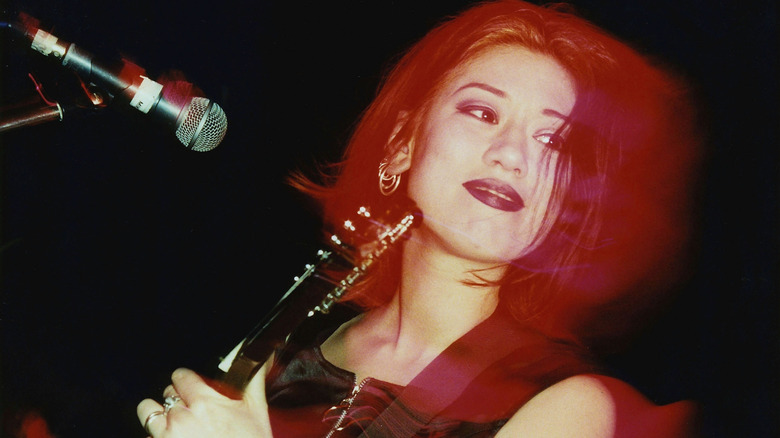
Emerging from the U.K.'s vibrant indie scene of the late '80s, shoegaze is the sound bath of rock sub-genres, and for some of its songs, the first listen will always be the best. Bands like My Bloody Valentine and Lush entranced listeners by blending '60s psychedelia, the Velvet Underground's drone, and the amp-melting tones of bands such as the Jesus and Mary Chain or Sonic Youth. Taking rock songs and albums into new, more expansive spaces in the '90s, they recorded songs we'd give everything for the chance to experience again for the first time.
Whoever coined the term "shoegaze" or "shoegazing" is unclear, but it speaks to the tendency of that genre's guitarists to stare at the effects pedals at their feet while playing. Here, we've rounded up five songs that, in our opinion, exemplify everything we love about '90s shoegaze: the songs' ingenuity, dreamy and delicate poetry, and shimmering and vast soundscapes. But most importantly, they make us want to erase our memories and start over with that first, glorious, and most impactful listen.
Falling Down — Chapterhouse
Though Chapterhouse didn't attain the notoriety of peers like My Bloody Valentine or Slowdive, the band was one of shoegaze's most inventive. Formed in 1987, the quintet evolved from playing space rock to bringing psychedelic and electronic influences into the genre, while helping to define it. On "Falling Down," off the 1991 debut album "Whirlpool," layers of guitars and echoey vocals encounter beats and groovy basslines. In conversation with the rave-oriented "Madchester" sound of contemporaries such as the Stone Roses or Happy Mondays, the song represents shoegaze at its most danceable.
But if the groovy parts of "Falling Down" threaten to make the song some sort of party anthem, lines like "Suffocate me gently baby / Drown me in your velvet snow" — drenched in reverb and echoey effects — quickly bring us back down to our feelings. As much as the massive distorted, delayed, and effected guitars, oblique and melancholy lyrics like this seem to be the house style of shoegaze.
Perhaps buoyed by its eclecticism, "Whirlpool" — produced by the Cocteau Twins' Robin Guthrie, who is a fixture on many shoegaze album credits — helped bring Chapterhouse to wider audiences, peaking at No. 23 on the U.K. album charts. Listening to "Falling Down," you hear a band that, like its peers, was unafraid to experiment in service of its ethereal aesthetic.
Morningrise — Slowdive
Shoegaze aficionados might be surprised that the Slowdive song we've included doesn't appear on its seminal "Souvlaki" album. That album has many songs that sounds even cooler today than they did upon release in 1993, and there's no doubt the shoegaze sound matures and flowers on it. But with the title track of 1991's "Morningrise" EP, you can really hear the genre sprout. Melancholy and moving at a plodding pace while remaining catchy, the guitar distortion and layers of echoey vocals make the song wide, hallucinatory, and unforgettable.
The lyrics evoke alienation, loneliness, and longing, perfectly complementing the spectral mood echoing and reverberating over the soundscape. The opening salvo — "I cross the field and watch the sun fall down / A million people clap, it makes me frown" — nails that sense of angst and disconnection, and the refrain "Looking 'round, I see you slip away / You seem more beautiful than yesterday" just drips with heartbreak and melancholy. It's fully within the thematic wheelhouse of indie rock like this, and we're here for it. "Morningrise" gets brighter, fuller, and more mesmerizing with every listen, but there was nothing like hearing it for the first time.
Only Shallow — My Bloody Valentine
If there's both an immovable object and unstoppable force in shoegaze — a sonic Rome that all roads lead to — it must be My Bloody Valentine's 1991 masterpiece "Loveless." It's best listened to from start to finish, and every track on it could join our list. Opening with shimmering guitar lines crashing into walls of sound, the opening track "Only Shallow" encapsulates the swirl of dreaminess, serene pastures, sublime aura, and melancholy mood of this stunning album.
Woven into the mix are Bilinda Butcher's serene, luminous vocal lines. It's hard to make out what she's saying, of course, but the lyrics seem to depict alienation, disconnection, and isolation, such as in the melancholy final couplet: "Look in the mirror, she's not there / Where she won't care, somewhere." Few opening tracks are as powerful and critical to establishing an album's vibe as "Only Shallow."
The album that "Only Shallow" grabbed us so firmly from on the first listen is cliché for a reason; it often takes struggle and suffering to produce great art, and the recording of "Loveless" was a protracted, years-long process. Guitarist Kevin Shields, who played almost every instrument on the album, struggled to find the right sound and cycled through 17 producers and multiple studios, nearly bankrupting the label Creation Records. Still, what emerged from that crucible is a peerless, timeless album: shoegaze's Sistine Chapel.
Throwing Back the Apple — Pale Saints
With melodic and harmonic hooks that soar above lush textures, Pale Saints' "Throwing Back the Apple" shows us how important pop sensibility can be for shoegaze. Guitar lines — some even without distortion — weave through the arrangement, setting the stage for delicate vocal melodies and harmonies. Off the band's second album "In Ribbons," released in 1992, the song is more driving than most of the genre, even upbeat.
While this might be shoegaze you can listen to with your morning coffee as you're getting ready for the day, the lyrics aren't so uplifting. Obliquely, they seem to depict a kind of sinking into slumber or even death. "Don't fall too deep / Don't try and sleep," the speaker urges, before submitting at last, "Beneath the vines we dream." Minimal and abstract, the listener is left to fill in the gaps, but the mood is unmistakable.
Hailing from Leeds, U.K., Pale Saints started as a trio in the late '80s, releasing its debut album "The Comforts of Madness" before adding Meriel Barham, a founding member of Lush, to fill out guitars with Graeme Naysmith and vocal duties with bassist Ian Masters. On the band's first full-length album as a quartet, you can hear their creative chemistry blossoming, shedding petals, and bearing fruit.
Monochrome — Lush
Among the first bands to be called "shoegazers," Lush exemplified this sonic lineage. Led by songwriters, guitarists, and vocalists Miki Berenyi and Emma Anderson, the band signed to English indie label 4AD in 1989 and became one of the few in the scene to find mainstream success. "Monochrome," off the band's 1992 album "Spooky," floods the ears with cascading layers of dulcet harmonies, echoey guitars, reverberating drums, and cascading melodies.
Depicting a collapsing relationship, the lyrics are devastating: "Your eyes are like saucers but mine are just clouded in gray," goes the second chorus, "I've so much to tell but I can't and you just go away." Writers often use the term "ethereal" to describe songs like this — otherworldly, too light for this world — but we think this song is more "oceanic." Listening to "Monochrome" is like floating, akin to being pulled out to sea by the tides and by the moon, and an experience no more vivid than on the first-ever listen.