

5 Songs That Best Capture The Poetic Soul Of Folk Rock
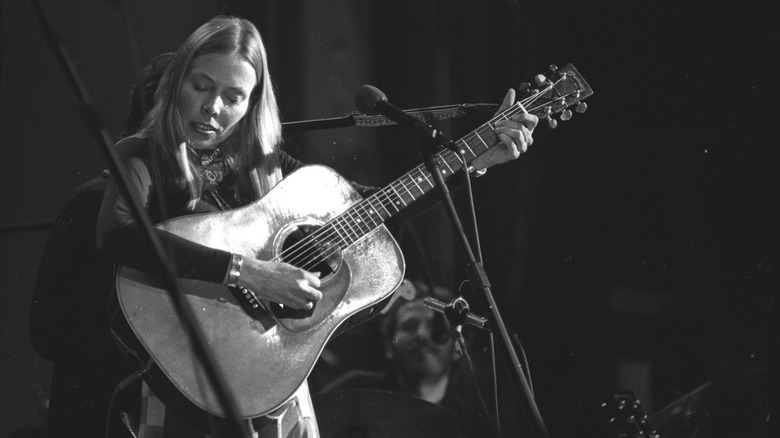
The softer the guitar, the more poetic the lyrics, right? That's the stereotype when it comes to folk and folk's slightly more muscular cousin with a beard, folk rock. Growing out of the '40s American folk revival and coming to a head in the '60s with the adoption of rock elements, folk rock retains the best parts of both, including a poetic soul that shines through in its best works.
The word "poetic" is a sticky one, though. Folks often use it to generally mean "articulately written and/or beautifully stated." This is true, but it's more accurate to say that lyrics are "poetic" if they wield language in a novel, creative way that stands out from everyday speech. So, "He got angry, and so did I / Yelled so loud I wanted to cry"? No. We're looking for the precise opposite when sifting through folk rock to find its brightest souls. And while we need to focus on well-composed lyrics, it's important not to forget music, which can support or betray a song's sentiments. We're also talking about folk rock and not straight-up folk, so we've got to highlight songs that have mid-to-up-tempo elements and additional instrumentation besides a one-person acoustic guitar, like a bass and drums.
In the end, our choices for songs come from revered artists who've rightfully taken their place in the folk and folk rock pantheon. This includes Joan Baez, Joni Mitchell, Simon & Garfunkel, Crosby, Stills, Nash & Young, and the musician who helped popularize the whole folk rock thing to begin with, Bob Dylan.
The Sounds of Silence — Simon & Garfunkel
There isn't a more quintessential folk rock song than Simon & Garfunkel's "The Sounds of Silence" from 1966's "Sounds of Silence," a song so weighty, so mythical in feeling and scope, that it's almost uncomfortable for folks to approach sincerely. But if we want to divest its pure, poetic soul, we've got to do what Paul Simon did at a mere 23 years old, when he tackled a song "well beyond my age and abilities," as The Guardian quotes him.
"The Sounds of Silence's" lyrics are amongst the most chilling, bleak, and honest ever written. Verse three is worth quoting in full to make our point: "And in the naked light, I saw / Ten thousand people, maybe more / People talking without speaking / People hearing without listening / People writing songs that voices never shared / And no one dared / Disturb the sound of silence." Is there a more sensitive take on human lives that never make headlines, never speak up, and never get heard?
So inspired was this song that Simon doesn't even know where it came from or what it means aside from what it directly says. In this way, "The Sounds of Silence" even typifies the most romantic visions about what it is to be a poet, swept away in spontaneous visions of truth and light.
Funny enough, Simon couldn't stand the more uptempo, rockier version of the song that eventually caught on with the listening public. Garfunkel was more open to the reworked version, which he called "interesting." As Far Out Magazine quotes him, Garfunkel once told producer Tom Wilson, "I suppose it might do something." But in subsequent years, Simon & Garfunkel often performed the song in a fully folk way, anyway.
Diamonds and Rust — Joan Baez
Joan Baez tends to not get as much attention as fellow folk-turned-folk-rock artists like Bob Dylan or Joni Mitchell, but she's no less deserving of attention. Getting her first record deal in 1960, a mere two years after finishing high school, Baez rose to acclaim in the folk community practically overnight. She had a voice like crystal, natural songwriting ability, a gentle spirit, but a quiet resolve that led her towards activism in the mid-60s, particularly of the Civil Rights and anti-Vietnam War variety. But out of all of her work, it's 1975's "Diamonds and Rust" from the album of the same name that best embodies the poetic soul of folk rock.
Though Baez wrote "Diamonds and Rust" about her own specific relationship circumstances, it can be applied to anyone and is a '70s song that nails the meaning of life. Beautifully worded, but with a conversational twist, it starts, "Well, I'll be damned / Here comes your ghost again," a line that captures the song's simmering resentment and underlying sorrow. While we can't highlight every stand-out line, the song's bridge says, "Our breath comes out white clouds / Mingles and hangs in the air / Speaking strictly for me / We both could have died then and there."
Now for the kicker: Baez wrote this about Bob Dylan, with whom she shared a relationship in the early '60s that ended in 1965. Hence lines like, "My poetry was lousy, you said / Where are you calling from? / A booth in the Midwest." But it's alright, because as the song's title states, the pressures of time can produce both diamonds and rust. American Songwriter quotes Baez saying, "It's all poetry."
Cold Blue Steel and Sweet Fire — Joni Mitchell
We can't talk about the poetic soul of anything without Joni Mitchell, one of the most lauded poets of her generation. An 11-time Grammy winner, Mitchell is one of those musicians who deserves every accolade she's received. She also came comparatively late to the folk scene, starting as a pure folk singer with 1968's "A Song to a Seagull" before shifting into folk-rock and finally a long period of eclectic, jazz-hybrid work starting with 1976's "Hejira." This was a moment-defining album that hardly anyone talks about anymore, one that represented moving on from the '60s dream. But as far as pure poetic beauty is concerned, we've got to choose "Cold Blue Steel and Sweet Fire" from 1972's "For the Roses."
Stated plainly, "Cold Blue Steel and Sweet Fire" is a song about heroin addiction. Not hers, but James Taylor's, with whom she shared a difficult romance. "Cold Blue Steel and Sweet Fire" isn't poetic in a mournful or head-in-the-clouds kind of way, but a ragged, frenetic kind of way that mirrors an addict's erratic behavior. It also doesn't paint Taylor as a victim, or call out specific people or places, though. It's more of a stream-of-consciousness concept piece.
Out of its many masterfully-written lines, there's, "Pawnshops crisscrossed and padlocked / Corridors, spit-on prayers and pleas / Sparks fly up from Sweet Fire / Black soot of Lady Release," and, "Red water in the bathroom sink / Fever and the scum brown bowl/ Blue Steel still begging but it's indistinct / Someone's Hi-Fi drumming Jelly Roll." If those lyrics don't make your eyebrows rise and your lips mouth, "whoa," we don't know what to tell you.
Visions of Johanna — Bob Dylan
We're not the first to call "Visions of Johanna" from Bob Dylan's "Blonde on Blonde" (1966) a work of superb lyrical craftsmanship. In 1999, the U.K.'s Poet Laureate, Andrew Motion, called the song's lyrics the best lyrics ever written (per The Guardian). But no matter if you agree with that grand statement, you have to admit there's something truly crackling and arcane about "Visions of Johanna's" lyrics.
We only have space for a smattering of lyrics, but we need to quote them at length to show their structure and rhyme scheme: "In the empty lot where the ladies play blindman's bluff with the key chain / And the all-night girls they whisper of escapades out on the 'D' train / We can hear the night watchman click his flashlight / Ask himself if it's him or them that's really insane." Another example is, "The fiddler, he now steps to the road / He writes ev'rything's been returned which was owed / On the back of the fish truck that loads / While my conscience explodes / The harmonicas play the skeleton keys and the rain / And these visions of Johanna are now all that remain."
What does all this extremely well-phrased poetry mean? The general consensus is that it's a collage of images that creates a webwork about women. The character "Johanna" is a stand-in for the connection that Dylan just can't seem to forge. And indeed, Dylan had a complicated love life, which included, as mentioned, fellow folk icon Joan Baez (who some believe "Visions of Johanna" is actually about). But really, no one would care about any of these interpretations if the song's soul didn't sing so well.
Helpless — Crosby, Stills, Nash, and Young
Supergroup Crosby, Still, Nash, and Young managed to produce one studio album together in their initial time together, 1970's "Déjà Vu," before singer-songwriter extraordinaire Neil Young left to do his own (very successful) thing. It's his guitar work and songwriting that elevated "Déjà Vu" to near-masterpiece status, a pitch-point blend of folk and rock released the year after the quartet debuted at Woodstock. But out of all of the album's surprisingly soulful, mid-tempo, and low key tracks, it's "Helpless" that demonstrates the sprit of folk rock the finest. And yes, Young wrote the lyrics.
Those lyrics are vaguely haunting in and of themselves, especially when coupled with Young's thin, warbling, vulnerable voice: "Blue, blue windows behind the stars / Yellow moon on the rise / Big birds flying across the sky / Throwing shadows on our eyes / Leave us." Knowing that the song is autobiographical, though, makes its melody, background singing, piano, and fragile tenor really strike home. Young wrote the song about when he contracted polio at the age of 5 – hence the childlike phrasing of the lyrics, which describe Young literally looking out the window, but being unable to go outside. As the chorus heartbreakingly says, "Helpless, helpless, helpless (Helpless, helpless, helpless, helpless) / Babe, can you hear me now? (Helpless, helpless, helpless, helpless) / The chains are locked and tied across the door (Helpless, helpless, helpless, helpless)."
It's a testament to the impact of this event on Young that he remembered it all those years later and chose to immortalize it along with Crosby, Stills, and Nash. It's also a testament to the power of that song that it radiates folk rock's poetic spirit.