

5 Songs From 1985 That Define Rock History
1985 sat right in the middle of the decade with songs that defined rock history, but what is '80s rock, anyway? Is it frizzy-haired stadium bands like Def Leppard and Whitesnake? Is it genre-mashing new wave outfits like the Police and the Cure? Is it American hardcore groups like Black Flag and Minor Threat that developed in response to '70s punk? Yes to all of the above and more.
That's our first point: Songs that define rock in 1985 should fashion a portrait of the state of rock that year. There's a case to be made that the entirety of the '80s was one long period of transition, experimentation, and the search for musical meaning between the golden eras of classic rock and the advent of grunge. We can only say that in hindsight, though. Our song choices need to be very much of-the-moment and capture its essence. This doesn't necessarily mean the most widespread, popular songs, but it might (and in two cases, definitely does). Rather, it means highlighting the most vibrant representatives of rock's various '85 branches via the year's album releases.
Speaking of popular songs, we've got a track that readers will recognize on the spot: "Everybody Wants To Rule the World" by Tears for Fears, the quintessential (and arguably best) synth-wielding pop-rock track of the decade. We've also got entries from The Cult, Hüsker Dü, an era-bridging track from Dire Straits, and an odd-man-out entry from the ever-enigmatic Tom Waits.
She Sells Sanctuary — The Cult
Even though the Cult isn't a punk band by any stretch, you can still catch rougher influences in the Ian Astbury and Billy Duffy-made outfit, especially in its more choppy chords and guitar-led sections. Astbury considered himself a punk in his youth — an outsider amongst fellows — as he told Drowned in Sound, while Duffy was attracted to "energy, danger, some sex appeal," and eventually glam and punk, per PRS for Music. Bundle those influences together, and you get a gothic-leaning group in the same family as Killing Joke, the Cure, the Smiths, and even the Sisters of Mercy, who all released albums in '85. But out of all those bands' songs, it's the Cult's "She Sells Sanctuary" from "Love" that best embodies 1985 rock.
"She Sells Sanctuary" was the Cult's breakout hit, even though it didn't crack the Billboard Hot 100 (though it reached No. 15 in the U.K.). This worked in the song's favor: It wasn't too mainstream to be sellout, it gathered punks, new wave fans, and even metalheads under its musical wing, and was guitar-driven enough to actually feel like a "rock" song, and it had a dark vibe (like the band), even though the music is quite bright and listenable. It's also proven the band's most enduring song, as evidenced by its 262 million Spotify listens, far higher than 1989's "Fire Woman," which reached No. 46 on the Billboard Hot 100.
But under the eyeliner, stylized clothes, and violin bow opening, "She Sells Sanctuary" works so well because it's just an extremely simple rock song built on the three most common guitar chords possible: G, D, and C. This makes it timeless above all else.
Money for Nothing — Dire Straits
Coming late to the classic rock game with their 1978 self-titled debut, Dire Straits were well-positioned to bridge generations. And while most people probably know them for "Sultans of Swing," a song earmarked by a Mark Knopfler-plucked, killer solo imprinted on classic rock fans for life, it's 1985's "Money for Nothing" from "Brothers in Arms" that stayed at No. 1 for three weeks on the Billboard Hot 100. But it's not the song's success, nor "Brothers in Arms" 30 million in sales, that defines rock history in 1985 — it's MTV.
Both the longer album version and shorter single version of "Money for Nothing" open with a swimmy, floaty soundscape that crescendos into the song's opening riff as a falsetto voice sings "I want my MTV" — the channel's OG slogan. Maybe that's why the video for "Money for Nothing" shows a crudely 3D-modeled dude pointing at a neon-painted Knopfler on a TV. Maybe that's also why verse one starts, "Hah, now look at them yo-yos, that's the way you do it / You play the guitar on the MTV / That ain't workin', that's the way you do it / Money for nothing and your chicks for free." At this point, let's remind people of how all-consuming and career-making or breaking MTV was in the '80s.
Yes, "Money for Nothing" is a satire of the music industry. It's also very '70s in its music — bluesy and built around a simple, minor pentatonic scale. That's how "Money for Nothing" exemplified rock both past and present, by carrying musical sensibilities from the band's origins into a self-satirical take on the band's present. Now that's rock history.
Everybody Wants to Rule the World — Tears for Fears
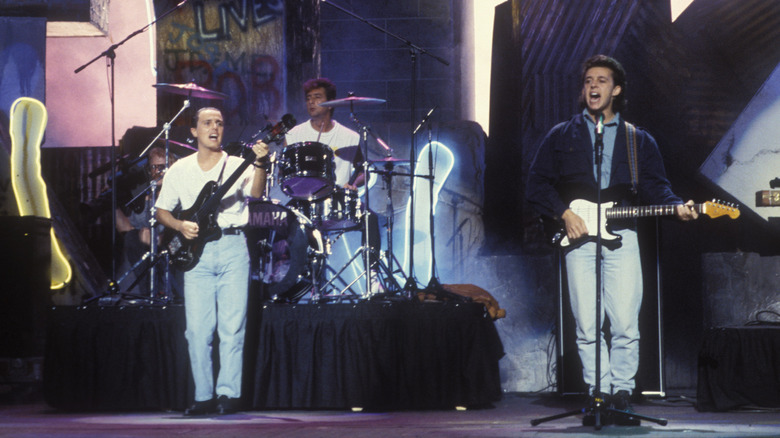
1985 was Tears for Fears' year. "Shout" and "Everybody Wants to Rule the World" both went to No. 1 on the Billboard Hot 100 within two months of each other, a phenomenal feat that cinched the band's careers and place in rock history forever. Their 1985 album, "Songs From The Big Chair," rode the synth-rock wave that'd been building since the late '70s and delivered the band's crowning achievement right at the height of that wave's crest. With "Everybody Wants to Rule the World," Tears for Fears wrote a song that not only defines rock in 1985 but is a top contender for defining rock across the entire decade.
Musically, everything about "Everybody Wants to Rule the World" is pitch-perfect and sounds completely of its time. It's a sparse, dreamy track bolstered by sparse, dreamy synth chords and a trance-like bass pulse that blossoms, instrumentally, in the lead-in to the chorus ("So glad we've almost made it / So sad they had to fade it"). Then, the song resolves its tight melody on the very name of the song. But really, it's space that makes the song work — space enough to let feelings and thoughts linger.
"Everybody Wants to Rule the World" also defines rock in 1985 because of instrumental choices that could have only come from its time. No matter that one half of Tears for Fears, Roland Orzabal, built their hit from "two simple, chimey chords" on his acoustic guitar (per Music Radar), a set of very specific '80s gear defines the song's timbre. This includes a Sequential Circuits Prophet T-8 for the core synth line, a synth that ended production in 1985 with only 800 units sold.
The Girl Who Lives on Heaven Hill — Hüsker Dü
Is Hüsker Dü a hardcore band? Post-hardcore? Some kind of second-wave American punk? A proto-grunge outfit? A precursor to '90s "alternative rock," as it was called? Yes to all of the above, plus a bit of pop and a smattering of garage and noise scenes. In 1984, they released "Zen Arcade," containing a song like "Hare Krsna" that still sounds cooler than anything you'd hear today. The next year, they released "New Day Rising," a lighter album that bundled together all of the above-mentioned sounds into a single work, with "The Girl Who Lives on Heaven Hill" as its stand-out track.
Astute, first-time listeners to "The Girl Who Lives on Heaven Hill" might be able to pick up on its post-hardcore/proto-grunge elements. It's there in the several-note lead guitar lines that flash and vanish in the song's verse. It's there in the repeating downstroke guitar chugs that flash and vanish in between upstrokes. It's there in the quiet-loud dynamics that swell in and out throughout the whole piece (used extensively by Pixies and Nirvana). If you listen to the song and pretend it came from 1995 instead of 1985, you'll swear it's true. "The Girl Who Lives on Heaven Hill" acts as a kind of nexus between eras that uses its past influences to paint the path forward.
Even though Hüsker Dü broke up in 1987, two years after releasing "New Day Rising," they left their mark. Besides Pixies and Nirvana, Hüsker Dü and a song like "The Girl Who Lives on Heaven Hill" influenced Green Day, Foo Fighters, Dinosaur Jr., and more.
Clap Hands — Tom Waits
With Tom Waits' 1985 masterpiece, "Rain Dogs," Waits finally evolved into a junkyard, clockwork harlequin clanging down the street, drunkenly stumbling through visions of cigarette smoke, lazy trombones, and out-of-tune pianos as its bolts shake out of its seams. Such is "Southern Gothic" art of the Waits variety, weaving together dark, vaudeville-inspired vignettes of down-and-out people with jazz, folk, country, rockabilly, lounge, swamp rock, roots rock, and dousing it all in cheap whiskey. But out of all this wonderful madness, it's "Clap Hands" that best defines 1985 outré, art-for-art's-sake rock. Musicians like Waits are always working in the wings, possessed by drives blind to mainstream musical movements.
Starting with what's possibly a gong, "Clap Hands" transitions to a main marimba riff set against an acoustic guitar. The sensation is dissonant and unsettling, just like the opening lyrics, "Sane, sane, they're all insane / The fireman's blind, the conductor's lame / A Cincinnati jacket and a sad luck dame / Hanging out the window with a bottle full of rain." Waits' wordplay smashes together contradictory imagery across the song, which returns to its refrain, "Clap hands." What in the heck does this mean? Well, maybe it doesn't matter if everyone's clapping their hands together.
"Rain Dogs" reached No. 181 on the Billboard 200, and none of Waits' singles have ever charted on the Billboard Hot 100. And yet, he's immensely respected, not the least of which by Radiohead's Thom Yorke (especially "Rain Dogs"). This is why a song like "Clap Hands" typifies rock in 1985: It came from a musician who staunchly marched to his own beat and inspired those to come. And in case folks have forgotten, this was always rock, too.