

The 5 Best Bob Dylan Songs That Aren't Blowin' In The Wind
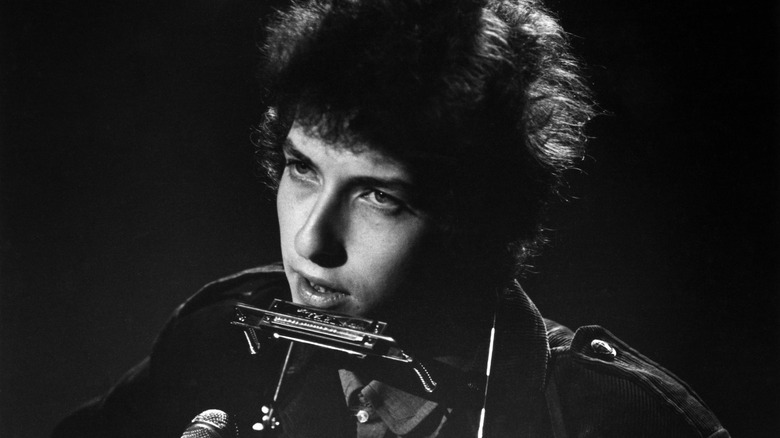
"Blowin' in the Wind" is often cited as Dylan's masterpiece, but the songwriter's discography is enormous, and the truth is, there are countless songs that could be described as his best. Here, we present alternative Bob Dylan tracks that might be considered among his finest work, after all, it's not often a singer-songwriter receives the Nobel Prize for Literature. In fact, it's only happened once, when it was given to Bob Dylan in 2016.
Critics have praised Dylan's songwriting skills ever since he emerged as a folk performer in New York City in the early 1960s, but he became a legend in 1963 with "Blowin' in the Wind," a protest song that came to reflect the resilience of the Civil Rights Movement. Dylan performed the song at several key Civil Rights events, and it became an anthem of the movement.
However, many of his other songs are iconic too. For this article, we have sifted through the records Dylan made during his classic era and selected five exceptional songs that together also reveal his range as one of the finest songwriters of all time.
Subterranean Homesick Blues
The opening track to Bob Dylan's classic 1965 album "Bringing It All Back Home," "Subterranean Homesick Blues," sees the songwriter at his most dexterous as both a lyricist and vocalist. The track sketches out a number of picaresque street scenes, starting with the famous couplet "Johnny's in the basement mixing up the medicine/ I'm on the pavement, thinking about the government."
The track seemingly contains allusions to drug culture, counterculture, and the Civil Rights Movement, and does so at a rapid pace that reflects the breakneck pace of social change during the 1960s. For some, it is a proto-rap track thanks to Dylan's machine-gun delivery, which was informed by his growing interest in the avant-garde writing of the Beat Generation writers Jack Kerouac, Allen Ginsberg, and William Burroughs.
"Subterranean Homesick Blues" was also forward thinking in being the track that announced the songwriter's embrace of electric guitar and his decisive rejection of folk purism — to the alienation of some fans and former collaborators. It's one of the most enthralling, adrenaline-inducing performances in Dylan's entire discography, and still has a refreshing, unhinged sound more than half a century after it was recorded.
Don't Think Twice, It's Alright
While "Blowin' in the Wind" opens side A of "The Freewheelin' Bob Dylan" and announces him as a singularly effective writer of protest songs, "Don't Think Twice, It's Alright," which begins side B, demonstrates the breadth of his talent. One of Dylan's most celebrated early songs has to do with his complicated love life: "Don't Think Twice, It's Alright." On the surface, it's a straightforward lament chronicling the end of a relationship. Dylan employs a series of simplistic, poetic images to describe the emotional distance between the pair, such as "it ain't no use in turnin' on your light, babe / I'm on the dark side of the road."
But there is something incredibly affecting in his use of the lyric quoted in the title. Though delivered in a seemingly sentimental tone, the verses that surround it make it quite clear that there is a streak of irony running through the song; whereas the title refrain may seem charitable, it is obvious the narrator is still bitter. "You just kinda wasted my precious time / But don't think twice, it's alright." Meanwhile, the song's sprightly rhythm and upbeat tempo reflect the narrator's defiance and resilience; a slower version might have made it a typical break-up song, but typical is exactly what it's not.
"Don't Think Twice, It's Alright" has levels of nuance rarely seen in popular songs that came before it. It has pointed the way for future artists to employ greater subtlety in matters of the heart, and broadened the palette for later songwriters.
The Times they Are a-Changin'
Bob Dylan wrote a great many protest songs during his career, but few had the initial impact or cast a shadow as long as "The Times They Are a-Changin'," the title track of his 1964 album. Despite Dylan's knack for writing songs that seem to capture the spirit of the age, he firmly rejected the "voice of a generation" label, describing himself coyly as a "song and dance man." But "The Times They Are a-Changin'" became hugely prescient despite his humility.
The song was recorded around a month prior to the assassination of President John F. Kennedy, an event that shook American society to the core. Dylan had a concert the night after the assassination, and saw that his new song would make a suitable opener — even if he didn't understand why.
As he later described in the 1973 "Bob Dylan" biographer Anthony Scaduto: "I thought, 'Wow, how can I open with that song? I'll get rocks thrown at me.' But I had to sing it, my whole concert takes off from there. I know I had no understanding of anything. Something had just gone haywire in the country and they were applauding the song. And I couldn't understand why they were clapping, or why I wrote the song. I couldn't understand anything. For me, it was just insane." The song has lost none of its power and is still able to summon that strange feeling when events beyond our control make it feel as though the earth has noticeably turned into a new era.
Ballad of a Thin Man
Bob Dylan was famous for typically being spiky in his responses to journalists and other media figures who used to interrogate him about his political views, his music, and his creative practices back in the 1960s. Much of the time, it seemed that Dylan resented such intrusions from those who were outside of the decade's counterculture, who painted the songwriter and other figures in his orbit as freakish and eccentric. And in 1965, he channeled that frustration into "Ballad of a Thin Man," a funereal, biting track that seems to pull a curtain around the exciting new scene Dylan found himself a part of.
The story is addressed to a Mr. Jones, a faceless square who finds himself confronted by various countercultural happenings that he can't explain. "Something is happening here, but you don't know what it is / Do you, Mr. Jones?" says the narrator by way of accusation. Down the years, fans have attempted to pin a set identity on Mr. Jones, however, Dylan makes it clear that Jones is a cipher for the mainstream and the buttoned-down, conventional attitude that Americans were breaking out of during the 1960s.
"Ballad of a Thin Man" sees Dylan reveling in the exclusivity of the counterculture and the incomprehension of the mainstream in response to it. It is also him at his most vitriolic; listen to the song, and you can likely decide what side of the partition you might find yourself inhabiting.
Isis
Bob Dylan's work didn't always focus on social movements, historical themes, or the counterculture. In fact, as his artistry evolved, he began to embrace his ability to create narrative songs rendered in vivid detail, as shown on "Isis," the epic album track from his 1975 album "Desire."
Written in collaboration with songwriter and theater director Jacques Levy, Dylan announced during concerts around the time of its composition that "Isis" was about marriage. But within just a few lines, the song transforms into a mysterious hero's journey. It begins: "I married Isis on the fifth day of May / But I could not hold on to her very long / So I cut off my hair and I rode straight away / For the wild unknown country where I could not go wrong."
The narrator encounters an adventurer who takes him to a land where "pyramids [are] embedded in ice," and joins him in attempting to extract a body from a tomb, all the while dreaming of going home with treasure of his own. But the adventure falls apart, and the narrator eventually returns to Isis, the "mystical child" whom he curses, proclaiming: "What drives me to you is what drives me insane." It is clear that a romantic relationship isn't the only subject at the core of "Isis," and the track's rich symbolism has attracted the attention of Dylan scholars in the decades since its release. Beyond interpretation, however, it is simply a compelling story with the power to hold the listener's rapt attention for a full seven minutes.