

5 Songs From 1967 That Prove It Was The Decade's Best Year For Sunshine Pop
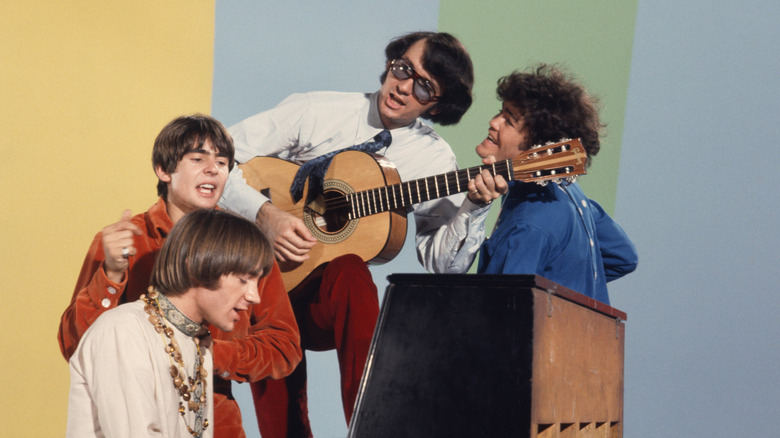
Given all that happened, 1967 was arguably one of the most transformative years in rock history, with popular songs ranging from light sunshine pop to heavy psychedelic sounds. Bands like The Beatles and even the Rolling Stones openly embraced psychedelia, as did various newer acts that rose to prominence around that time, such as Cream and The Jimi Hendrix Experience. Yet, on a lighter note, the subgenre of sunshine pop was also taking over the airwaves in 1967.
Add a dash of psychedelia to rich, oftentimes orchestral arrangements — ideally with lots of organ, harpsichord, and flute — and then combine those elements with multi-part vocal harmonies and oftentimes carefree, uplifting lyrics. That's sunshine pop in a nutshell.
As you may have inferred from the above description, bands like The Beach Boys, The Association, The Monkees, and the curiously named the Mamas & the Papas laid out the blueprint for sunshine pop in 1966. But it was in 1967 when it really exploded in popularity, giving us countless classics that music fans still adore in more modern times. This list naturally doesn't include all of those all-time sunshine pop bangers from 1967; instead, we've chosen five of the very best (with no more than one entry per band) while justifying why each song made the year such a definitive one for the genre.
Windy — The Association
When you think of The Association, you probably recall songs like "Cherish" and "Never My Love," two tunes that have been played at countless prom nights and weddings in the decades since their release. You may even remember them as the band that originally performed "Along Comes Mary," which got the pop-punk treatment in the '90s from the Bloodhound Gang (and whatever happened to those guys, anyway?)? But what about "Windy," which spent four weeks at No. 1 in the summer of 1967? For some reason, it doesn't seem to get as much love from modern listeners, but it's probably the best example of how The Association was on top of the sunshine pop scene during its peak hit-making period of 1966 to 1967.
Yes, it would have been tempting to include "Never My Love" as our entry for The Association, but while it is indeed a beautiful love song, it doesn't fit the sunshine pop ethos anywhere as much as "Windy" does. With an uptempo beat that picks up even more in the outro, breezy (no pun intended) lyrics about a woman whose personality is akin to the wind in her name, and The Association's trademark vocal harmonies, it has all the ingredients for a standout sunshine pop song. Just don't let the fact that several session musicians (including members of The Wrecking Crew) played all the instruments in the recording take away from your enjoyment of the tune.
The 59th Street Bridge Song (Feelin' Groovy) — Harpers Bizarre
Years before he produced some of Van Halen's best albums, Ted Templeman was part of a band called Harpers Bizarre, which cracked the top 15 of the Billboard singles charts with its only major hit, a cover of Simon & Garfunkel's "The 59th Street Bridge Song (Feelin' Groovy)." While already a bouncy, cheerful-sounding song in its original incarnation, the new version benefited from a lush arrangement (courtesy of the iconic Leon Russell) that put it squarely in sunshine pop territory. It also has a wider range of instrumentation than the basic guitars and drums (with a little flute toward the end) of the Simon & Garfunkel version. But that's not where Harpers Bizarre has the legendary duo beaten most convincingly.
Rather surprisingly, it's the now-obscure band that harmonizes better. That's not to say Paul Simon and Art Garfunkel weren't playing their A-game on their version of "The 59th Street Bridge Song," but Templeman and his Harpers Bizarre bandmates knock it out of the park in the a cappella section in the middle of the song. That truly helps make their cover worth the extra minute of runtime, while making it even harder to believe that Templeman would later become much more famous for his work behind the mixing board with one of the all-time greats of hard rock.
My World Fell Down — Sagittarius
Not all sunshine pop has to be about "sunshine-y" topics — sometimes, the best songs in this subgenre can be about heartbreak and sadness, with matching lyrics about the leaves being brown in the wintertime. That's definitely the case with Sagittarius' "My World Fell Down," which sounds like an outtake from The Beach Boys' strange and tragic "Smile" album sessions in the best way possible. It certainly helps that this short-lived project featured would-be country legend Glen Campbell, who was not that far removed from his brief stint as Brian Wilson's touring replacement in The Beach Boys. Furthering The Beach Boys connection in Sagittarius were Bruce Johnston, who later replaced Wilson on a more permanent basis, and band leader Gary Usher, who was one of Wilson's frequent songwriting partners.
Despite having some recognizable names in the band, Sagittarius could only reach No. 70 on the Billboard Hot 100 with "My World Fell Down" — a criminally low peak position for a song with such on-point vocal harmonies and an intricate arrangement that could easily compete with Wilson's finest. As good as the nearly three-minute-long single version is, the 45 RPM version above, which tacks on close to a minute of additional music, is even better with all sorts of out-there sound effects in the middle, followed by a beautiful yet melancholy bonus refrain. It may have been too ahead of its time to be a bigger hit on the singles charts, but that's also what helped it stand the test of time as a certified sunshine pop classic.
The Rain, The Park & Other Things — The Cowsills
It's easy to forget that before they became best known for their version of the title track from the musical "Hair," and before they served as the inspiration for TV's "The Partridge Family," The Cowsills made a number of appearances on the Billboard Hot 100. The most prominent of the real-life family band's early hits was the first one, "The Rain, the Park & Other Things," which went all the way to No. 2 in late 1967 and stands out to this day as one of sunshine pop's finest from that year — if not of all time.
The song wastes no time in establishing its greatness, starting out with rainy-day sound effects that set the mood as lead singer William Cowsill tells what seems to be a feel-good story of meeting a random girl with flowers in her hair. Everything seems to be going well for the song's protagonist until the plot twist toward the end, where the sun shines again and the "flower girl" is gone, leaving him to wonder if he merely dreamed the encounter.
Don't mind the fact that the song's title is another example of sunshine pop irony. "The Rain, The Park & Other Things" is a compelling, if ultimately bittersweet story song that perfectly evokes the feel of the title through its sound effects, arrangement, and the Cowsill family's tight harmonization.
Daydream Believer — The Monkees
By the end of 1967, The Monkees had four No. 1 albums, several big hits on the singles charts, and a successful TV sitcom — not bad for a band oftentimes mockingly referred to as the "Prefab Four." But what many fans may overlook is how The Monkees had evolved so much musically after about one year of superstardom. Not only were they mostly playing their own instruments in the studio; they were also recording more mature songs such as "Shades of Gray" from 1967's "Headquarters" ... and our final entry in this list, "Daydream Believer," which was released late that year ahead of its parent album, 1968's "The Birds, the Bees & the Monkees."
Much like the above entry, there's a bittersweet tinge to the lyrics of this song, which was penned by Kingston Trio alumnus John Stewart. This time, it's sung from the point of view of what seems to be a young man contemplating the realities and expectations of everyday adult life. The lyrics are simple and sparse, as is the arrangement, at least in comparison to the other songs in this list. But sunshine pop is a vibe as much as it is a subgenre, and while the song does hint that one's daydreams might not always come true, it's bouncy and whimsical enough to cheer you up, like the "sleepy Jean" being referred to in the chorus.