

5 Hit Songs That Prove 1979 Was The Decade's Best Year For New Wave Music
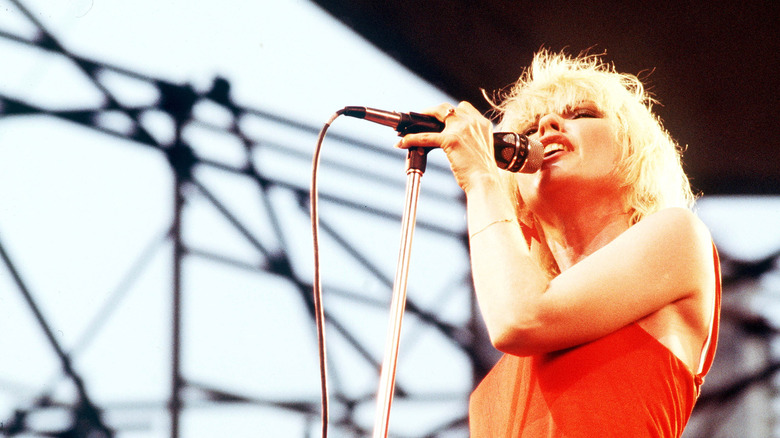
New wave, the genre of music that saw punk attitude collide with pop's commercial instincts, became a phenomenon in both the U.S. and the U.K. in the aftermath of the punk explosion of the mid-1970s. And in our opinion, 1979 is the year that new wave hit its high watermark for the decade, as these five timeless tracks from that year show.
New wave is notable for its sonic diversity, and these songs combine punk's rebellious, don't-care-what-anybody-else-thinks attitude with a range of other influences, from disco to reggae to electro and more. Each one is quirky, instantly recognizable, and representative of the attitude of many musicians at the time that, after the clear-out of rock cliches that punk provided, anything was possible. The shadow cast by the new wave classics released in 1979 is long — indeed, they could fit easily alongside modern tracks on any indie playlist.
Cars — Gary Numan
1979 was a massive year for Gary Numan, who broke through in his native U.K. with his band Tubeway Army with the chart-topping "Are 'Friends' Electric?" before quickly segueing into a solo career with "Cars." Whereas the former topped the charts in Britain but failed to hit the Hot 100 in the U.S., "Cars" made a huge splash in both markets, hitting No. 1 in the U.K. at the end of 1979 and breaking into the Top 10 in the U.S. a few months later.
Like Numan's earlier work, "Cars" showcases the musician's pioneering use of electronic textures to create radio-friendly synth pop. "Cars," however, is arguably a greater achievement than "Friends," with a danceable tempo and earworm robotic vocal part that is utterly addictive. There would be many Numan imitators throughout the 1980s, but nothing would match the widespread appeal of his biggest hit. The musician claims he wrote the song in minutes, with the four-note bassline coming to him as the first four notes he played on first purchasing a bass guitar following his breakthrough success with Tubeway Army, a reminder that new wave's biggest breakthroughs often came from the simplest ideas.
Heart of Glass — Blondie
Blondie was one of the gems of the late '70s New York scene, becoming legends at the famous club CBGB before breaking through with several notable charting singles, including "Hanging on the Telephone," which hit No. 5 in the U.K. That track was a cover of a 1976 song by the Nerves, but "Heart of Glass," written by Blondie lead singer Debbie Harry and guitarist Chris Stein, was the record that proved the band was the full package.
"Heart of Glass" is an irresistible slice of can-do new wave. The track is propelled by syncopated synth percussion and keys, as well as a disco-inspired bassline and funky guitar parts. It is a slick and crisp instrumental, and Harry's icy vocals fit seamlessly in. Punks may have been dismissive of Blondie's pop sensibility, but it would truly take a heart of glass to write the song off as corny. The record-buying public lapped it up, sending it to No. 1 on the Billboard Hot 100 in April 1979, and it has remained one of the most popular songs of that year ever since, unlike these underrated Blondie songs that we bet you've never heard of.
Pop Muzik — M
M is the eccentric synth-pop project of musician Robin Scott, whose 1979 U.S. No. 1, "Pop Muzik," effectively blends disco and electro to create a sonic palette that would be exploited by countless musicians throughout the 1980s with only a fraction of Scott's success. Scott's innovation was putting melodic synth center stage, but while "Pop Muzik" was the sound of the future, Scott suggested he was actually looking backward and attempting to unify listeners rather than alienate them.
"I was looking to make a fusion of various styles which somehow would summarise the last 25 years of pop music," he told Fred Bronson, author of The Billboard Book of Number One Hits in 1985. "Whereas rock 'n' roll had created a generation gap, disco was bringing people together on an enormous scale. That's why I really wanted to make a simple, bland statement, which was, 'All we're talking about basically [is] pop music.'"
But there is nothing bland about "Pop Muzik." Scott's half-sung, proto-rap vocal contrasts fabulously with the bubblegum sound of the stacked, harmonized backing, just as the spiky synth parts cut against the simple, funky bassline. It's cheeky, fun, and still sounds fresh.
Message in a Bottle — The Police
"Message in a Bottle" is a pristine slice of reggae-infused new wave in a discography replete with them, but it was especially seismic for the Police in 1979 as the band's first single to top the U.K. Singles Chart. The single also solidified the band as a chart force in the U.S. after a strong showing for the rereleased single "Roxanne" earlier that year.
Written by bassist and lead vocalist Sting, "Message in a Bottle" sees the trio lock into a reggae rhythm at a rollicking pace, with Sting's four-note bassline accompanied by Stewart Copeland's off-kilter drum pattern and some infectiously angular chords from guitarist Andy Summers. The track's one-line chorus, "Sending out an S-O-S," shows that the simplicity of punk was a touchstone of new wave acts such as the Police, who drilled down into its commercial appeal to great success. "Message in a Bottle" is one of the highlights of the band's early period, and despite stylistic changes down the decades, it remains a radio staple for a reason.
Video Killed the Radio Star — The Buggles
Perhaps the most prescient song of the 1970s, the Buggles' 1979 No. 1 "Video Killed the Radio Star" prefigured the dawn of the MTV generation and the dominance of music videos that was to follow in the decade that followed. Indeed, the video for the track was the very first thing broadcast by the channel when it went on air. The fact that the song is an undeniable bop makes it all the better.
The Buggles was made up of multi-instrumentalists and producers Geoff Downes, later of prog rock band Yes, and producer Trevor Horn, who would enjoy more major success as the producer of Frankie Goes To Hollywood and others. The Buggles were initially a concept band, intended to be a robotic version of the Beatles. Inspired by the man-machine aesthetic of Kraftwerk and the work of science fiction writer J.G. Ballard, the band's first single foresaw a world of mechanized culture.
The song itself also benefits from technological advances, with an intentionally futuristic sound. "We were probably the first techno duo, ahead of the Pet Shop Boys and everybody. The idea was to make the instruments sound fake, " Downes told The Guardian. The duo employed a host of studio techniques to form an instrumental that Horn estimated would take 26 musicians to recreate in a live setting. "Video Killed the Radio Star" is both timeless and utterly of its time, and though it peaked at just No. 40 on the Billboard Hot 100, it has retained a huge online listenership in recent years.