

5 Ronettes Songs That Prove They Were One Of The Most Influential Groups Of The Early '60s
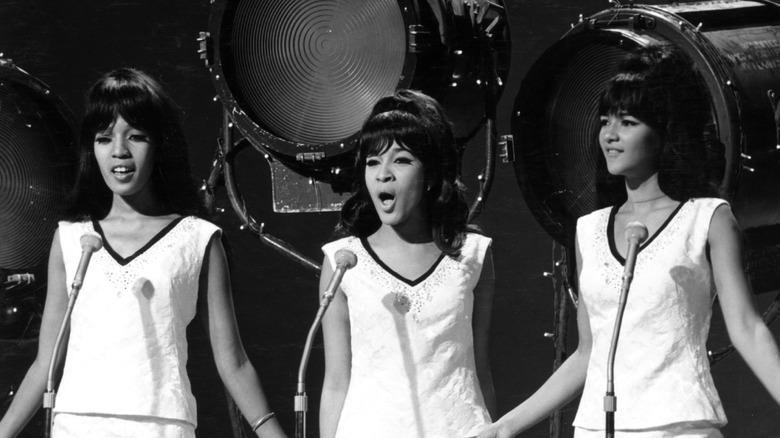
Among the most important and sound-creating pop acts of the first half of the 1960s was New York-based vocal trio the Ronettes. Sisters Ronnie Bennett and Estelle Bennett, and their cousin Nedra Talley (later, Ross) formed a vocal group in the late 1950s, influenced by other singing acts just starting to rise in popularity. After producer Phil Spector discovered the trio, he used the singers as an instrument for his progressive studio techniques, and the Ronettes became a force on the pop and R&B charts, churning out one haunting, pleading, and romantic single after another. Its combo of intricately arranged and exquisitely performed love songs came to define the "girl group" pop of the era.
The musicians' time as a major act that sent hit singles into the ether was quite short, spanning just 1963 to 1966. But the Ronettes didn't need much time to establish themselves as one of the classic acts of '60s pop, the girl group era. They faded from the spotlight, but left an indelible mark. Estelle died in 2009, and the heart-wrenching death of Ronnie Bennett (later Spector) came in 2022. The final living Ronette, Nedra Talley Ross, died in April of 2026. They may be gone, but their music is here to stay, and these five songs show off the influence and importance of the Ronettes.
Be My Baby
"Be My Baby" is a rich, layered, and unabashedly romantic pop tune, as well as a song that makes any movie scene drop-dead electrifying. It's the act's first to make any noise on the national charts, and it's dominated by Ronnie Bennett's performance: emotive, romantic, and yearning as she pleads her case to a would-be lover. She's supported in her grand gesture by an arrangement full of echo, backing vocals, swelling strings, and a frenetic, heart-quickening drum beat that makes the whole thing sound nervous, ghostly, and timeless.
"Be My Baby" hit No. 2 in 1963, and in its wake left it musicians so dazzled that it was often imitated and emulated. Session drummer Hal Blaine's particular rhythm was lifted for dozens of other songs, while Beach Boys mastermind Brian Wilson considered "Be My Baby" to be the greatest single ever, and it's what prompted him to write "Don't Worry Baby" in response. That's the impact of "Be My Baby": It made lush production and careful design non-negotiable in pop music.
Walking in the Rain
A No. 23 hit in 1964, "Walking in the Rain" bears the music of a group that has perfected its sound. Bolstered by Phil Spector's sweeping arrangement and sonically overwhelming production style logically known as the "Wall of Sound," "Walking in the Rain" is a moony, swooning love song bursting with giddy romantic feelings. It's a song about a crush, but it's innovative in that it's a love song devoted to someone entirely unclear. "Walking in the Rain" is sung from the point of view of someone singing about their ideal partner, whom they haven't quite met. "He'll be kind of shy, but real good lookin' too / and I'll be certain he's my guy by the things he'll like to do," Ronnie Bennett explains.
Ronettes lead vocalist Ronnie Barrett got the perfect recording of "Walking in the Rain" on her first try, according to Rolling Stone. She was able to get in character that quickly, indicating that this is a song with instant and universal appeal; the rain and stormy sound effects demonstrate how to easily add ambiance. Subsequently, the song became a semi-standard. "Walking in the Rain" was frequently covered by pop acts in the 1960s and 1970s, among them the Walker Brothers, Jay and the Americans, and the Partridge Family.
Baby, I Love You
In what was ultimately a very small discography, the Ronettes managed to cover many different and disparate sides of love, including the litany of feelings associated with it. If "Be My Baby" depicted the bravery and release of expressing feelings and making a case for romance, and "Walking in the Rain" captures pining, "Baby, I Love You" is the happy ending. It's blunt, it's glorious, and leader Ronnie Barrett is lyrically almost overwhelmed with emotion. "Have I ever told you / how good it feels to hold you?" she wonders. "I think I may start crying," she adds.
And while the group didn't write its own material, the trio were experts at interpreting songs, bringing out all the innate intense emotion, putting on a performance that's grand and spectacular and emotionally intimate and honest. The Ronettes showed all the other love song and pop song singers that came later exactly how to present a love song, demonstrating that feelings sold records, as "Baby, I Love You," as simple and straightforward as it is, went to No. 24 in 1964.
Sleigh Ride
The Ronettes contributed three tracks to "A Christmas Gift For You from Philles Records," a 1963 compilation of acts on its label and produced by Phil Spector. It's a holiday album consisting almost entirely of girl groups performing well-known Christmas carols and holiday songs, and the Ronettes stand out with their so-1960s but ultimately groundbreaking take on "Sleigh Ride." Up to that point, the most common iteration of that tune was as an instrumental, in the style of its originator, the Boston Pops Orchestra. Lyrics were written later on, and the Ronettes used them to make a song that sounded like a cool '60s girl group song — but also timeless.
"Sleigh Ride" sold the idea of contemporary Christmas pop, following centuries of Christmas carols and decades of crooner versions of those songs. Holiday albums by pop artists are incredibly common these days, but the Ronettes showed how it could be done. Its "Sleigh Ride" has hipness, R&B sounds, and a rock 'n' roll edge, all jaunty, jittery, and merry. Sixty years after its initial release, "Sleigh Ride" finally hit the Top 10 in 2023, the same year it was certified triple platinum. All that time, the Ronettes had become part of the holiday celebration of millions.
(The Best Part of) Breakin' Up
With "(The Best Part of) Breakin' Up," which squeaked into the Top 40 of the Hot 100 in the spring of 1964, the Ronettes explored new and rarely treaded ground in the pop music sphere. It's part of the canon of breakup songs that will get Boomers mad all over again, but that's because it's a very honest look at a very messy relationship. "(The Best Part of) Breakin' Up" is about a volatile couple who frequently split up, if only to get back together again almost immediately. This isn't a cathartic, "glad we're over" breakup song, nor a "take me back" one, but one about the fear and impact of a split, even though it never quite sticks. That's some pretty advanced lyrical content and an indication that American pop in the rock 'n' roll era was heading into its creative adolescence.
"(The Best Part of) Breakin' Up" is also a quiet triumph of the Ronettes' style. The harmonies are powerful and captivating, while the mix is equal parts R&B and rock. It's a song that pushes and stomps, blurring the lines between the two predominant musical forms of the era.