

5 New Wave Songs From The '80s That Still Transfix Late Boomers Today
New wave was the music movement that merged edgy rock and raucous punk with a synth-driven adhesive, uniting all the best elements of the decades that came before into a buoyant, edgy sound. Late boomers — those born between 1956 and 1964 — heard the punchy sound coming over the horizon and latched onto the new wave vibe with both hands and the biggest hairdos they could muster, leaving indelible memories that, decades later, awaken with the first bars of these songs.
The mix of club sounds, pop melodies, and outrageous visual style generated many of the innovative music videos that helped define the early days of MTV. With textures ranging from New Romantic to electro-pop — and even early adoption of rap and hip-hop from some acts — there was plenty for late boomers to chew on in the new wave catalog.
Our selections for these five new wave tunes, which still have a lock on the hearts and eardrums of the late boomer generation, are a grab bag of some of the decade's snazziest sound makers. We stuck with bands and songs that were still deep in their new-wave feels, before they evolved into polished performers with more mainstream appeal. Innovators like Devo and Blondie get appreciation here, as does future mainstreamer Duran Duran. A double dose of one-hit-wonder works (at least in the U.S.) from A Flock of Seagulls and Missing Persons round out the set of these exemplary and still-mesmerizing '80s new wave songs.
Whip It – Devo
In an era still being introduced to what new wave had to offer, Devo was composed of wavemakers rather than wave riders. Many late boomers got their radio-friendly introduction to new wave via "Whip It," the 1980 Devo classic that helped usher in the sound. The band wasn't exactly new by then, but the cheeky double entendre of the title was a novelty in the music world, with listeners giggling about S&M without digging deeper into the meaning of the lyrics. That sort of goofiness, paired with zany videos and performance art visuals, helped soften the sell of the super-intellectual Devo and its brainy-yet-entertaining exploration of the de-evolution of humanity in the post-consumer age. Yeah, Devo went deep.
Even when they just enjoyed the electricity of such an innovative sound, late boomers dug what Devo was laying down, with the song's springy rhythm and constant refrain of "Whip it / Whip it good!" The red plastic flowerpot hats and sleeveless black bodysuits the band wore in the video may have been a little odd, but the visuals were a fit for the oddball sounds.
Devo served up a piping-hot slice of reality expansion that gave weird art-rock nerds a place in the music scene, right alongside fellow fun weirdos Talking Heads and avant-garde pioneer Laurie Anderson. And though "Whip It" may have seemed super edgy at the time, now it feels like a grandfatherly track that made space for the artful rockers yet to come, albeit one that is hard to resist revisiting.
Planet Earth – Duran Duran
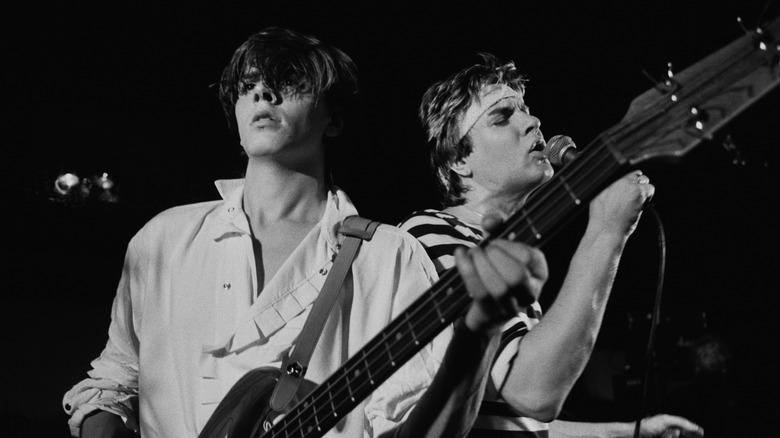
Duran Duran long ago traded its zippy synths and plucky weirdness for modern disco gloss, but when "Planet Earth" introduced the band to the world, it was new wave to the max. Sure, the frilled collars and puffy pirate shirts seem like fashion mistakes in hindsight, but when the fivesome showed up grooving to an electro-throb beat with a danceable, inescapable gravity, the whole package was too intriguing to look away from.
The 1981 single had the groovy energy of a cyberpunk film — fitting for Duran Duran's sci-fi-inspired name — with impressionistic lyrics describing the post-apocalyptic world that Cold War babies were convinced was coming. "Look now, look all around, there's no sign of life," singer Simon Le Bon wails, "This is planet earth, you're looking at planet earth." The image is chilling, but the propulsive backing tracks transform it into a groundbreaking new wave dance fest.
Duran Duran would quickly choose better clothes and smooth out its sound, working with top-tier producers like Nile Rodgers and shifting to a refined textural delivery that emulated acts like Roxy Music. That evolution turned the band into a worldwide phenomenon and heralded a second musical British Invasion, similar to the one The Beatles launched in the '60s. But the naive, try-anything passion of "Planet Earth" will always be a valentine to the late boomer's early new-wave love.
Words – Missing Persons
When Dale Bozzio of Missing Persons showed up on MTV sing-squeaking "Words," there was no turning away from the television. Her blast of platinum-blond hair with bursts of neon pink and electric blue was shocking at the time, and her wacky plastic peek-a-boo outfit left little to the imagination. But the look was entirely fitting for the herky-jerky charm of the song, delivered with Bozzio's hiccuping vocals about how useless words were in a content-saturated post-modern setting. It was a new wave sucker punch that energized the landscape with both its message and its infectious melody.
Missing Persons tapped into the sense of social isolation that was already creeping into American culture in the early '80s. Lyrics like "Media overload bombarding you with action / It's getting near impossible to cause distraction / Someone answer me before I pull out the plug" seem eerily prescient in the post-social media, smartphone-saturated 21st century, but Bozzio was setting the table in 1982. Was Bozzio a new-wave oracle reporting on a vision from the future, or have we always been inundated with mind-numbing media mish-mash? Probably a little of both.
With its "Do you hear me? / Do you care?" directness and boingy electronic delivery, "Words" is one of those timeless songs that late boomers and even Gen X-ers can pop on today and feel like it's a new release. The generations after may not catch the vibe, but as Missing Persons foretold, that was totally expected.
I Ran – A Flock of Seagulls
Who could ever forget the first time they saw A Flock of Seagulls' singer Mike Score and his sculptural eagle's-beak hairdo? It was the kind of freaky strangeness late boomers were starting to embrace in their musicians, and "I Ran" was a danceable ditty with just enough attitude to rock above all the synth work. Furthermore, Score's unadorned voice had the sort of robotic drone that said anyone could join in on the new wave fun, as long as they had access to plenty of Aqua Net to keep their 'do on point.
The minimalist storytelling in the lyrics drew upon the growing '80s paranoia of the UFO experience, spurred by classic late-'70s sci-fi films like "Invasion of the Body Snatchers" and "Close Encounters of the Third Kind." At first, it sounds like a simple meet-cute, with Score singing, "I walk along the avenue / I never thought I'd meet a girl like you," before admitting, "And I ran, I ran so far away." A shy romantic move, maybe? Not likely when he reveals in the second verse, "A cloud appears above your head / A beam of light comes shining down on you." Yikes. No wonder he ran.
Does the overwhelming romance outweigh the icy cyberpunk terror of being abducted by an intergalactic temptress? Or is this new wave classic simply describing the all-encompassing cosmic strangeness of new love? Late boomers know the answer is yes to both.
Rapture – Blondie
Blondie's sound was difficult to pigeonhole; there were new wave touches all over the place, but Debbie Harry and crew also threw in strokes of disco, rock, and even early hip-hop, as in the timeless tune "Rapture." Harry was a New York City art scene darling who hung with quirky cats like Andy Warhol, bringing a built-in level of creative street cred to her musical project. So the already-successful Blondie taking this genre-bending 1981 new wave jam to No. 1 made perfect sense to those who'd followed the band's evolution.
Harry's eerie falsetto vocals and trills of brassy saxophone on this tune are punctuated by lightning-powered guitar blasts that demonstrate Blondie's new-wave eccentricity. At the halfway point, Harry launches into a wacky rapped tale about an alien abducting and eating an earthling before chowing down on all the cars it can find, then moving on to eating bars and clubs. It may seem wan now, but it made "Rapture" the first No. 1 song to contain rapping, a historic first for the band and the music world.
The cosmic kookiness was worlds away from what rap would become in just a few short years, but it helped thin the veil between the mainstream and hip-hop realms by using new wave as a catch-all artistic label. Decades later, Debbie Harry would become a record-setter for the oldest female singer to hit No. 1, but late boomers will always remember her and Blondie for this scrappy, trendsetting new wave classic.