

These 5 Female Guitarists Of The '80s Are Criminally Underrated
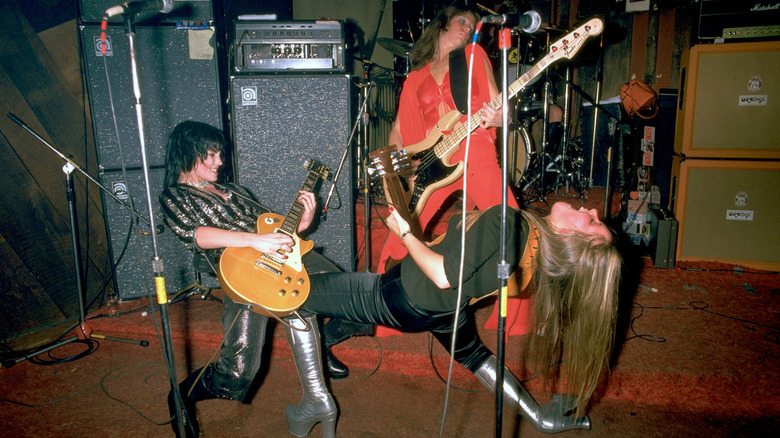
If nothing else, the '80s were the decade of shred. Eddie Van Halen, Yngwie Malmsteen, Randy Rhoads, Steve Vai: These are some of the names that come to mind when thinking of all sorts of virtuosic and influential guitarists from the decade. Other names, however, tend to get overlooked — especially of the female variety. Thankfully, we're here to rectify this oversight and highlight some criminally underrated 80's frontwomen, songwriters, and shredders of all bends.
That's our first point: While it's easy to see a guitarist doing some crazy arpeggios and say, "Wow, that's awesome," it's far easier to overlook guitarists who serve their songs rather than beg for attention. That doesn't mean we're going to focus predominantly on singer-songwriter types, but rather that no type of guitarist is off the table. And even though we're highlighting female guitarists, we're not giving out any condescending participation trophies; our choices truly deserve proper respect. The '80s fostered guitarwork of the highest tier that resonates onward through the present, especially in rock, and including women whose work is of a genuinely superlative calibre.
Musically savvy readers could probably guess a couple of our choices, like Michael Jackson's guitarist, Jennifer Batten, or Prince's guitarist, Wendy Melvoin. We've also got to give nods to the estimable "Heavy Metal Queen," Lita Ford, as well as the ever-strangely-underrated Nancy Wilson of Heart, plus the quintessence of rock, Joan Jett.
Nancy Wilson
One listen to Heart's Nancy Wilson playing the extended acoustic opener to "Crazy on You," and you'll wonder why she's so underrated or why anyone ever doubted her. Her fingerpicking technique is practically flawless, as is her sense of rhythm, note articulation, and overall feel. But people did doubt her, including producer Mike Flicker, who loved vocalist Ann Wilson but wasn't so sure about her sister, Nancy. However, thanks to a lot of work from Nancy to prove herself, plus Ann refusing to form Heart without her sister — as Nancy told Billy Corgan in a YouTube interview — we got the sibling-led, dual-vocal attack of Heart.
Heart crossed over from the '70s to '80s without issue, and in fact were more popular in the '80s, when they released both of their No. 1 tracks on the Billboard Hot 100, "Alone" and "These Dreams." Nancy didn't just back "Heart" this entire time, she fronted it, taking the vocal lead on songs like one of those No. 1s, "These Dreams," in addition to her guitar playing.
It took a lot of pushing and striving to reach that point, going all the way back to Nancy and Ann's childhood. The Wilson family neighbors said Nancy should stop playing guitar because "it'll ruin her nails" (per Louder Sound). Thankfully, her parents disregarded such nonsense and supplied their daughter with whatever instruments they could. At the same time, the musical world had few female guitarists for Nancy to emulate, but that didn't matter. She took inspiration from songwriting greats like Elton John, Paul McCartney, and Neil Young. That's how she became not only an early female rock guitarist, but a superb player that no one should underrate in any way.
Lita Ford
Lita Ford wasn't just a good guitarist who happened to play during the '80s, she was a full-on rockstar living a rockstar lifestyle. After playing with The Runaways in the '70s, she shifted into a solo career in the '80s that earned her the informal moniker "Heavy Metal Queen," included a duo with the Prince of Darkness himself, Ozzy Osbourne, and involved numerous self-reported flings with rock frontmen in true, hedonistic '80s fashion. Ford walked the walk while shredding the fretboard. And yet, she was undervalued and remains underrated.
No matter that Ford got her start in the '70s, her solo career and persona found ideal footing during the '80s. She easily slid into the glam rock aesthetic of the day — hair, showmanship, attitude, etc. — which culminated in the aforementioned Ozzy duo, "Close My Eyes Forever," the final track on her final '80s album, the self-titled "Lita." This legitimately excellent, well-phrased, and well-plucked rock ballad remains Ford's most listened-to Spotify song by a huge margin. The song's even got a surprisingly tasteful, non-flashy solo that demonstrates how Ford ultimately let her music do the talking, no matter the focus on image.
But it was image that did Ford in, same as it lifted her work into the limelight. While musicians heard her musical intelligence, the general public saw her as something closer to "chick with guitar" — an image that her label happily leaned into, judging by her album covers. It's not clear exactly how much this affected her long-term legacy, but Ford deserves to be anything but underrated.
Jennifer Batten
How good do you figure a guitarist had to be to tour with Michael Jackson? On three world tours, no less: "Bad," "Dangerous," and "HIStory," including Jackson's 1993 legendary Super Bowl performance. That's hundreds of thousands of collective fans watching her play the most stand-out guitarwork from Jackson's discography, like the shredfest solo on "Beat It." Granted, two of those tours and the Super Bowl performance happened in the '90s, but Jennifer Batten's storied career started in 1987, when she auditioned to be Jackson's guitarist via video (by playing the "Beat It" solo, no less). She had a month of rehearsal before meeting Jackson face-to-face, during which she was asked, "Can you take a year off?, according to what she told Sessions Panel (via YouTube).
It took a lot of work to get to the point where Batten was able to audition for Michael Jackson, though. As a young person, she learned music theory and took guitar lessons with jazz guitarist Peter Sprague just to get into the Guitar Institute of Technology (G.I.T.). As she says in an interview with Hyperlocrian, she was the only student in her class who'd never performed live for a crowd. She was also the only woman in the entire school. Her first post-graduation gig earned her $12. But, believing that more and more women were playing guitar and should play guitar, she soldiered on.
All this is to say: Nobody handed Batten anything. She earned her keep and her career, both of which land her in the fabled guitarists of the '80s camp. She had the stage presence, confidence (and yes, iconic and eye-catching mask) to stand toe-to-toe with the King of Pop, which makes underrating her ludicrous.
Wendy Melvoin
Much like working with Michael Jackson, what kind of steely person does it take to play with Prince? This is The Purple One of which we're speaking, the guy who was brutally strict with his team and who had loads of unspoken rules for his staff to follow. This was apparently no problem for Wendy Melvoin, though, who not only played in Prince's band, the Revolution, but starred aside Prince in his 1984 semi-autobiography, "Purple Rain." She played with Prince on stage in the film, strumming the very recognizable opening chords to "Purple Rain," same as she continued to do over the course of her life even as her career evolved well past the '80s.
Even more than starring alongside Prince, however, Melvoin was the closest thing in Prince's coterie to a true musical partner. In the studio, Prince let her have free rein with her gear, her tone, her arrangement, etc. He cared more about the feeling of the music and how Melvoin performed on stage than anything else. And as fans of Melvoin attest to this day on forums like Reddit and Prince.org, Melvoin wasn't just a rank-and-file goon who played rote notes; she captured and exuded a big part of Prince's sound and soul.
More recently, Melvoin has worked with indie rock singer Sombr, who not only calls her "our secret weapon," but, "one of the world's great musicians" (per Music Radar). Sombr cites the same kind of between-the-notes presence that is distinctly Melvoin — even when she plays bass — rather than strict technical know-how (although Melvoin's got those, too). All these chops trace back to the '80s and elevate Melvoin to a place where it's criminal to consider her underrated.
Joan Jett
Joan Jett isn't going to win any points for being a highly accomplished technical guitarist. But that's not why she makes our list. Jett was like the incarnation of rock itself, even without her No. 1 cover of "I Love Rock 'N Roll." The attitude, fire, rebelliousness, leather, and eyeliner: Jett was the full package. But even though most people remember her as an icon and frontwoman for her band, the Blackhearts, she also played the guitar — rhythm guitar in this case, propelling songs forward with the precise energy and thrashy chords they needed.
Jett was always drawn to rock, particularly the punk-adjacent, jeans-and-leather variety. When she asked her parents for a guitar at 12 years old, she said, "And I don't want no folk guitar" (per Proxy Music). She so perfectly adopted the attitude and style of what she loved that, when she met music producer Kim Fowley at the LA nightclub Rodney Bingenheimer's English Disco, he put her in a band. That's how Jett wound up in the Runaways at a mere 15 years old. Yes, this means that Jett and Lita Ford played in the same band together before Jett launched her own label, Blackheart Records, after 23 labels told her, "No, thanks."
But far from being merely a young trailblazer, Jett truly loved playing guitar and is about as authentic as you can get. She's still got her old, beater Epiphone with cracks and "personality," as she told Guitar Center in an interview. "It's beat up, but I beat it up," she said. This kind of approach, when coupled with Jett's raw, rugged playing style and legacy, makes her more than worthy of never being underrated.