

5 John Denver Songs That Prove He Was The Ultimate Idealist Of The '70s
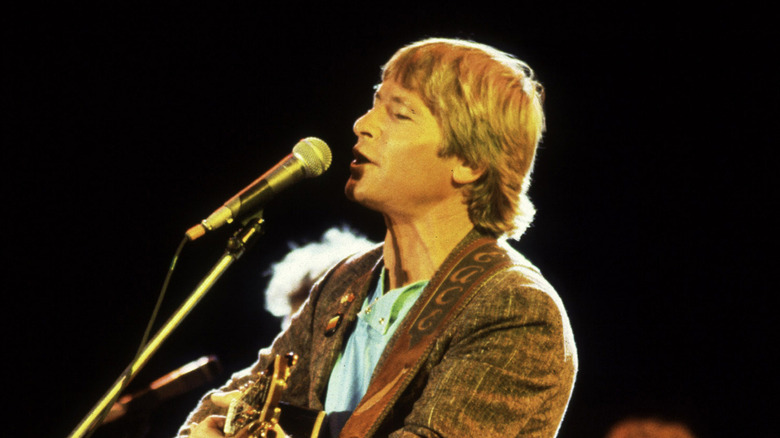
John Denver created music that sometimes felt a little too earnest to be true. But the more the singer-songwriter's dedication to social and environmental causes became known, the more evident it was that he wasn't faking his sincerity; this was an honest-to-goodness idealist with a guitar and a choir-boy voice, wearing his heart on his sleeve and his optimism in his Buster Brown haircut. Of all the musicians peddling hope and good vibes in the '70s, he was one of the few who made good things actually seem possible. That spirit lives on in the songs Denver left behind after his tragic death in 1997.
We find John Denver's idealism most present in his songs about nature, a passion that made him an unabashed champion of the planet and the humans who populate it. The almost-spiritual adoration of nature made classics out of hits like "Take Me Home, Country Roads," "Rocky Mountain High," and "Annie's Song." Lesser-known tunes such as "Gospel Changes" displayed the singer's refreshingly clear-eyed hopefulness, in poetic form. And the celebratory "Calypso" makes us wish Denver's soaring idealism had continued into an age where optimism can be in short supply.
Take Me Home, Country Roads
The anthem for West Virginians and anyone else in love with their home territory, "Take Me Home, Country Roads" is a John Denver classic that reminded listeners that there's always a way back to your roots. It also gave West Virginia "Almost Heaven," a 2018 travel slogan with cozy, baked-in familiarity, even if it came almost 50 years after the song was released.
Despite name-dropping West Virginia in the first lines, the occurrence of that particular state's name is incidental. Writers Bill Danoff and Taffy Nivert, who would go on to be half of Starland Vocal Band, were actually inspired by the pastoral scenery of a Maryland drive; West Virginia happened to have the rhythm the lyrics needed, so they used it instead. The song was originally meant for Johnny Cash, but when Denver ended up helping Danoff and Nivert finish it up, the three performed it the very next night at a venue in Washington, D.C. Denver recorded and released it the next year, and it quickly became a signature tune.
Regardless of the location or the descriptions in the lyrics, the singer idealized the notion that you actually can go home again, and his audience caught the vibe. This John Denver classic has even become an Oktoberfest anthem for its celebration of rural life. His joyous description of going home in general is what stuck, whether you get there down country roads, city streets, or suburban avenues.
Rocky Mountain High
John Denver's other well-known location-based hit, "Rocky Mountain High," offered a vision of his figurative rebirth after discovering the awe-inspiring magic of Colorado's natural beauty. His love of the state even factors into the truth about Denver's last name, which he changed from Deutschendorf as a tribute. For many listeners, it was an introduction to this striking region of the U.S., instilling a sense of awe that summed up musically what otherwise might only be felt by a trip to the mountain range itself.
"He was born in the summer of his 27th year / Coming home to a place he'd never been before," Denver sings. "He left yesterday behind him / You might say he was born again / You might say he found a key for every door." His religious reverence for the awe-inspiring power of nature takes on an evangelical aspect this time, strong enough to wash away the past and allow him a new beginning.
The song caused a bit of a flap early on when it was perceived to be about drug use and was banned from radio for a bit. But this homage to the pristine wilds of the American Mountain West brings with it a high that doesn't require substance consumption. The natural high is evident in the way Denver shares his reverence.
Annie's Song
Another tribute to the power of nature and love, "Annie's Song," which is sometimes referred to as "You Fill Up My Senses," compares love to some of the most majestic phenomena on the planet. It's one of John Denver's simplest songs, and yet it's also among his most affecting, thanks to the direct and vulnerable way he expresses what's in his heart for all to hear.
Imagine having someone write a song that turns your presence into a metaphor for "a night in the forest," "mountains in springtime," and "a walk in the rain." For a nature-lover like Denver, it's the highest praise possible, an ideal that turns what others might find mundane into divine appreciation. The minuscule becomes monumental and magnificent in the songwriter's singular vision.
Inspiration for the song struck Denver as he skied the mountains near Aspen, spurred by he and then-wife, Annie Martell, coming through a rough patch in their relationship. The tenderness of Denver's description and his intensity of emotion resonates with pretty much everyone who's ever felt love of any kind, which likely helped make this ballad one of the singer's No. 1 hits.
Gospel Changes
John Denver goes for a more direct approach to his idealistic views with "Gospel Changes," a gentle folk tune that explains the kernel of faith without naming names. The song makes strategic use of Christian imagery to bring the basics of the religion down to earth, and shows how skilled Denver was at making grand ideas relatable to everyone who listened.
Denver didn't write this one, but his interpretation of Jack Williams' work makes it sound like a natural fit for the introspective singer. The message is a simple one: The struggle to transcend is nothing new, and if you strip it down to its fundamentals, it all points to being a good human and adhering to the tenet of "live and let live."
Things take a bit of a change in the chorus, though. "Now we got new names and faces this time around," Denver sings, which sounds an awful lot like the decidedly non-Christian idea of reincarnation. If you keep an open mind while listening, you just might pick up on the notion that goodness is a universal concept, and everyone is just doing their best. It's a standard of kindness and respect this hopeful singer believed in strongly enough to infuse his music with it — and aren't we all lucky that he did.
Calypso
One of John Denver's most inspiring environmental anthems came as a tribute to legendary ocean explorer Jacques Cousteau and his team, who explored the watery depths and revealed the otherworldly environment to the rest of us. The song includes the sound of a clanging brass bell that emulates what Denver likely heard during his 1975 trip on the Calypso, Cousteau's boat. Orchestral flourishes add layers of atmosphere to give a sense of majesty and authenticity. It's also a great tune to sing along to at top volume, with zero shame.
Denver wasn't even trying to disguise his ardent love for the planet here, not that he did much on his other songs, either. But there's something majestic about devotional-sounding lines like "To work in the service of life and the living / In search of the answers to questions unknown" and "To live on the land we must learn from the sea." They give the song a spiritual dimension, like a hymn to the ocean and the intrepid souls who explore its wonders to share them with the world.
Once the shanty-style sing-song chorus swells with "Ay, Calypso I sing to your spirit," it's like joining a church choir of starry-eyed sailors who truly love the sea. You can hear the enthusiasm and elation as Denver's voice rises to meet the soaring vocalizations that follow. There's no keeping the idealistic chills at bay when you sense how devoted he was to the subject matter.