

5 Bob Dylan Songs That Prove 1965 Was The Best Year Of His Career
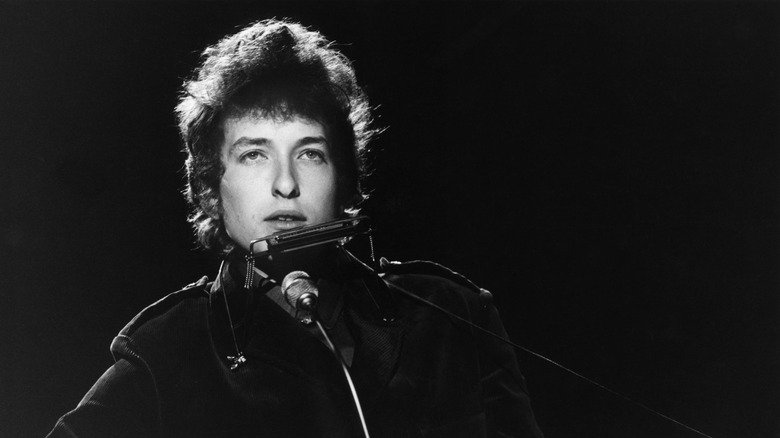
Bob Dylan's storied career boasts many years that could be said to be his creative, commercial, and overall peak, but it's nearly impossible for us to choose anything other than 1965. Critics and fans at the time weren't exactly happy with Dylan's career trajectory as the year progressed, and it's fun to wonder how they'd perceive it now, with hindsight, but the innovative sounds, classic hit songs, underrated masterpieces, and overall magic that Dylan captured in 1965 are second to none across his career.
Sure, there are reasonable arguments to be made for other years, most notably 1975, which saw the excellent "Blood on the Tracks" as well as a number of excellent live recordings, but the depth of 1965, without a truly bad song, pushes it ahead of the pack. It's one of the few years Dylan released two albums, and both have gone down as classics: "Highway 61 Revisited" and "Bringing It All Back Home."
On these two albums are enough tracks to make a much longer list, but our chosen five songs helped define the growing zeitgeist of rock 'n' roll, including folk and blues songs that showcased Dylan's ability as a poet and culture critic — all among his greatest strengths as an artist. Of course, we've included some of his best-known songs, such as "Mr. Tambourine Man," but deeper works such as "Queen Jane Approximately" also demonstrate how Dylan was at the height of his powers in 1965. All together, we think this variety of songs proves that year was certainly the best of Dylan's career.
Like a Rolling Stone
It may be Bob Dylan's best-known hit, a rock 'n' roll masterpiece that has since defined much of the genre after him, but "Like a Rolling Stone," however popular, deserves a bit of reflection and rumination. This 1965 song never reached No. 1, but it's become Dylan's most iconic for a reason: it represented the stylistic turn of the mid-'60s that heavily influenced rock 'n' roll as we know it today. Leading off "Highway 61 Revisited," Dylan's classic 1965 album, "Like a Rolling Stone" sets a perfect, euphoric tone for the music to come.
The legacy of "Like a Rolling Stone" as one of rock's finest tracks endures for good reason. Its bright electric guitar progression paired with an iconic organ riff makes for one of the more memorable arrangements in all of '60s rock, and Dylan's vocal performance shines with pure, youthful passion. The song's story of its lost protagonist, filled with rich detail and unique phrases, is as colorful as it is interesting, and "Like a Rolling Stone" is consequently an essential piece of '60s culture and remembrance. The song is fun, quotable, historically important, and its iconic "How does it feel?" is likely one of the most memorable lines in rock history.
Desolation Row
"Desolation Row" closes the storied album "Highway 61 Revisited" in a style '65 Dylan fans were more used to, yet still makes a truly memorable impression. The song is a weaving folk odyssey more similar to a grand Renaissance painting in style than anything else, telling interconnected surrealist stories about figures from Cain and Abel to Cinderella, all set within the fictitious Desolation Row. It represents the height of Dylan's impressionist poetry and is a perfect closer for the revered album.
Set behind a simple, strummed blues-folk style consisting of just a couple of guitars, "Desolation Row" has a larger-than-life feeling that can be interpreted in a number of ways, but likely alludes to the '60s bohemian movement. The original album recording is the essential version, but an electric alternative on The Bootleg Series: Vol. 12 further boosts the song's power. At nearly 12 minutes and with a flurry of strange and unrelated lyrics, "Desolation Row" can be a lot to chew on, but it's absolutely worth the time. In fact, we think this may be Dylan's best and most definitive song, and one of the greatest folk — and honestly, overall — songs of all time.
Mr. Tambourine Man
There are few songs more synonymous with Bob Dylan and as universally revered as "Mr. Tambourine Man," which was the most notable highlight on his 1965 album "Bringing It All Back Home." The song was also a No.1 hit in the summer of '65, yet not for Dylan, but instead from rock band the Byrds, which reached the coveted top spot among a stacked '65 with its rendition. Dylan's is more stripped-back and classically folky, but the power of the song is nonetheless evident in each version.
"Mr. Tambourine Man" is another track from Dylan's stellar year of '65 that became a standard-bearing and timeless height of songwriting. Its chorus may seem simple at face value, and indeed parts of it are, but the grand story told in the rest of the song is one of weariness, inspiration, and hope, all within a long night's walk in New Orleans. The vivid sincerity and fantastical dreamings of Dylan's flourishing pen are endearing and moving, and it's no surprise this song has become the classic that it is. The song can also be enjoyed with a new sound in a later 1975 live performance from Dylan's Rolling Thunder Revue tour.
Ballad of a Thin Man
A step away from his more folky and sentimental tracks, "Ballad of a Thin Man" is another story entirely, being full of vitriol, disgust, and a blues rock sound that showcases Dylan's supreme versatility of sound and themes in 1965. Its slow organ and buildup to its chorus are a unique style in Dylan's discography, and the song is even more memorable with this contrast to his other work. His vocals also shine in "Ballad of a Thin Man," especially in a rapturous 1966 live performance in Edinburgh, Scotland.
A protest against the music industry and rock journalists alike through its fantastical narrative, "Ballad of a Thin Man" paints a hateful portrait of a "Mr. Jones," who stands in opposition to Dylan and '60s counterculture. It's certainly Dylan at his most anti-establishment, and his unique phrasings and scenarios to tell the story are as ridiculous as they are effective. It's another triumph of "Highway 61 Revisited," an album truly without a bad or even merely good song.
Queen Jane Approximately
Though it was released as a B-side single in '66, "Queen Jane Approximately" was originally included as an album track on 1965's "Highway 61 Revisited," and while it doesn't take scathing digs at the establishment or tell a timeless poetic story, it's still among Bob Dylan's best musical arrangements. Full of groovy organs and guitars, it's a rich, warm soundscape that has become one of his best pop songs, a style he'd continue to master in later years.
The blues-inspired sound of "Queen Jane Approximately" is charming and catchy, and Dylan lets loose with some passionate vocals over some colorful verses and the repeated line "Won't you come see me, Queen Jane?" The story within is romantic-inspired, though still with that classic Dylan vagueness, and the ambiguity lands well over the inspired production. It's an achievement in itself that an album's deep track could have this level of supreme quality, further proof of the inarguable heights of Dylan's '65.