

The 5 Best Bonnie Tyler Songs That Aren't Total Eclipse Of The Heart
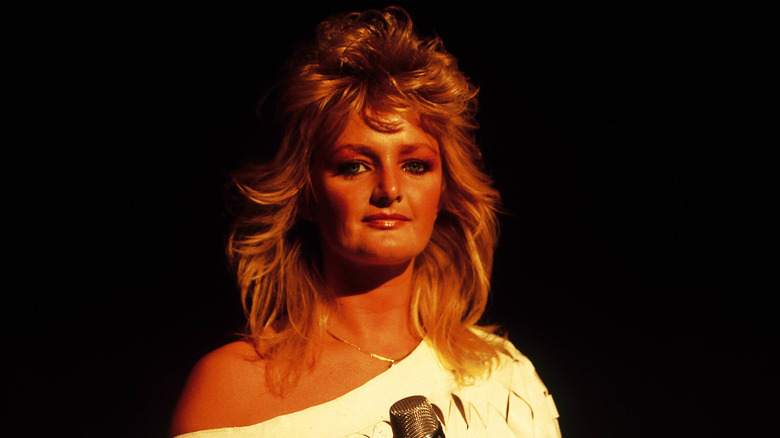
For many people, it's safe to assume that Bonnie Tyler equals one song: "Total Eclipse of the Heart," which went No. 1 in 1983 and recently joined the 1-billion listens club on Spotify. The song is fantastically theatrical, grandiose, and immense. After all, Jim Steinman originally wrote it for a Nosferatu musical — a wild backstory, indeed. But beyond such a mega, career-defining hit, Tyler's got a lot of other songs worth exploring.
First off, we admit that we're biased towards '80s Bonnie Tyler. But let's be honest, so are a lot of other people — did we mention "Total Eclipse of the Heart"? In contrast to Tyler's fairly generic '70s pop ballad stylings, '80s Tyler is vastly more vibrant, gutsy, out-there, and even has hints of rock. This is true even though her post-"Total Eclipse of the Heart" musical career left her chasing that song's style and sound. If fans prefer the earlier version of Tyler, with tracks like "Lost in France" (1977) or "It's a Heartache" (1978), then enjoy. But for our part, we've gone with songs that are bold, bring out the best in Tyler's husky voice and commanding character, are hooky enough without being too reliant on said hooks, and stand the test of time as straight-up well-written songs.
The tracks we've chosen all come from a span of five years, from 1983's "Faster Than the Speed of Night" to 1988's "Hide Your Heart." This was peak Tyler, and is full of songs that ought to slip into your playlists.
Holding Out for a Hero
The most obvious of our choices, of course, 1984's "Holding Out for a Hero" is an awesome song. Peaking at No. 34 on the Billboard Hot 100 (Tyler's third-highest song), it never reached No. 1, but Hollywood gave it a remarkable second life. Over the decades, movies like "Shrek 2 (2004)," "Short Circuit 2 (1988)," "The Super Mario Bros. Movie (2023), and many more, "Holding Out for a Hero" accompanies scenes revolving around one central idea: an underdog finally gets a chance for glory.
Of course, the song fits that scenario; it was written for it. Jim Steinman, the guy who wrote "Total Eclipse of the Heart," co-wrote "Holding Out for a Hero" for 1984's "Footloose," featuring a young Kevin Bacon dancing in defiance of close-minded authorities and small-town ordinances. Specifically, "Holding Out for Hero" serves as the theme for one of the movie's memorable scenes where Ren McCormack (Bacon's character) plays chicken with the town bully, Chuck Cranston, using tractors. Thus, the blueprint for future "Holding Out for a Hero" uses: an underdog everyone underestimates, a surprising display of semi-unwitting courage, and an ultimate victory.
But even without such a history in film and TV, "Holding Out for a Hero" is still a killer track. It's got all the same characteristics as Steinman's other irresistibly hammy and musically sumptuous tracks, like Meat Loaf's "I'd Do Anything for Love (but I Won't Do That)," "Paradise by the Dashboard Light," and "Two Out of Three Ain't Bad" (quite the pedigree). And in the hoarse croons of Tyler, "Holding Out for a Hero" found the perfect voice. Highly, highly recommended.
The Best
We all know that fantastic Tina Turner song, "The Best," right? "You're simply the best / Better than all the rest," the chorus goes. Well, well. No matter that it's almost impossible at this point to extricate the song from Turner's iconic voice and swagger, it's not a Turner song — it's a Bonnie Tyler song. Tyler released it in 1988 on "Hide Your Heart," and Turner released her cover the very next year on "Foreign Affair." But no matter that "The Best" has resoundingly become a Tina Turner song in cultural memory, it's got all of the same core qualities when Tyler sings it, but heard through a Tyler filter.
Listeners to Tyler's original "The Best" will hear two differences between her version and Turner's version: the key is different (Tyler's is higher) and the instrumentation is different. But, they both have similar bass pulses at the bottom of the mix (accented eighth notes), the same build and release from verse to chorus, and the same four-chord motif following the first line of the chorus ("Cause you're simply the best" in Tyler's original). Turner's version deploys a saxophone for the solo, while Tyler's uses a guitar. That's sexy sax power for you.
But ultimately, our point is this: If you like Turner's rendition of "The Best," then you'll like Tyler's original. Turner fans owe it to themselves to hear the track that she wielded to reach No. 15 on the Billboard Hot 100, while Tyler fans need no convincing. Tyler's song has soul, sentiment, bravado, and sensitivity in equal measures, and is well worth a listen.
If You Were A Woman (And I Was A Man)
Warning: Ultra-'80s track incoming. The snare on the drum machine, the boop-boop synth line, the background woo woos, the jangly electric guitar, the music video's whackadoodle gothic manor circus: Bonnie Tyler's "If You Were A Woman (And I Was A Man)" from 1986's "Secret Dreams and Forbidden Fire" is possibly the most '80s of all of her '80s songs. It's also pretty dang good in and of itself and reached No. 77 on the Billboard Hot 100. It's a bit musically stock, but it's still cool.
If you couldn't tell from our above description, or the pageantry of the video for "If You Were A Woman (And I Was A Man)," Jim Steinman's DNA is all over the song; he produced it. If he'd written it, who knows how high it could've climbed the charts? Granted, it's easy to assume that the song was an attempt to try and reclaim the earlier, colossal success of "Total Eclipse of the Heart." Both songs contain parallel musical elements, similar cinematographic components in their videos, and are sopping with drama and grandeur (though nothing beats "Total Eclipse of the Heart" on this front).
And you know what? Even if you don't like "If You Were A Woman (And I Was A Man)," just watch the video at least once. You'll be muttering "What in the world?" about every five seconds of its glorious length, especially at the football shoulder-pad wearing, but otherwise shirtless, string quartet and the dancing harlequin(?) that jumps out in front of them. There's also the mud wrestlers and zip line gun dude zipping in front of the giant spiderweb. Uh-huh, like we said.
Faster Than the Speed of Night
Time to go back to the year that Bonnie Tyler cinched her career. "Total Eclipse of the Heart" was track four on her 1983 album, "Faster Than the Speed of Light," two tracks after the album's title track. The latter track exudes the same over-the-top musical theater sensibilities as the album's biggest song (Jim Steinman was the producer), leans heavily into guitar riffs (played on Flying Vs, judging by the music video), has some pop music piano arpeggios, and comes with yet another gonzo, smoke-and-light-suffused music video featuring armored dudes jousting on motorcycles. What can we say? Someone on her team must have pushing these dream-logic theatrics really hard.
But have no fear, because all such compositional and cinematographic elements only add to "Faster Than the Speed of Light," not detract from it. "Faster Than the Speed of Light" develops naturally over its runtime, doesn't overuse its chorus, doesn't overstay its welcome, has some sweet duel-guitar licks, and is a solid Meat Loaf-like song in addition to being a solid '80s track.
Plus, "Faster Than the Speed of Light" fits perfectly on its album, which besides "Total Eclipse of the Heart" contains "Have You Ever Seen The Rain? (a Creedence Clearwater Revival cover), "Straight From the Heart" (covered by Bryan Adams the same year), "Take Me Back," and plenty of other stand-out tracks. Each song is unique enough not to blend into others, yet it matches the sound and vibe of the entire album. "Faster Than the Speed of Light" is Tyler's best album overall, and its title track is a worthy addition to her catalogue.
Here She Comes
A bit more mellow than the rest of our choices, Bonnie Tyler's "Here She Comes" is a song that's easy for folks to miss. It wasn't released on any of her studio albums, but came out on the soundtrack for the 1984 remastered version of "Metropolis," the legendary 1927 sci-fi film directed by German filmmaker Fritz Lang. What does the song have to do with sci-fi's first feature film to depict a futuristic dystopia built on a class-stratified society that lives aside sentient machines? Uh ... Nothing. Composer Giorgio Moroder just wanted a rock opera version of "Metropolis." But we can consider that part of the charm of the song, if not the remaster that featured it.
"Here She Comes" stands out from the other Tyler recommendations in this article because it actually pushes her signature, husky voice to the forefront rather than production design and instrumental flourishes. That voice really gets the chance to shine, and even belt a bit, through a tight melody backed by big power-chorded guitars. It's all a bit pared-back and simpler than we're accustomed to from '80s Tyler, and serves as a reminder of why a song we're not including on our list, the pre-'80s "It's a Heartache" (1978), reached No. 3 on the Billboard.
And because we can't help but mention it, those desiring the same flair from "Here She Comes" as from Tyler's work with Jim Steinman can look to the song's music video. There's some statues of soldiers from various historical eras that come to life and follow Tyler down dark, wet alleyways before a UFO visits and a duplicate Tyler chases the original Tyler in a car. Right. Just give the song a listen.