

5 Cat Stevens Songs That Prove 1971 Was The Best Year Of His Career
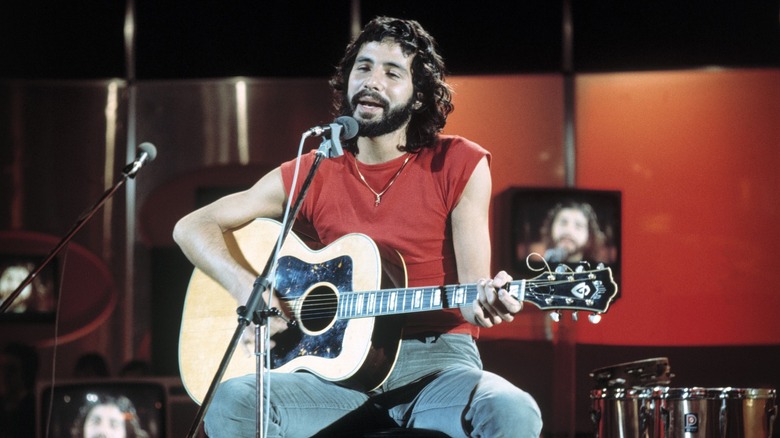
The year 1971 could very well be music's best ever, and as it was the most commercially and creatively significant time of his career, Cat Stevens is a big reason why. After toiling as a songwriter in the 1960s, creating demos that became mega-hits for others, Cat Stevens broke out as a solo artist in the early 1970s, and his staggering talents couldn't be denied. His compositions were love songs about life itself, both passionate and vulnerable. They were delivered with a soulful, pleading, and warm voice that really felt the lyrics, and usually accompanied by little else besides Stevens' own guitar and maybe a piano. Stevens' songs spoke to things deep, moving, and universal, and he became a superstar in the singer-songwriter-dominated '70s.
Stevens certainly had triumphs before and after that one transcendent, magical, and career-defining year. As a musician who converted to a new religion, Stevens (later known as Yusuf Islam) left mainstream pop and rock music, but he'd eventually revisit his earlier works. Most of those best-known songs all seemed to strike it big in 1971. Here are the five tunes that made that year so impactful for Stevens.
Wild World
Cat Stevens' "Tea for the Tillerman" LP hit stores in November 1970, but the only track that would rock the pop chart was the single "Wild World," which began its climb in February 1971 and peaked at No. 11 that April. Uneasy and more than a little patronizing, it's from the panicked point of view of an individual whose loved one is leaving him. Perhaps it's a lover trying to leave the relationship or a parent nervous about setting their child loose into the world; either way, "Wild World" is a melancholy song full of dire warnings about the true nature of society. It's not a nice place out there, and a person looking to rely on optimism and kindness is going to get metaphorically eaten alive.
There's a pain and fragility to a lot of Stevens' work, and it's captured in "Wild World." And while he's crying out to the subject to see his point of view, he also imbues the song with the elements that make his brand of folk music, with its big, anthemic choruses that make resisting a singalong almost impossible, so attractive.
Moonshadow
Mere months after "Tea for the Tillerman," Cat Stevens struck again with another full-length LP, "Teaser and the Firecat." The first single, "Moonshadow," edged its way into the top 30 by the summer of 1971. That was perfect timing for such a simple and understated classic-to-be to rise in popularity, as "Moonshadow" must have featured prominently in countless beachside, bonfire, and campfire singalongs that season. While it's a Stevens original, "Moonshadow" sounds and feels like a timeless, traditional folk song that's been around for centuries, passed down via performance at informal gatherings.
That's part of the charm and success of Stevens: He originated and perfected brand-new, old-fashioned songs for contemporary audiences, making "Moonshadow" a monumental moment in 1971. Stevens wrote it based on the real experience of being alone on a beach, away from city lights for the first time. That honesty is both attractive and palpable in the final form of "Moonshadow."
Peace Train
At its best intentioned and most effective, folk music simultaneously appeals to the hearts and minds of its audience, and it can truly effect change. Cat Stevens, who espoused big ideas about the human condition and the individual's place in a sometimes confusing and cruel world, picked the right genre for his songs, and that was made clear in the fall of 1971 when his rollicking, enveloping folk song "Peace Train" hit No. 7 on the Billboard Hot 100. Though very much a product of its time, the lyrics of "Peace Train" don't explicitly mention the Vietnam War — or any war at all — but then, the message is so much bigger than any one military conflict.
With "Peace Train," Stevens followed up the aggressive, psychedelic rock-driven anti-war music movement of the late 1960s with a return to the more cerebral and heartfelt messaging of the folk music from the earlier part of the decade. Stevens set a tone for the counterculture as it aged into adulthood and still protested the Vietnam War, all while inviting its audience to be part of an even larger and more idealistic movement.
If You Want to Sing Out, Sing Out
One way that Cat Stevens left his mark on 1971 was by expanding into other realms of music. He provided most of the soundtrack for the quirky cult-classic movie "Harold and Maude." The story of a unique and sweet love between a young man who wants to die and an old woman for whom death can't come fast enough was told in part and indirectly through the deep and complex songs of Stevens. Another '70s star, Elton John, passed on the job, leaving Stevens to offer tunes from his "Mona Bone Jakon" and "Tea for the Tillerman" LPs, as well as the brand-new, previously unheard "If You Want to Sing Out, Sing Out."
That song, a gentle but direct suggestion to be true to oneself and follow one's own path and heart, served as the thesis of both the film and Stevens' career, right as it reached its peak. Crying out for understanding and issuing a message of unity — that's what Stevens' music was all about, and he encapsulated it with "If You Want to Sing Out, Sing Out." Stevens promises, "You can do what you want, the opportunity's on / and if you find a new way, you can do it today."
Morning Has Broken
The only song on the 1971 album "Teaser and the Firecat" that Cat Stevens didn't write himself was "Morning Has Broken." Stevens' version of the tune first reached listeners in 1971, but its popularity would carry into 1972, when it reached a career-best position of No. 6 on the Hot 100. In one of his last musical achievements of the banner year of 1971, Stevens connected himself and his genre-blending style with spiritual and religious music much older than himself and his audience.
"Morning Has Broken" is a gentle and beautiful song in which the performer expresses thanks and adoration for the opportunity to live one more day in a world that's profoundly beautiful. Powerful meditations aren't often the material that major pop hits are made from, nor is the inspiration for "Morning Has Broken." Stevens' arrangement is based on a 19th-century Gaelic hymn, and he uses the words written in 1931 by English author and poet Eleanor Farjeon.