

Shoegaze Never Had A No. 1 Hit — But These 5 Songs Prove The Genre's Incredible Influence
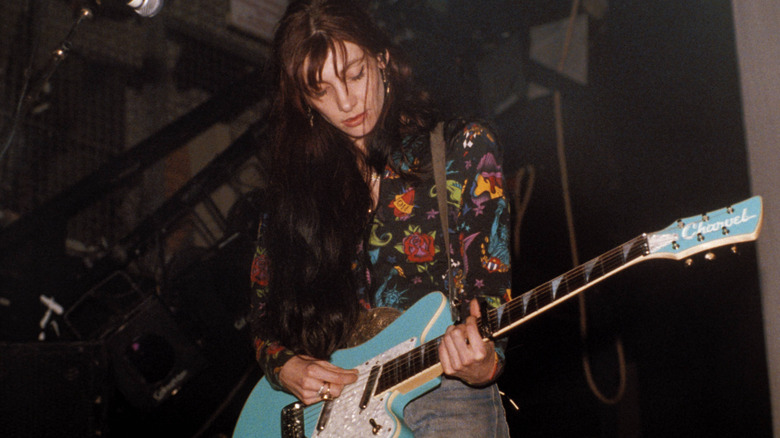
It tracks that shoegaze, the genre of indie rock named after the way its guitarists would stare at the pedals at their feet, never scored a No. 1 charting hit. Massive commercial success was never in the cards for '80s and '90s U.K. bands like My Bloody Valentine and Slowdive, yet their influence looms large. The dreamy, ethereal songs that they and their peers produced took the heavy guitar sounds of Dinosaur Jr. and Sonic Youth to England and laid the groundwork for numerous bands and multiple musical movements. You can hear the fuzzy, effected guitars and introspective lyrics that define the genre in everything from the moody indie of Beach House to the nu-metal bombast of the Deftones.
There are many influential candidates for this list, including some shoegaze songs we'd trade the world to hear again for the first time, but we've narrowed it down to five exemplary tracks that truly showcase the genre's enduring imprint on music. By both setting the template for the genre and pushing at its boundaries, they remain as relevant and instructive as ever. These songs endure, living on through established bands and in every kid who has picked up a Fender Jazzmaster guitar, lined up the effects pedals, and cranked up the amp. From The Jesus and Mary Chain's "Just Like Honey" to Slowdive's "Souvlaki Space Station," this is shoegaze at its most inventive, innovative, ethereal, and emotional.
Souvlaki Space Station — Slowdive
If you had to pick one record to introduce shoegaze to a friend, Slowdive's seminal album "Souvlaki" would rank among the top choices. Every song on it is gorgeous (and heartbreaking), but "Souvlaki Space Station" showcases the ethereal, atmospheric side of the genre. It's a roughly six-minute, spaced-out odyssey pushed along by delayed guitars, haunting vocal harmonies, and echoey drums. With a driving bassline, the song brings ambient electronic and dub influences into shoegaze, making the rock song sound even cooler today than it did when it was released in 1993.
Not that you'd make them out, but the lyrics of "Souvlaki Space Station" are devastating. Sung by guitarist and keyboardist Rachel Goswell, they seem to bristle at an ex. The final verse lays everything bare: "Curse your soul / I don't wanna hear you / (And I) Curse your soul / I don't wanna know you." That they sound gorgeous, while dripping with outright scorn, adds to the emotional tenor of the album. And it comes from an authentic space: Goswell and fellow Slowdive founder and main songwriter Neil Halstead broke up while working on "Souvlaki."
So many bands take cues from "Souvlaki's" lush guitar textures, including 2010s indie bands like DIIV and Beach House. Slowdive's influence also extends to bands blending metal and shoegaze, such as Deafheaven. As that band's singer, George Clarke, told Westword, "As far as that whole genre is concerned that is, I think, the best band to have come out of it."
Duel — Swervedriver
Swervedriver will always be considered part of the shoegaze movement. It never fully took off in the band's native England, with its first album "Raise" the highest-charting, peaking at No. 44 in the U.K. Charts in 1991. But it did make inroads in the U.S., buoyed by college radio airplay, tours with Soundgarden and Smashing Pumpkins, and an appearance on MTV's "120 Minutes." "Duel," off the band's 1993 album "Mezcal Head," isn't as downbeat as other songs in the genre, but it's driven by the heavy layers of distorted guitars that define shoegaze.
The riff-oriented shoegaze sound of "Duel" shows the influence of American alternative bands like Dinosaur Jr., but it's the lyrics that really fit the bill: luminous, gorgeous, and a little inscrutable. We're not sure what "A million stars out tonight / Could spark neon from candlelight" means exactly, but the image sits perfectly among the song's guitar textures.
Because Swervedriver pushed at the margins of shoegaze and touched on hard rock and metal influences, you can hear its influence in rock subgenres like post-hardcore and emo. Think bands like Hum, the Deftones, and Title Fight. And of course, indie rockers like Tame Impala (another band with a driving-themed name) create similar, expansive guitar tapestries.
Come In Alone — My Bloody Valentine
Influencing everyone from Smashing Pumpkins' Billy Corgan to the Deftones' Chino Moreno, My Bloody Valentine's 1991 album "Loveless" is considered a masterpiece of shoegaze. The album's fuzzy soundscapes, soaked in reverb and echo effects, are pleasantly disorienting. And on a record that's full of the shoegaze version of bangers, the seventh track, "Come In Alone," perfectly encapsulates the sound and mood of the genre's early '90s peak.
"Come In Alone" is a shoegaze song to soundtrack your dreams. With floating riffs drifting above oceanic-like layers of textures, the guitarwork isn't just stunning; it's groundbreaking. "Come In Alone" features a technique developed by guitarist Kevin Shields called "glide guitar," which involves using the whammy bar while strumming to continually bend the pitch. "I thought, 'Wow, it sounds totally like some weird tape,'" he recalled to Far Out, "sort of a copy of a copy of a copy." The effect is mesmerizing, and decades later, numerous online tutorial videos continue to bring this innovation to new generations of players.
Making "Come In Alone" a shoegaze gem are the vocals of second guitarist Bilinda Butcher, delivering spare, bleak poetry. "Why I don't need to believe / What you see," she sings, perhaps referencing a relationship falling apart, "To look up and around / You were gone / Words came out to a sound." Abstract, melancholy, and undoubtedly emo, they linger in the air and then evaporate like mist in the sun.
Just Like Honey — The Jesus and Mary Chain
If shoegaze is a family, then The Jesus and Mary Chain is one of the parents. The Scottish psychedelic alternative band's 1985 debut record, "Psychocandy," birthed the sound. With its washed-out beat and layers of distorted guitars, the album's first track, "Just Like Honey," checks all the boxes. Released before the term "shoegaze" was coined, it shows how much the genre owes to Motown-like walls of sound and the Velvet Underground's iconic drone. Some critics effectively describe the band as proto-shoegaze rather than the real thing, but one listen to "Psychocandy" should put that distinction to bed.
Breathily delivered by Jim Reid, the lyrics match the vibe by being cryptic yet evocative. They let the listener fill in the gaps. "Walking back to you is the hardest thing that I can do / That I can do for you, for you" goes the second verse, seemingly evoking being trapped in the "honey" of a passionate relationship gone sour. And in the house-style of shoegaze, the vocals act mostly like an instrument; a part of the sonic texture rather than the focal point.
The influence of The Jesus and Mary Chain extends well beyond Lush, My Bloody Valentine, and the shoegaze family. It's in the DNA of all indie rock that creates expansive, noisy soundscapes like A Place To Bury Strangers. "All of their sounds and textures made their songs so mysterious," guitarist Oliver Ackerman told Wired, "There was this beautiful feeling of not knowing exactly what was going on."
Dreams Burn Down — Ride
Shoegaze first envelops you in its warm embrace and then lets you roam vast sonic spaces. Symptoms of listening include sensations of falling, drifting, or floating, and Ride's "Dreams Burn Down" does exactly that.
Andy Bell and Mark Gardener's guitars in "Dreams Burn Down" undulate from melodic phrases to gritty, noisy outbursts. Seemingly depicting being trapped in a toxic relationship, the lyrics are steeped in bitterness and longing. Landing on the couplet, "I just want what I can't have / 'Til my dreams burn down and choke me every time," the chorus is an emotional flamethrower. "Dreams Burn Down" and the rest of Ride's aptly-titled 1990 album "Nowhere" struck a chord in their native England, if not in the U.S.
The Oxford-based band's debut peaked at No. 11 on the U.K. album charts, expanding the genre's influence. "It's classic shoegaze in the sense that it's noisy as hell yet stunningly beautiful," writer and rock critic Kenneth Partridge told the AV Club, later adding, "... you can say the only shoegazers that really preceded Ride were The Jesus And Mary Chain and My Bloody Valentine." But as much as Ride impacted the shoegaze of its time, it remains an enduring influence. After the band's breakup in 1996, Bell struck it truly big by joining Brit-pop behemoth Oasis. But just about any indie band trading in atmospheric walls of sound is indebted.