

5 Hit Songs That Prove 1982 Was The Decade's Greatest Year For Women In Rock
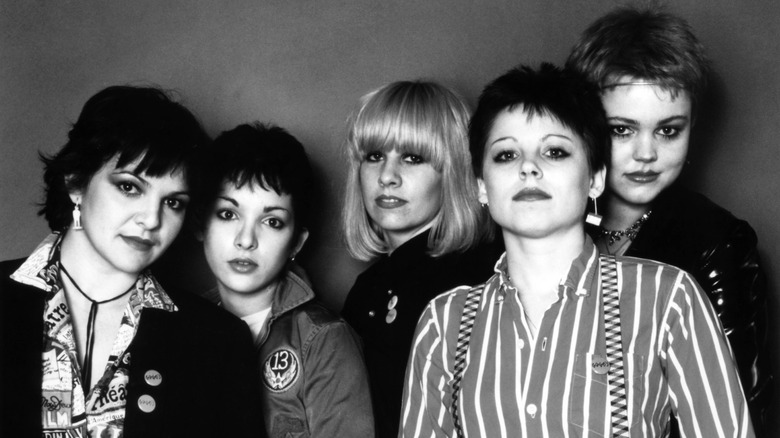
The year 1982 was particularly a good one for the ladies of rock. At that time, '60s rock trailblazers like Janis Joplin and Grace Slick and female-fronted bands from the '70s like Fleetwood Mac and Heart had opened the doors for their successors. By the early '80s, plenty of talented women had proven that they had what it took to play rock 'n' roll.
The year 1982 was a great year for women in rock because of how many of them shot up the Billboard charts, or broke records, or earned Grammys for songs that came out that year. For the purposes of this article, though, we aren't including 1982 chart-toppers "Physical" by Olivia Newton-John or "Mickey" by Toni Basil. While both songs went to No. 1, those songs don't quite rock, and their singers, though entertaining, lacked any rock 'n' roll swagger. However, artists like Joan Jett and the Blackhearts and Stevie Nicks definitely made our list because they are obviously badasses of rock. All of the women on this list exemplify what rock 'n' roll is about, whether it's because of the sound and style of their music, their prowess on their electric guitars and drum kits, their rebellious attitudes, or their modern (at the time) take on rock.
I Love Rock 'n' Roll — Joan Jett & the Blackhearts
Joan Jett & the Blackhearts' cover of the Arrows' "I Love Rock 'n' Roll" earned Jett the acclaim she'd been striving for since she helped form the all-girl band the Runaways in the mid-'70s, when she was still a teenager. That band broke up in 1979, but Jett was far from done. She released the solo album "Bad Reputation" before putting together the Blackhearts as her backing band. After being rejected by 23 record companies, she refused to take no for an answer. Instead, she started her own label to release the album "I Love Rock 'n Roll" in 1981.
According to Jett's website, she and her longtime business partner sold albums out of their car, and because of her determination and grit, her fan base grew. Eventually, the titular song gained traction on the radio and took off on the mainstream charts beginning in February 1982, climbing all the way to No. 1 by March 20, where it stayed for seven weeks. Jett was vindicated, and it must have been gratifying proving all of those record companies wrong. Sticking it to the man is very rock 'n' roll, and Jett definitely did that with this song.
It was her biggest hit to date, but 1982 also saw two more songs from her debut album with the Blackhearts climb the charts: "Crimson and Clover" reached No. 7 and "Do You Wanna Touch Me (Oh Yeah)" peaked at No. 20, making it a pretty stellar year for her. Interestingly, all three of Jett's songs that made the charts that year were covers. Whatever works.
Edge of Seventeen — Stevie Nicks
By 1982, Stevie Nicks was already a rock 'n' roll role model from her time with Fleetwood Mac, but she had written more songs than the band could put out, considering she wasn't the only songwriter in the now-legendary group. So, she did what any prolific artist would do — she put out a solo record, releasing "Bella Donna" in 1981. The album featured three songs that charted high on Billboard's Hot 100 between '81 and '82. Two of those were duets with iconic rockers Tom Petty and Don Henley, but Nick's song "Edge of Seventeen," which peaked at No. 11 in April 1982, really showcased her rock 'n' roll spirit with its chugging guitar and commanding vocal delivery.
Nicks has never shied away from using her real-life situations and emotions in her songwriting, and this song came from an emotional place as well, possibly lending to its power. According to what she told Rolling Stone in 1981, the lyrics that say, "And the days go by like a strand in the wind" and "Well, I went today / Maybe I will go again tomorrow" had to do with her uncle, who was dying of cancer. John Lennon was also killed while she was working on the song, so the theme of death was heavy on her mind, and that's where the "white-winged dove" image comes from — it's symbolic of "a spirit that is leaving a body," she said.
"Edge of Seventeen" was nominated for a Grammy for best rock vocal performance by a female. And while the song was a hit in 1982, today, it's the most popular of her solo works on Spotify by a large margin. A banger is as a banger does.
We Got the Beat — the Go-Gos
While all the women on this list are phenomenal musicians, they were all backed by men in their bands. Not the Go-Go's, though — which makes them even more of a standout in a year that saw many women rise to the top of the charts. They wrote their own songs, played their own instruments, and dominated the charts in 1982 like the bunch of bosses they were.
Singer Belinda Carlisle, rhythm guitarist Jane Wiedlin, lead guitarist Charlotte Caffey, drummer Gina Schock, and bassist Kathy Valentine hailed from the LA punk scene but created a more pop-rock, radio-friendly sound with the Go-Go's. The group released "Beauty and the Beat" in 1981, and while two songs from the band's debut album charted well on the Billboard Hot 100, "We Got the Beat" held the No. 2 spot for three solid weeks in March 1982. Not to mention, "Beauty and the Beat" was also the No. 1 album that same month, holding the spot for six weeks. The band even still holds the record for being the only all-girl rock group to ever have a No. 1 album.
"We Got the Beat" was percussion-driven, uptempo, and dance-worthy, and it was put together quickly. "I didn't labor on the lyrics," Caffey told Billboard in 2016. "It's a simple song, which goes back to the '60s, when I had my ears glued to the radio for the Stones, the Beatles, and the Beach Boys." So, even though no men were involved in writing or playing the song, they do get credit for inspiration.
Shadows of the Night — Pat Benatar
By the time Pat Benatar released her fourth album, "Get Nervous," in 1982, she'd already made her name as a rock frontwoman with powerful pipes, landing seven songs on Billboard's Top 40 hits in three years. Her hit "Shadows of the Night" went to No. 13 that year and No. 3 on the Mainstream Rock chart. The track was among Benatar's most dramatic, highlighting her vocal prowess and delivering some of those huge '80s power ballad vibes. Indeed, it put the rock world on notice that it was her turn to hold the mic, and she knew what to do with it. Benatar's work on the song won her a Grammy for best rock vocal performance by a female.
To really bring home the point that women were harnessing their power in '82, the music video leaned into Rosie the Riveter and World War II themes. Notably, Benatar plays a soldier with perfect lipstick who has a hand in blowing up a Nazi compound, singing "Shadows of the Night" as she pilots a WWII-era plane away from the scene. That's pretty dang rock 'n' roll.
Gloria — Laura Branigan
The name Laura Branigan may not be as familiar as some of the other rockin' ladies on this list, but make no mistake: In 1982, everyone knew who she was. That year, after trying her hand at being in a band in the 1970s and working as a backup singer for Leonard Cohen, Branigan released her debut solo album, "Branigan." The second track on the LP was "Gloria," and it was glorious.
A reworking of an Italian song that had already been a hit song in Europe, the song hit the Billboard Hot 100 in July 1982 and stayed there for 36 weeks, slowly climbing until it secured the No. 2 spot in November. Branigan died of a brain aneurysm in 2004 at 47, but according to a post on her official Facebook page, in 1982, she broke a record: Thirty-six weeks was the longest any female vocalist had spent on the Billboard charts at that time.
"Gloria" was a little bit disco, a little bit pop, and a lot of synth — which was becoming a more standard component in rock at the time. But what really made the song rock was Branigan's seemingly effortless yet potent vocal delivery. It's the kind of song that gets you trying to sing loud when no one else can hear you, only to realize it's not as easy as she makes it seem. It's no surprise that Branigan was nominated for the Grammy for best female pop vocal performance for "Gloria." She had several other hits throughout the 80s, but none of her songs ever climbed as high or stayed on the charts as long as her 1982 hit.