

5 Rock Songs From 1955 That Sound Even Cooler Today
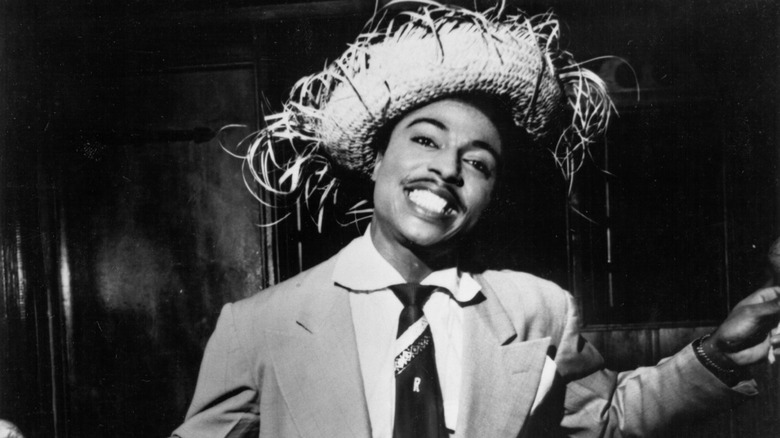
It may seem unbelievable that rock 'n' roll songs released more than seven decades ago can still appeal to modern listeners, but they surely do. For instance, 1955 was an important year for rock 'n' roll; it was when musicians who would go on to be some of the most legendary names in the genre released groundbreaking work. Just a cursory look at what artists were putting out back in 1955 reveals that many of that year's hit songs have proven to be timeless — as these five specially selected tracks prove.
Stars like Chuck Berry, Bo Diddley, and Little Richard all put out signature songs that would become the inspiration for iconic artists of the 1960s and beyond. Not only were these tracks groundbreaking when they first appeared, but they have also gained kudos down the years for simply refusing to age, maintaining that manic, mischievous energy that first made them stand out to the record-buying public. Whereas other hits of the era may sound corny or dated, these have retained their edge, and their vintage production value has only given them an added degree of retro charm. So, crank your stereo volume up as high as humanly possible, kick off your shoes, and prepare to rock out to some foundational moments of musical genius that sound even cooler today than when they were released way back in 1955.
Maybellene — Chuck Berry
The 1955 single "Maybellene" is the moment that made Chuck Berry a living rock 'n' roll legend who inspired Bruce Springsteen's greatest songs. Indeed, the song announced him as a once-in-a-generation talent who was pushing the bounds of the new, subversive genre. "Maybellene" runs like a rocket, underpinned by a driving double bass and Berry's commanding, rapid-fire vocals. There is little else you will find released in 1955 that gallops along at such a speed, while the track's dynamics, with Berry's vocals high in the mix and the thick bass sound, make it sound as if it could have been recorded decades later.
Undoubtedly subversive at the time of its release — its lyrics about aggressively pursuing an errant lover aside — the track nevertheless found a large audience among 1950s rock fans, who sent it to No. 5 on the pop chart and No. 1 on the R&B chart. Berry would, of course, go on to have more timeless hits. But nothing could be as seismic as "Maybellene," which is the sound of popular music changing in one great two-and-a-half-minute leap into the future.
Bo Diddley — Bo Diddley
Another game-changing record released in 1955 was Bo Diddley's self-titled single, which introduced the "Bo Diddley beat" (aka the most iconic rhythm in rock music) and changed the sound of the genre forever. The charismatic guitarist made the singular move of giving the track his own stage name, and in doing so, he ensured his own immortality thanks to that single tune alone. Diddley had a long and distinguished career, with a flurry of hits in the 1950s and 1960s and a reputation as a much-respected live act right up until the end of his career. But his self-titled single is legendary for the Bo Diddley beat alone: An innovative syncopated rhythm that gives the song its unforgettable and danceable shuffle.
Immediate contemporaries like Buddy Holly released songs that made the Bo Diddley beat their own. So did later generations of rockers such as The Rolling Stones, Tom Petty and the Heartbreakers, and KT Tunstall. But Diddley's original, which topped the R&B chart for two weeks and was later covered by The Beatles, is the place to go to hear that beat in all its radical glory.
Tutti Frutti — Little Richard
If Chuck Berry and Bo Diddley were establishing the framework for rock guitar in the decades that followed, then pianist and vocalist Little Richard was taking rock 'n' roll vocal performances to a whole new level. Nobody had ever sung in such a raw, rebellious, and outrageous style as Richard, whose vocal prowess still bursts through the speakers like no other singer in the history of rock. "Tutti Frutti" is Little Richard's most famous song, which opens with his legendary utterance: "A-wop-bop-a-loo-bop, a-lop-bam-boom!" An insertion that functions like a vocalized drum fill, the nonsense phrase introduced the idea of rock 'n' roll being a genre in which the voice is primarily an instrument.
The "Tutti Frutti" template was followed by later artists such as Robert Plant and countless vocalists who were willing to use nonsense as part of their performances. Richard's use of high notes to punctuate the ends of lines has also been widely imitated, most notably by the Beatles in the group's early work. Though early versions of "Tutti Frutti" were sexually explicit, Richard changed many of the lyrics to make the song marketable to a popular audience. But the song's innate subversive nature is plain to see, and it's still a riot seven decades later.
Ain't That a Shame — Fats Domino
Fats Domino was a legend in his own right back in the day — indeed, Little Richard himself cited the singer-songwriter as one of the best to ever do it. Like Richard, Domino was a pianist, though Richard bowed to his contemporary's ability when it came to making the keys sing. "Ain't That a Shame" was written by Domino and his longtime producer Dave Bartholomew, and it was a turning point in the young star's career. The song proved to be a breakthrough for the musician, who had first debuted as a recording artist six years earlier with the single "The Fat Man." The bluesy rock 'n' roll track is innovative for its combination of ironically uptempo instrumentation and performance with sardonic lyricism, and it's a precursor to songs like the Bob Dylan classic "Don't Think Twice, It's Alright.
Despite being pressed at a higher speed than Domino's actual studio performance to put off potential copycats, the song topped the pop chart when covered by Pat Boone months after the original release. Nevertheless, the cover helped Domino's tune become a classic and one of the most-covered of the era. It was reportedly the first song future Beatle John Lennon learned to play on guitar and was a cornerstone of his 1975 "Rock 'n' Roll" album. Listen today, and Domino's irresistible charm is plain to see.
Speedoo — The Cadillacs
The pioneers of rock 'n' roll were influenced by the earlier popular genres of the 1950s, such as doo-wop. Indeed, many early rock 'n' roll classics bore doo-wop hallmarks. "Speedoo," for example, is a classic 1955 track by The Cadillacs. Previously known as The Carnations, The Cadillacs was an early R&B and doo-wop outfit that joined the rock 'n' roll revolution with "Speedoo," though the brass, percussive backing vocals, and smooth instrumentation remained from its earlier sound.
The song is especially notable for the silky performance of lead singer Earl Carroll, who intones, "They often call me Speedoo, but my real name is Mr. Earl." The track was a mainstream hit, cracking the Top 20 of Billboard's pop chart and hitting No. 3 on the R&B chart. Though many fans would undoubtedly point to 1954's "Gloria" as the group at its very best, "Speedoo" was its breakthrough moment and is worth revisiting to trace how rock 'n' roll was built on the back of what came before it.