

5 Flop Disco Songs That Have Earned Respect From Younger Generations
Some of the best and most important disco songs of the late 1970s or thereabouts were commercial duds when they were initially released, but later generations would save them from obscurity and elevate those tunes to classic status. For whatever reason, certain songs that, from a contemporary perspective, sound like bona fide disco hits — with their propulsive beats, ecstatic melodies, jittery strings, and loud horns — just couldn't get many people out onto the dance floor or into the record stores back in the golden age of disco. Instead, they were slow-burners, taking years or even decades to become hits, and in new and indirect ways. Such disco gems inspired other musicians, have been covered and sampled frequently, and appear on numerous movie and TV show soundtracks. Did they ever make it to the upper reaches of the Hot 100, or onto the pop chart at all? They didn't, but that doesn't matter in the long run.
Here are five also-rans from the disco boom that would eventually find the credit and attention they were due, from latter-day, too-young-for-disco audiences that saw something special.
Street Player — Chicago
Perhaps guilty of betraying its most loyal fans when it switched genres, Chicago was one of the most inoffensive and middle-of-the-road soft rock bands of the 1980s. Before that, Chicago was a large rock band with a boisterous horn section that allowed it to blend elements of jazz and R&B into its music. Well equipped to get in on the disco craze, Chicago released what's probably its most danceable and funkiest tune ever in 1979, "Street Player." A radical reworking of a song of the same name by R&B group Rufus, Chicago's "Street Player" bursts out right away with a descending horn line and a good 30 seconds of brassy blasting before singer Peter Cetera takes over with some passionate crooning. Within the first minute, listeners have already heard two of the most familiar sections in recent pop memory: the horn line and the "street sounds swirling through my mind" bit. Nevertheless, "Street Player" hit the skids, reaching No. 91 on the R&B chart and missing the Hot 100 entirely.
Younger listeners have found plenty to appreciate in the song, though. It's Chicago's "Street Player," not Rufus', that's been sampled and interpolated more than 50 times, mostly by younger electronic and hip-hop artists. It's the basis for the 1994 dance hit "The Bomb (These Sounds Fall Into My Mind)" by the Bucketheads, Slim Thug's 2011 track "Creepin'," and 2019's "Through My Mind" by Firebeatz and Schella.
Love Sensation
Released toward the end of the disco era proper in 1980, "Love Sensation" never landed on the Hot 100, but it was a smash hit in what few discotheques were still operational at the time, landing at No. 1 on Billboard's dance club singles chart. All the instrumentation required for a great disco song — bongos, electric guitar, strings, horns, and a killer synthesizer solo — are present on "Love Sensation," but it's Loleatta Holloway's sensual and celebratory vocal performance that takes it to another level. She translated the romantic ecstasy described by producer and songwriter Dan Hartman, the '80s hitmaker behind "I Can Dream About You" and a one-hit wonder you didn't know passed away, into dance floor bliss.
Finally, about a decade after its release, "Love Sensation" felt the sensation of love, first from other musicians working in the dance milieu and then plenty of casual listeners. Samantha Fox used a sample in the 1988 hit "I Wanna Have Some Fun," followed by Black Box for 1989's "Ride on Time" and Moby in 1993's "Move (You Make Me Feel So Good)." In between, 1991's "Good Vibrations" so heavily relied on "Love Sensation" that Marky Mark and the Funky Bunch recruited Holloway to perform with the crew and credited her properly in the No. 1 hit "Good Vibrations."
Rasputin
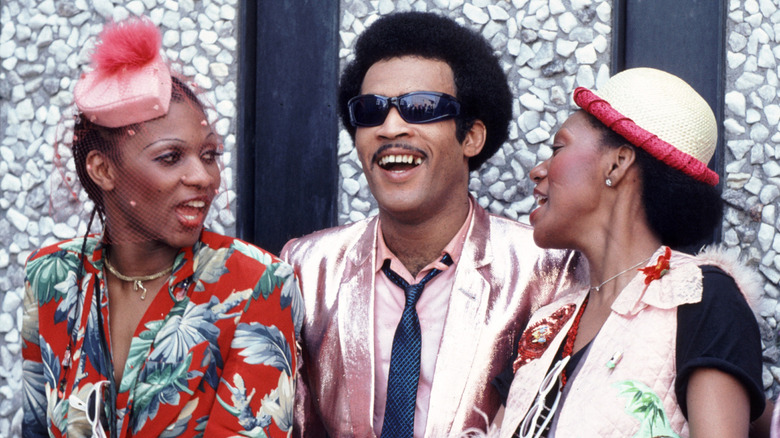
Before he orchestrated the grand hoax of Milli Vanilli, producer Frank Farian was the wildly successful architect of the 1970s act Boney M., a studio creation that used hired singers to perform Farian's disco confections live and on television. The pop-reggae-dance band was extremely popular throughout Europe and particularly in the U.K., where it enjoyed 17 Top 40 hits, among them "Rasputin." It reached No. 2 in the U.K. in 1978 but was completely ignored by radio and record buyers in the United States. Perhaps a song fawning all over legendary Russian figure Rasputin for his imposing physical stature and romantic prowess was too hard of a sell to American audiences in the midst of the Cold War. Disco songs at that time didn't require such rich lyrical content, after all.
"Rasputin" has endured as a relic of the late 1970s, held up as a cultural touchstone despite its abject failure in the U.S. Movies and TV shows popular in the states have featured "Rasputin" on their soundtracks, including "Black Mirror," "NCIS: Los Angeles," and "Under the Boardwalk." "Rasputin" has also proved to be a fertile sample source, used by a diverse group of dance acts as well as the rap group Insane Clown Posse.
Walk the Night
Successfully blending hard rock elements with disco, the Skatt Bros. came from the same label and personnel pool that made Kiss one of the biggest acts of the 1970s. Formed by Kiss writer and producer Sean Delaney, the Casablanca Records band didn't hide the fact that many of its members were part of the LGBTQ+ community, and its breakout single, "Walk the Night," subsequently got a lot of spins in bars and venues in New York City and San Francisco that catered to that demographic. Clubs of a more explicit nature also embraced "Walk the Night," which has quite direct and sexually explicit lyrics. In the relatively conservative 1970s, such a song was never going to garner Top 40 radio airplay, but "Walk the Night" did manage to make it to No. 9 on the dance music chart.
"Walk the Night" strolled into the daylight in the 2000s, when it started getting featured on soundtracks. Experienced by millions of gamers when it was used in the music-heavy title "Grand Theft Auto IV" in 2008," it has since been utilized to underscore plot points on episodes of "Fellow Travelers," "Euphoria," and "The Righteous Gemstones," and it earned a prominent spot in the smash horror movie "M3GAN."
Sing Sing
Gaz is an obscure and forgotten act that only briefly existed in the disco era. The group only ever put out one LP, a self-titled record in 1978 that featured keyboard player and main songwriter Thor Baldursson as well as a guitarist, a producer, and numerous studio singers.
With its bass line, guitar solos, instrumental breakdowns, and jazzy flourishes, "Sing Sing" left future generations with a lot to work with. As early as 1985, DJs, rap groups, and electronic musicians were taking pieces of "Sing Sing" and adding them to their songs. NWA's Eazy-E sampled the song twice in 1988, for "Eazy Chapter 8 Verse 10" and "I'mma Break it Down," and in 1997, it was central to "It's Yourz" by the Wu-Tang Clan. Kylie Minogue employed "Sing Sing" on 2007's "Speakerphone," and it's part of the remixes of recent hits like Dua Lipa's "Don't Start Now" and Daft Punk's "Get Lucky."