

Bob Dylan's Biographer Says The Icon Crowned This 1966 Epic Song His Best
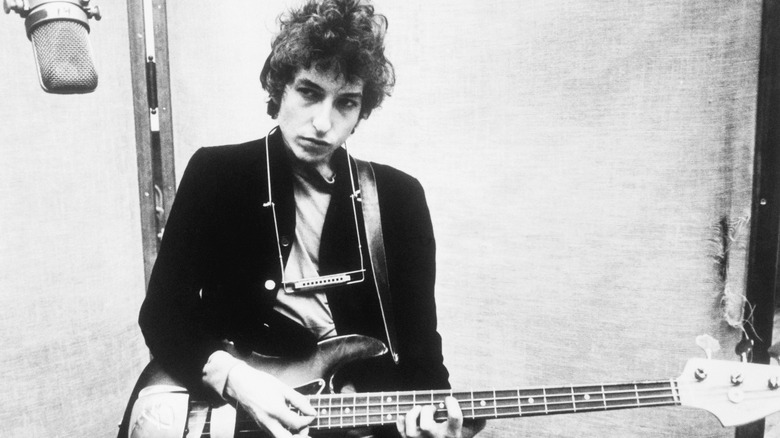
There are many songs in Bob Dylan's expansive discography that fans could claim are his very best. But according to the artist's biographer, Dylan himself favored a lengthy deep cut from one of his albums, rather than one of his more famous singles. "Sad-Eyed Lady of the Lowlands" is the final track of the 1966 double album "Blonde on Blonde." At 11 minutes long, it is one of the longest-running tracks in his catalog, with a tightly woven, cyclical chorus that anchors the subject of the song.
Speaking to Robert Shelton while the writer was gathering research for the 1986 Dylan biography "No Direction Home: The Life and Music of Bob Dylan," Dylan declared that "Sad-Eyed Lady" was "the best song I ever wrote." That the songwriter held this belief two decades on from his mid-'60s heyday, when the vast majority of his classic work was written, says a lot, but it's also somewhat surprising. Why not "Mr. Tambourine Man" or Dylan's cultural touchstone, "Like a Rolling Stone"? Perhaps it is thanks to the subject matter that Dylan held the song especially close to his heart.
A late-night love song to Bob Dylan's wife
Bob Dylan's work is populated with images of women who often play the role of mysterious or symbolic characters. And while on the face of it, the character of "Sad-Eyed Lady of the Lowlands" is equally mysterious and ungraspable, it is pretty clear who the song's chief inspiration is. What we know for sure is that the song was written around the time Dylan was beginning his relationship with his first wife, Sara Lownds.
Dylan may have had a complicated love life, but he was typically suspicious of making details of it public, and his relationship with Lownds was no exception. Dylan and Lownds had married in secret, with the wedding only coming to the attention of his fans months later through music magazine reports and an investigation by journalist Nora Ephron.
Dylan's dedication to his wife is also somewhat inaccessible to the listening public. "Sad-Eyed Lady" sees Dylan at his most surreal and poetic, and though the lyrics of the song are difficult to unpick, fans have long noted that "lowlands" appears to be a pun on his wife's name, which she took from a previous marriage. Dylan reportedly composed the epic track over the course of about six hours one night at a Nashville studio, waking up his musicians at around 4 a.m. to run through three takes of the track. None of the musicians were aware that the song was so long — listen closely, and a few minutes in you can hear them building to a crescendo, expecting the song to end long before it does.
The legacy of Sad-Eyed Lady of the Lowlands
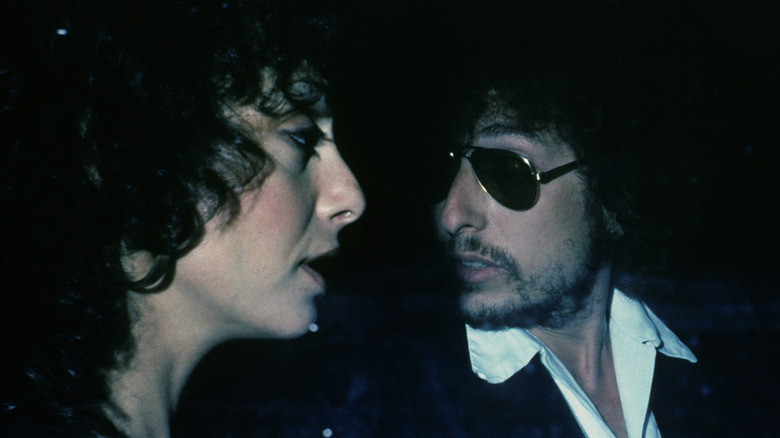
The distinctly uncommercial "Sad-Eyed Lady of the Lowlands" is now remembered as one of Bob Dylan's classic love songs, in which the surrealism of his imagery reflects the mystical aspect that reportedly underpinned his feelings toward his wife Sara. Describing the woman as both fragile and resilient, and an enigmatic presence that chimes with recollections of those who knew her at the time, it is a nuanced and effective portrait.
Dylan even made an intertextual allusion to the song, naming it in his 1976 song "Sara," in which he describes himself "Staying up for days in the Chelsea Hotel / Writing 'Sad-Eyed Lady of the Lowlands' for you." The line contradicts the accounts of the recording of "Blonde on Blonde" that say the song was written in Nashville; whether this is a classic piece of Dylan self-mythologizing or whether the song was actually composed in two locations is still up for debate.
Despite considering the song his finest work, Dylan has never included "Sad-Eyed Lady of the Lowlands" in a concert setlist. Perhaps this is due to the song's length making it unwieldy in a live setting, or one could argue that its lyrical content felt too personal for Dylan to want to share it live. However, the impact of the song on other artists is incalculable. Tom Waits has been effusive in his praise for the song, while Roger Waters has claimed the epic length of the song encouraged him to be more ambitious in his songwriting with Pink Floyd.