

5 Songs That Prove 1994 Was The Decade's Best Year For College Hits
Along with intellectual horizons, musical tastes tend to evolve and expand during the college years. If you went to school in the '90s, your CD binder no doubt swelled with iconic choices. But in a decade defined by musical invention, we think 1994 stands out as the best year for music that was popular on campus. Anyone listening to these five college hits from the year that Kurt Cobain died and Lollapalooza turned four will agree. Across rock genres — from indie and alternative to industrial, psychedelic, and folk — you can hear a creative groundswell.
On Sonic Youth's "Bull in the Heather" and Dinosaur Jr.'s "Feel The Pain," college rock favorites found distinct ways to package underground art for mass consumption, while Nine Inch Nails' "Closer" pulled harsh industrial rock out from the shadows. Though Stereolab largely eluded American audiences, college radio latched onto the infectious indie-pop of "Ping Pong." And when college students felt low, they had the warm embrace of Mazzy Star's "Fade into You." On these songs, you hear that 1994 was when the underground truly graduated.
Students certainly listened to acts like Nirvana, Smashing Pumpkins, or Counting Crows in 1994, but so did middle schoolers. This isn't about overall chart success or popularity, though some artists on this list gained it. "College hits" here means songs that were buoyed by student audiences or became popular on college or alternative radio. They showcase the invention that thrived across musical genres as they grew up. To us, they prove that musically, 1994 was the best year ever to be on campus.
Feel the Pain — Dinosaur Jr.
Dinosaur Jr. struck a very loudly amplified chord with college audiences in the '80s and '90s. Maybe it's because the band came from Amherst, Massachusetts, home to the University of Massachusetts and Amherst College. Or maybe it's the slacker-meets-guitar hero sound the trio throttled into existence through massive amps. With "Feel The Pain," the lead single off 1994's "Without a Sound" album, things came full-circle as the band rode the alternative rock wave they'd helped kick off. The song broke containment, thanks to infectious hooks and a Spike Jonze-directed music video on MTV. It climbed to the top of College Music Journal's (CMJ) College Cuts charts (tracking college radio plays) in September and reached No. 4 on Billboard's Alternative Airplay charts the next month.
Driven by J Mascis's furious, virtuosic guitarwork and plaintive vocal delivery, "Feel The Pain" bottles up the ingredients that make the band so influential. Turn the amps up to 10, mix in fuzzy riffs and clever changes, and create a catchy but completely bummed-out song. And the detached way Mascis sings lines like "I feel the pain of everyone / Then I feel nothing" becomes a sad cherry on top of the cake.
Recorded with Mascis as the only original member, some critics didn't love "Without a Sound." It "offends in its inoffensiveness," wrote Rolling Stone reviewer Matt Diehl. But what did he know? College listeners in 1994 dug in, and you can hear Dinosaur Jr.'s formula and stamp in countless bands, from shoegazers My Bloody Valentine to indie stalwarts like Pavement and Built To Spill.
Closer — Nine Inch Nails
Like other electronic subgenres, industrial music bubbled up from the underground in the early '90s. And no doubt, Nine Inch Nails — the musical project of Trent Reznor — and the song "Closer" played a massive role in the movement gaining mainstream attention. Featuring a chorus that had to be bleeped out on the radio and MTV, the song's dark and infectious synth and drum machine groove cast shadows over countless college playlists. In 1994, it became a college radio mainstay, and the "Downward Spiral" album it's on hit No. 1 on the CMJ Radio 150 charts in April. "Closer" broke wide, too, peaking at No. 11 on the Billboard Modern Rock Tracks charts.
Something was in the air when the song was released as a single in May 1994 — perhaps fans were still getting over the loss of Nirvana, with Kurt Cobain's death the month before. Whatever it was, college students — likely wearing black — tapped into the song's driving and danceable groove and nihilistic, angry lyrics about sex. "I wanna f*** you like an animal," the expletive-laced chorus, comes as a shock while still getting stuck in your head. But with lines like "You can have my isolation / You can have the hate it brings," the verses are equally devastating.
With the help of the college kids, "Closer" saw industrial music dress up in its finest pleather and hit the dance floor. Touched by Nine Inch Nail's darkness are musicians ranging from Chino Moreno of nu-metal band the Deftones to electronic musician Deadmau5. And "Closer" continues to haunt countless goth/industrial nights.
Bull in the Heather — Sonic Youth
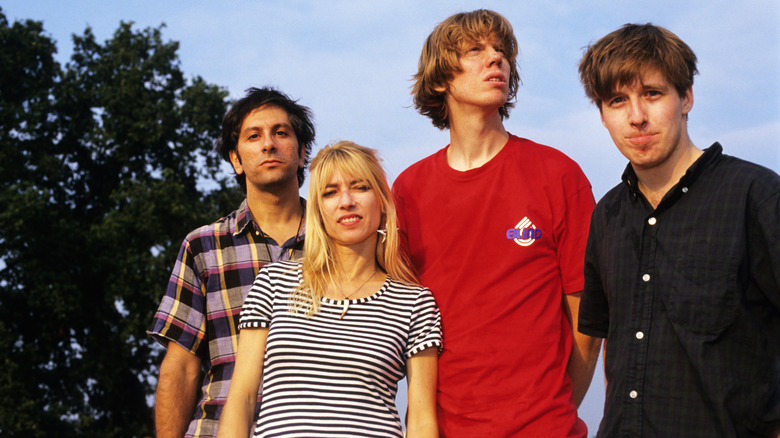
Sonic Youth had college radio to thank for both their rise and enduring influence. Along with underground '80s post-hardcore bands like Hüsker Dü and the Minutemen, the New York-based noise and art-rock quartet helped usher in the alternative sound that dominated the '90s. And in May of 1994, college students returned the favor. "Bull In The Heather" reached No. 3 on CMJ's College Cuts charts, tracking airplay on college and community radio stations. That bump no doubt helped the "Experimental Jet Set, Trash And No Star" album reach No. 34 on the Billboard 200.
With its driving grooves, interlaced guitar lines punctuated by distorted squeals, and Kim Gordon's sometimes chant-like delivery, "Bull In Heather" doesn't sound much like a radio song. Yet it is. It's hypnotic, it contains undeniable hooks, and its structure is traditional: verses, choruses (of sorts), and instrumental bridges. Lyrics like "Tell me that you wanna scold me / Tell me that you adore me" might also work in a pop song, but only out of context. Gordon told New York Magazine they address "using passiveness as a form of rebellion" in a "male-dominated culture."
In tapping into feminism and personal politics — themes you might encounter in college seminars — "Bull In The Heather" set the table for countless female-fronted bands. The video for the song stars Kathleen Hanna, whose riot girl punk band Bikini Kill took over campuses in the late '90s. Gordon was passing the bull.
Fade into You — Mazzy Star
With twangy guitars, downbeat, mellow grooves, and Hope Sandoval's breathy, unforgettable voice, Mazzy Star wove together folk, blues, and psychedelic influences to create its own alternative rock quilt. Released late in 1993 on the album "So Tonight That I Might See," "Fade into You" became a breakout hit the following year, reaching No. 3 on the Billboard Modern Rock Tracks charts (tracking alternative rock plays on commercial rock radio). By the time it hit that peak in August of 1994, the band had already cycled through CMJ's Top 150 charts, and its neo-psychedelic debut "She Hangs Brightly" even graced the cover of CMJ's New Music Report in May of 1990. College kids got the band first.
"Fade into You" was Mazzy Star's biggest and only charting song, which is why the band's been pegged (unfairly, we think) as a one-hit wonder. But there's no denying its dreaminess, melancholy, and powerful grip. Sandoval's lyrics, seemingly addressing a lover or romantic interest, evoke longing, heartache, and even rage. "I look to you and I see nothing / I look to you and see the truth," goes one devastating couplet, before shifting to attack mode, "You live your life and go in shadows / You'll come apart and you'll go blind." The emotions seem to drift, pushed along by a stripped-down arrangement featuring acoustic and slide guitar. It's a moody masterpiece that, in 1994, took the dusty road from campus coffee shop speakers to wider pastures before fading away into the distance.
Ping Pong — Stereolab
With its unique blend of '60s psychedelia and krautrock influences (sort of lounge rock meets bands like Can and Neu!), Stereolab had indie pop fans fully under their spell by the mid-'90s. Formed in London in 1990, the band — led by keyboardist and guitarist Laetitia Sadier and Tim Gane — gained a cult following with its first stateside release, "Transient Random-Noise Bursts With Announcements." Even though the 1994 album "Mars Audiac Quintet" and its single "Ping Pong" didn't get wide attention in the U.S., American college and independent radio DJs tuned in. By November, they were No. 2 on CMJ's Alternative Radio Airplay charts (tracking both commercial and non-commercial station activity).
You can hear why "Ping Pong" bounced around campuses in its day. Driven by a repeating horn and synth-inflected ascending scale and lush harmonies, it's at once effortlessly hip and bookish, philosophical. Sadier's serene-sounding singing belies the sharp socioeconomic critique in the lyrics: "It's alright, 'cause the historical pattern has shown / How the economical cycle tends to revolve / In a round of decades." Thriving in that tension between its gorgeous, lush sounds and incendiary content, the song sounds even cooler today than it did in 1994. It's a solid intro and fulfills prereqs for grad-level Stereolab studies. Should you pursue that degree, you'd be far from alone — electronic and indie artists like Air, MGMT, and Of Montreal all seem to be graduates.